
Intelligence in Nature
Because we are complex organisms, gifted with a superior intellect, we should be able to appreciate intelligence when we see it, and smart forms of life are all around us.
Even unicellular organisms like E.Coli bacteria, that we don’t consider terribly complex, can display interesting behaviors. For example, they are equipped with sensory molecules on their outer membrane, that enable them to sense and “taste” edible chemicals in the surroundings. By using some small tendrils that we call flagella, E.Coli are even able to swim towards these chemicals. These are unicellular forms of life that we don’t consider particularly “smart”, yet they are capable of seeking nutrients in their environment.
Image CC0 Creative Commons - Source
There are also more elegant forms of intelligence in nature, some even fascinated the famous code-breaker Alan Turing. In fact, he even wrote a paper where he used mathematical tools to demonstrate how complex organisms could arise from simple entities without an overarching master planner calling the shots (Turing 1952). We call this phenomenon “emergence” which describes the formation of intelligent bottom-up systems, originated by the assembly of relatively “stupid” elements.
I think an example will clarify this concept, let’s take the ants. If you were to take a single ant, it would not do anything interesting, yet if you place it in a colony of thousands of other ants, together they are able to form complex systems characterized by collective intelligence. Despite the fact that ant colonies have what we call “a queen” there is nothing hierarchical about their way of thinking. That’s because the queen is not an authoritarian figure, she doesn’t tell the workers what to do. It would be physically impossible for the queen anyway. Workers and harvester ants are spread through a vast network of tunnels and they are also outside looking for food. The workers don’t protect the queen because someone tells them to, but they do it because it’s written in their genes, the same way their genes instruct them to go out and look for food. Ant colonies are an example of decentralized authority because their intelligence comes from the bottom and the allocation of tasks comes from a feedback system where the near ant communicate with one another and the sum of their interactions determines which task the ants will take.
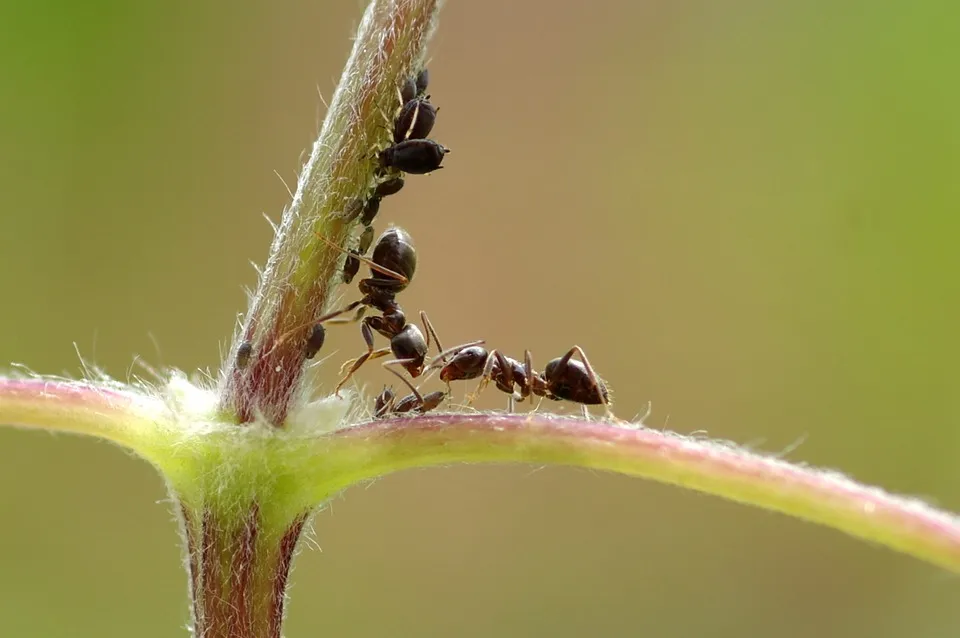
Image CC0 Creative Commons - Source
Image CC0 Creative Commons - Source
However, ant colonies are not the only example in nature of decentralized intelligence. Evelyn Fox Keller, an american Physicist, spent much of her life studying the intersection between physics and biology and she was fascinated by the odd behavior of slime mold. The oddity of this system is that generally slime molds exists in the form of distinctive single cells each minding their own business but that in the right conditions they start aggregating forming almost a large organism. This mold cells aggregate, can crawl on the soil consuming dead leaves and branches that finds on its path. The question was: who gives the signal to the cells to start aggregating? For years biologists were looking for “peacemaker” cells, leader cells that tell their “comrades” what to do. This hypothesis fitted nicely in our way of thinking. Someone must tell other cells what to do. So for years we have been looking for these “general” cells in slime mold, the search was in vain. Although we could not find peacemaker cells, we realized that the mold cells respond to a molecule called acrasin (it’s a cyclic form of AMP) and its presence signalled the cells it was time to aggregate (Keller and Segel 1970). Yet, we still had no idea about who was responsible for the secretion of acrasin, because mold cells seemed to be interchangeable. At the end Keller developed an equation that demonstrated that mold cells did not need a leader, but each cell is able to modulate the release of acrasin depending of the conditions of the environment. Cells nearby would simply follow the acrasin trail and form clusters of cells, all releasing more acrasin and thus attracting more cells creating a positive feedback loop.

Image in the public domain- Source
Image in the public domain- Source
So to recap, what is emergence? This is a bottom-up system that results from the grouping of simple elements that work together to fulfil tasks that are beyond the sum of the individual capabilities. To be able to form a “smart” system there are mainly 2 requirements: the elements should differentiate from one another (they have to be able to perform different tasks) and there must be integration among the elements (they must communicate with one another).
There is so much more to say about this topic, if I see enough interest I might make more posts about it.
Thank you
Thank you 
I wanted to end this post by thanking for making this banner for steemstem, to thank him, on the top of the commission I promised him I will also give him 50% of the SBD generated by this post, if you want to thank him, give it an upvote.
Created by
for making this banner for steemstem, to thank him, on the top of the commission I promised him I will also give him 50% of the SBD generated by this post, if you want to thank him, give it an upvote.Created by
References
Keller, E F, and L A Segel. 1970. “Initiation of Slime Mold Aggregation Viewed as an Instability.” Journal of theoretical biology 26(3): 399–415. http://www.ncbi.nlm.nih.gov/pubmed/5462335.
Turing, A. M. 1952. “The Chemical Basis of Morphogenesis.” Philosophical Transactions of the Royal Society B: Biological Sciences 237(641): 37–72. http://rstb.royalsocietypublishing.org/cgi/doi/10.1098/rstb.1952.0012.
Other Minds: The Octopus, the Sea, and the Deep Origins of Consciousness by Peter Godfrey-Smith
Communities that support me are:
To join 

IMMAGINE CC0 CREATIVE COMMONS, si ringrazia 

