

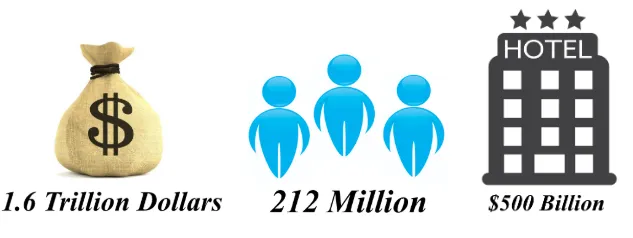
The hospitality industry and the hotel sector, specifically, is one of the world’s fastest-growing divisions of industry in the world. Hotels, in a big way, have helped ensure that this industry remains afloat despite the tough economic times that have made it impossible for many businesses to survive. To be precise, hotels keep 212 million people employed globally (14 million in the US) and make up about 30% of the hospitality industry. When looking at the numbers it seems like the hospitality industry is simply too big to fail, bringing in $1.6 trillion a year globally, which makes up about one-tenth of global GDP. With hotels alone bringing in roughly $500 billion globally and $208 billion in the US, it really puts things into perspective.
But despite the fluctuation of the economy, what is the key that has kept the hotel business booming? After all the hospitality industry is the number one employer in the United States behind the government.
Many speculate that hospitality success is due to workforce management and employee-guest engagement, which makes a lot of sense. Interpreting the data and analytics behind the business seems like the only practical reason that the hospitality (or any) businesses that are around today have stayed around. Obviously, this is not the only factor especially when it comes to hospitality, hotels specifically. Anyone can sell a room and bed, hotels must sell outstanding service with brand recognition in order to receive consistent customer satisfaction.
When it comes to brand recognition, one of the biggest household names that come to mind is Hilton. This is due to their decades of consistent customer satisfaction, made possible by their 163,000 employees in 5,400 properties worldwide. But what is it that keeps this enterprise running like clockwork? Because there are no ordinary hotel chains that rake in $9.1 billion yearly.
The Hilton brand was established in 1919 and is stronger than ever to date. Multiple factors contribute to the continued success of this company. Factors such as high level of property and employee management, extremely positive interaction with guests, and obviously loyalty programs. Along the way, Hilton has tweaked their business accordingly in order to consistently be a top competitor for decades. Therefore nothing in their strategy is new with the recent rumors of them incorporating blockchain technology to their business plan. In fact, it is well past due that global entities incorporate blockchain to manage scalability.
Most hotels do their best by working off partial and incomplete data resulting in satisfactory service. With the implementation of Aqua, hotels will be able to know exactly what their customers want and need for an outstanding experience before they even walk in the door.

We’ve all visited hotels and upon check-out been requested to fill out a survey regarding your stay at the hotel. Some people take it seriously, some don’t. But at the end of the day, this “data” helps hotels ensure a comfortable relaxing experience to all its customers. Now is the time to benefit from blockchain by sharing this data in the most secure manner. Aquaenables its users to share their trusted data in exchange for cryptocurrency which they can subsequently trade for hotel loyalty points or spend with participating vendors. But unlike most tech giants that take your data for free and sell it to the highest bidder, Aquaputs it to good use in order to benefit you, the customer.
Hiltons recent partnership with AquaIntelligence is a win/win for everyone. The majority of hotel success comes from repeat customers, and you can’t get loyal repeat customers without outstanding customer satisfaction. AQUA will immensely contribute to guarantee customer satisfaction by incorporating blockchain with its state of the art Artificial Intelligence and machine learning technology. Enabling hotels to learn about the customer through trusted and secured data, while simultaneously rewarding the customer for simply being themselves.
But that's not all.
Aquais a multi-functional application with a property management feature for hotels. Thanks to the blockchain and machine learning, hotels are able to have all their property management tools in one place rather than working across different platforms. This helps hotels reduce operating costs and response times in order for customers’ needs be met quickly and efficiently.
The future of customer satisfaction and business efficiency is here, its name is AQUA.