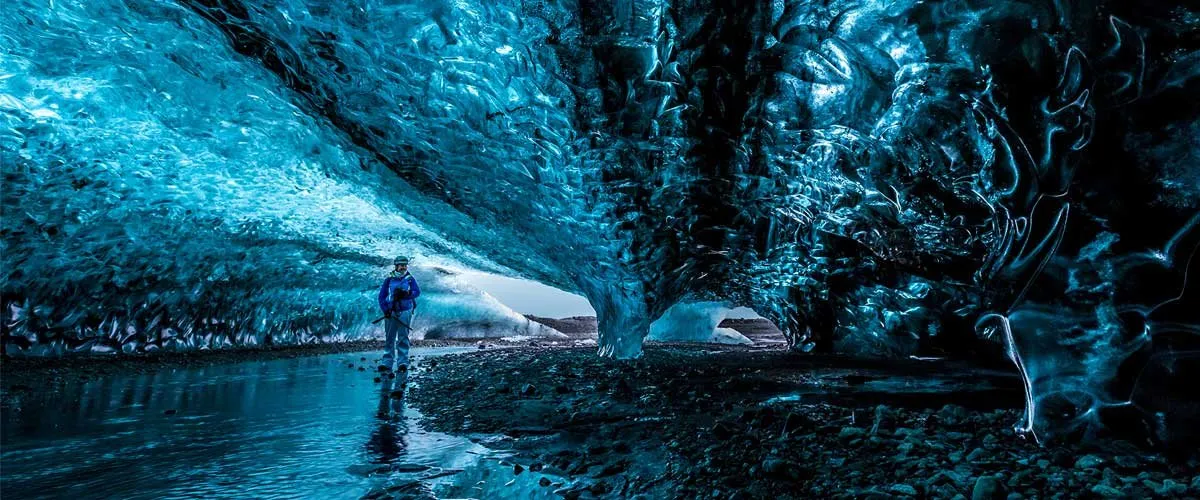
Glaciers are literally rivers of ice that flow. They are formed when snow builds up and doesn't melt creating heavy glacial ice from the pressure. This continues to build until the ice gets heavy enough to move down hill or it forces it's way through any geological weakness, heading in a downhill direction. This can start happening when the Ice gets to about 15 meters thick. The Ice starts to flow like a liquid when it gets to about 50 meters thick, due to the pressure of it's weight that breaks the bond between the ice particles that hold them together.
Glaciers can get to more than 2,100 meters thick and can cover land over a few million square kilometers. There are found in the polar regions as well as in some high mountains and high mountain ranges such as the Himalayas and the Andes. They are a large source of fresh water and travel at very different speed. Some travel slower than 1 meter a day and others faster than 30 meters a day. The speed that a glacier travels at also changes depending on the surrounding area, the climate, the temperature and the amount of precipitation that occurs.
Glacial Scarring:
Image Credit

Glaciers look "dirty" or have black ice from picking up soil and rocks as it moves over the land, it does this because of it's weight and movement. Glaciers shape landscapes as they move, creating many different land features after it recedes or dries up. Above is a picture of glacial scarring. I hope to one day visit a glacier.
Underneath a Glacier
Image Credit