
My Favourite Little Egret
Some time ago I was fortunate to be in a position where I was up close and personal with a Little Egret. This is a species of bird that is quite common in Australia, but often very flighty, so hard to get close to unless you are willing to spend a lot of time getting the bird accustomed to your presence.
What is a Little Egret?
The little egret (Egretta garzetta) is a species of small heron in the family Ardeidae. It is a white bird with a slender black beak, long black legs and, in the western sub-species, yellow feet. The bird is aquatic and feeds in shallow water (such as wetlands) and on land, consuming a variety of small creatures such as amphibians and small fish. Its breeding distribution is in wetlands in warm temperate to tropical parts of Europe, Africa, Asia, and Australia (thanks Wikipedia).

In Australia, the Little Egret is found mainly in coastal and inland areas of northern, eastern and south-eastern Australia. It is common on the north parts of Australia, uncommon in the south (although I photographed them frequently in Perth, which is South Western Australia), and only a winter visitor to Tasmania (source).
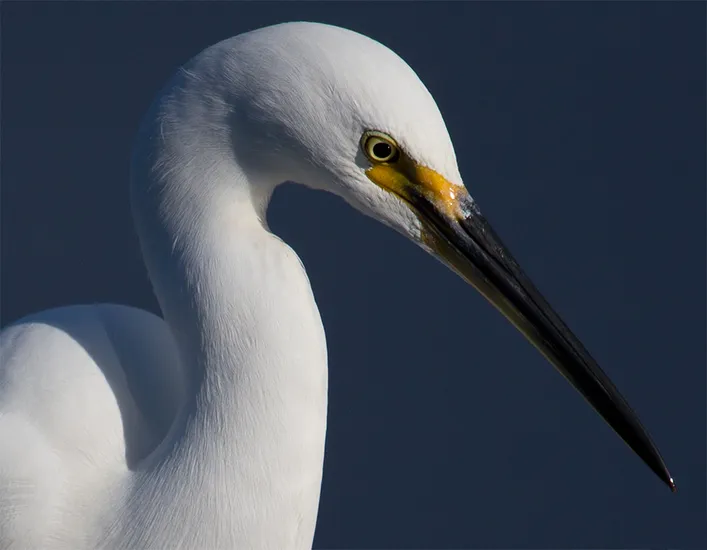
The image at the top of this post is one that I used as an entry into a wildlife photography competition a couple of years ago. It didn't place in the winners circle but I was very happy with the clarity of the image, the depth of colour and the interesting shadows across the birds neck and back. Even better, the background of this photo hasn't been altered at all. The clean, deep blue background was simply a result of the environment that I was shooting in.
The Reason why Most Wildlife Photographers are a Little Different
Wildlife photography is an form of art that requires a lot of sitting patiently, in complete silence, and often uncomfortable conditions while observing a single animal for hours on end. The photograph at the top of this post is a good example of one of these occasions. I waited in the same spot, without moving, for at least 4 hours to take this shot. The 4 hour wait was necessary so that the bird became used to my presence, and would feel comfortable moving close to me. I know the behaviour of this bird quite well, so was aware that eventually the bird would move close me while it was feeding.

Eventually, the Egret was only about 2 metres from me, which allowed me to take the first photograph in this post, and later the photo above. One of the things that I love about the first photograph, is that I didn't need to crop the image very much at all. I was so close to the bird at one stage during the photography session, that its head almost filled the frame of the image.
And the example of extreme patience that I describe here isn't even the most extreme example of dedication to this form of art out there. I know of one photographer who visited the same location, to photograph the same bird, exhibiting the same behaviour, for 6 years until he managed to take the one photograph that he was happy with. The photograph is utterly incredible, and won him numerous prizes. But this is the perfect example of the insane dedication that many photographers have for their art.

And it's this willingness to spend countless hours observing a single animal, in some of the most uncomfortable positons, that makes wildlife photographers very unique individuals. If you ever find yourself at a campsite, surrounded by wildlife photographers, you'll truly understand why I say that they are normally quite an odd breed of human being (I'm including myself in this group by the way).
So you want to be a Wildlife Photographer
If this is a hobby that you are interested in taking up, then the first thing you need is patience. And lots of it (well to be honest, the first thing you need is a camera, but that's another post topic altogether). There will be many days where you head out to find a specific species of animal or bird, and come home empty handed. While many species are predictable in their nature, and you will often know where they will be feeding or resting, you can never be certain that the conditions will be right to photograph in or that the animal or bird will be in a good pose or exhibiting the type of behaviour that you are looking for. And sometimes, the species you are looking for won't even be there.
There will also be many occasions where think you've taken the perfect photo. And after arriving at home and excitedly looking through the few hundred photographs that you took over a period of many hours, you delete the entire collection in pure frustration after discovering that your pictures are worthless. I've done this more times than I care to admit, or remember for that matter. It can be a hard pill to swallow.
And finally, you'll need to prepare to photograph in a variety of conditions. For example, the person who photograph the Kingfisher above spent countless hours waist deep in water to take that photograph. So you need to have the right clothing and equipment to photograph in these conditions.
I spend a lot of time lying prone on the ground while photographing my subjects. So I make sure to wear thick clothing that can make this position slightly more comfortable. Some people take thick mats to lie on however I personally prefer to be able to move quickly from one location to the next, so don't like lots of equipment.
This reminds me of a time while I was photographing Rainbow Bee-Eaters. I had found a nice, well hidden spot amongst some thick grass and high bushes that gave me the perfect view of a tree where the Rainbow Bee-Eaters were perching. I was sitting quietly, taking hundreds of photographs when I heard a rustling and slithering sound that I recognised as being slightly dangerous. I look to my right and see a Tiger Snake heading right towards me. Somehow, I was able to grab every single item around me and jump out of my hiding spot within a matter of seconds to get away from the slithering beast. Hence my preference to be able to move quickly.

So, to recap what you need to consider when photographing wildlife:
- Do you have the appropriate clothing for the location you want to visit?
- Do you have the patience to sit still for hours on end?
- Are you willing to risk spending hours photographing wildlife, only to discover that your images are complete rubbish?
- Are you willing to arrive at your destination, potentially after driving for hours to get there, to discover that the conditions are not at all suitable for photographing in?
- and, finally, are you willing to sit unwittingly in the travel path of venomous snakes?
If you have answered yes to any of the above, then you may very well have what it takes to photograph wildlife.
Have you got any funny or interesting stories about your photography sessions? Share them below in the comments.

