
Evolution has thrown up a lot of really, really strange critters over the years. One of the strangest, and certainly one of the ones to which paleontologists have applied the most effort to in figuring out is Helicoprion- the shark with a spiral of teeth.
Helicoprion's famous jaw structure. [Image source]

Helicoprion wasn't strictly a shark. Instead, it was the largest of the now extinct order of Eugeneodontida, growing to over thirty feet in length. To look at it, however, it probably would have looked exactly like a shark, except for the spiral jaw structure, which could contain over 150 teeth. (And you probably wouldn't want to take a closer look at it if you were in the water.) The Eugeneodonts all had similar spiral shaped structures in their jaws- the problem was, however, that Eugenodonts were also largely cartilaginous fish. The teeth are literally the only parts of the animals we had.
This is less than a problem in some ways than you would think. We could know that they came from an oceangoing animal, given the deposits the fossils were found in. We could tell that it was likely from some sort of fish- though there were some false starts that considered them to be eels. Slowly we figured out their ancestry, eventually proving them to be distant relatives of the ratfish. Their teeth also resembled shark teeth in quite a few ways. Through the whole process, though, we had no idea where their weird jaw spiral went.
An 1899 depiction of what Helicoprion's jaw might have looked like. [Image source]

Most of the paleontologists who first worked on it usually assumed that the structure was held outside the jaw- closing the mouth with a giant spiral of teeth inside seems understandably problematic. Other believed that they weren't even teeth, and instead belonged on the tail or elsewhere on the body. Everyone who did think they were teeth also assumed that it was a structure of the upper jaw until the discovery of a related species, Ornithoprion, was shown to have its spiral in its lower jaw. In 1966, it was proven that at least some of its spiral was contained in its mouth.
A more recent, but still outdated, reconstruction of Helicoprion. [Image source]
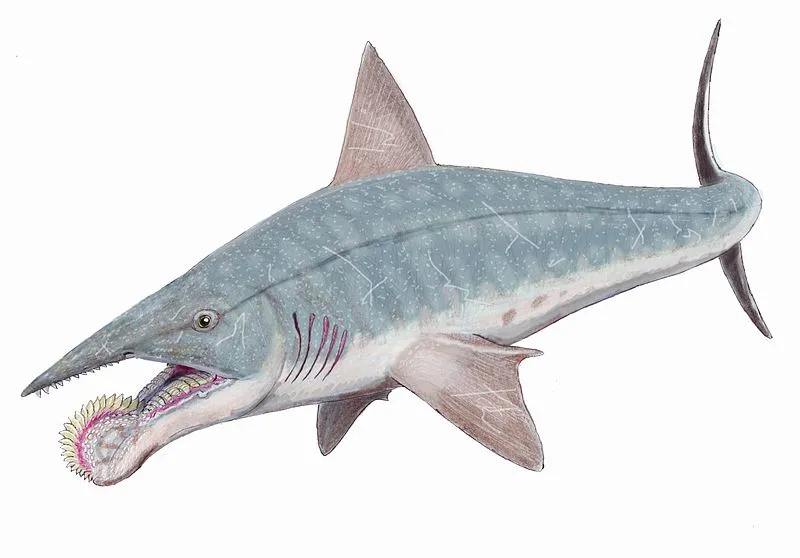
Helicoprion and its kin lived during the early Permian, the era before the Triassic. They were largely extinct by the time of the Permian mass extinction- the greatest mass extinction in the history of Earth- and if any survived up until the mass extinction, they didn't survive past it. They were all obligate carnivores, and likely consumed soft-bodied prey, as they lacked teeth in their upper jaw. Their prey would have been repeatedly sliced up by the tooth spiral before being eaten.
Most of the world's Helicoprion and other Eugeneodonts have been found in Montana, though the first example was found in Kazakhstan. In 2013, the debate was finally settled by a fossil found in Montana. The spiral was, in fact, largely contained within the jaw.
The modern conception of Helicoprion. [Image source]

Who knows, though? Maybe we'll find more fossils which change our picture of Helicoprion. We're pretty sure we've got it right at this point, but there's always just that little bit of uncertainty left. We'll certainly learn more about the other Eugenodonts, many of which had bizarre jaw structures different than Helicoprion's.
One important lesson to take away from the saga of Helicoprion is the skill which we've gained from reconstructing ancient creatures from fragmentary clues. We're at the point where given a single bone we can reconstruct many creatures from scratch. It's an incredibly detailed and specialist skill, and one I'll be going into in much greater detail in the future- but for now, you shouldn't just be marveling at nature's creativity. You should be proud at our skills in decoding nature's past.
*
A few of the different reconstructions of Helicoprion over the years. [Image source]

If you found Helicoprion interesting, you might want to check out my post on Dunkleosteus, an armor-plated seagoing titan who lived long before Helicoprion ever showed up on the scene- which was a good thing for Helicoprion!
Bibliography:
https://en.wikipedia.org/wiki/Helicoprion
https://en.wikipedia.org/wiki/Eugeneodontida
http://phenomena.nationalgeographic.com/2013/02/26/buzzsaw-jaw-helicoprion-was-a-freaky-ratfish/
https://blogs.scientificamerican.com/running-ponies/prehistoric-ghost-shark-helicoprions-spiral-toothed-jaw-explained/