


Hola querido hiver.
Hoy te llevo de visita al Edificio Paraninfo de la Universidad de Zaragoza. Está situado en pleno centro de la ciudad de Zaragoza y resalta respecto a las construcciones que le rodean por su estilo neoclásico, tan característico de esta zona.
El edificio se inauguró en 1893 como Facultad de Medicina y Ciencias y el arquitecto responsable fue Ricardo Magdalena, quien proyectó otros lugares emblemáticos de Zaragoza, así que seguro que en el futuro volverá a ser nombrado en este blog.


En la actualidad este edificio tiene múltiples usos y alberga el Museo de Ciencias Naturales de la Universidad de Zaragoza, una biblioteca, cafetería, salas de exposiciones y lugar de celebración de conferencias, entre otros.
La entrada principal está situada en la Plaza de Basilio Paraíso, uno de los extremos del Paseo Independencia. Es realmente difícil conseguir una fotografía diurna de su fachada sin que haya alguien esperando a sus puertas. Es uno de los puntos que los zaragozanos utilizan para encontrarse con otras personas.


La portada es rica en simbolismos y decoraciones, siendo la figura central la diosa Minerva por ser la ciencia una de las áreas que estaban bajo su protección para los romanos.


Además de las cuatros estatuas sedentes que franquean las entrada al visitante, alrededor de todo el edificio están presentes unos medallones con las cabezas de otros científicos.


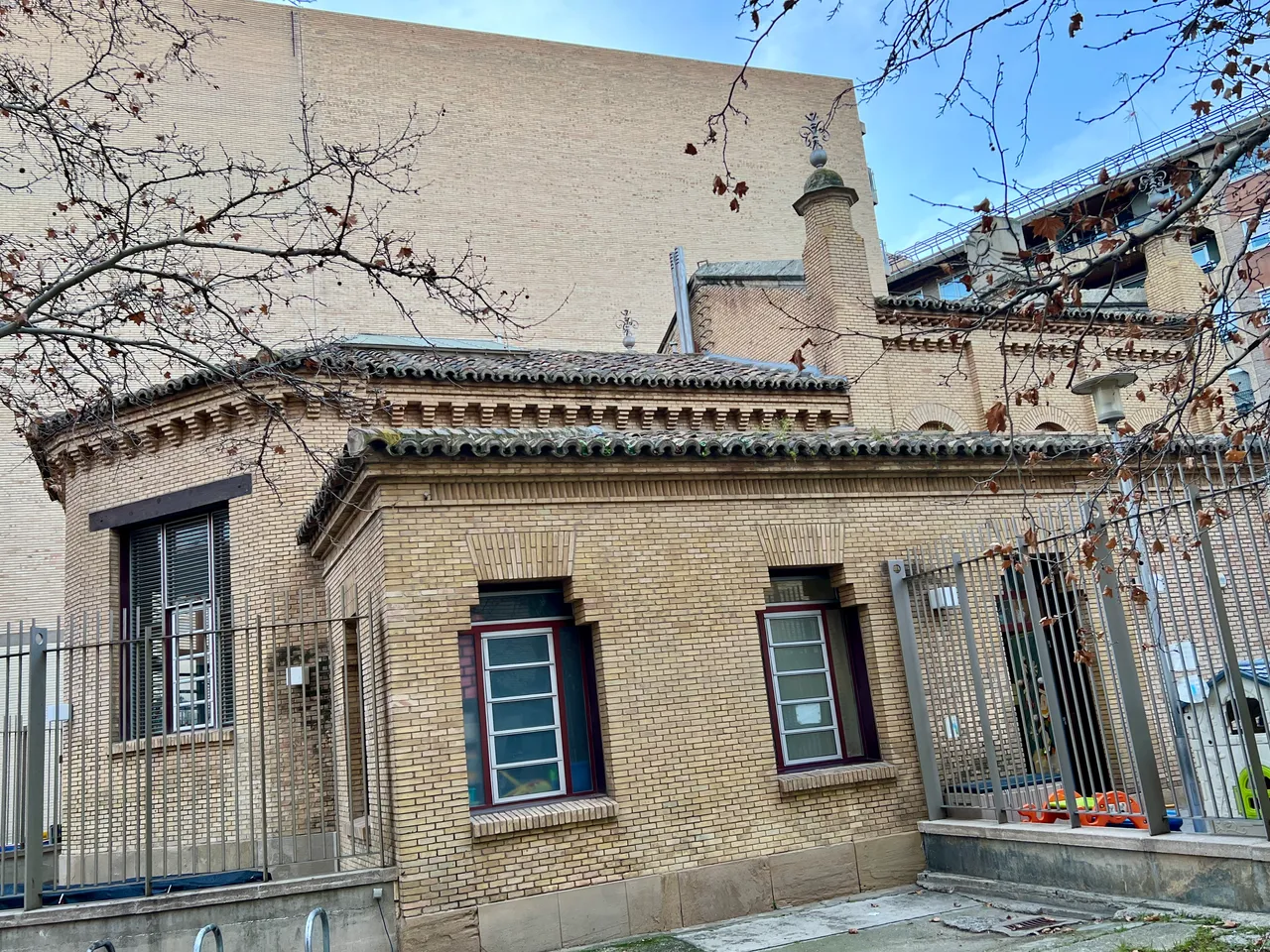
Nos vamos al lateral derecho por la calle Doctor Cerrada. Trasladándonos a la parte trasera encontramos que el edificio es parte de un complejo más amplio y que se complementa con otras construcciones que le siguen en estilo.
Un pasadizo nos conduce hasta lo que en tiempos fue el Instituto Anatómico Forense. Lo he llegado a conocer funcionando. Ahora es... ¡una ludoteca! No necesitaré decirte que ahora es bastante más agradable pasar por allí.


Si giramos la vista hacia la izquierda vemos la actual Facultad de Ciencias Económicas y Empresariales, y frente a ella, en un edificio más moderno, su biblioteca. En esta parte el ambiente estudiantil te lleva a recordar los propios años universitarios.


Volvemos sobre nuestros pasos y atravesamos de nuevo el pasadizo hasta alcanzar la parte trasera del Paraninfo. Lo seguimos rodeando para salir a la Gran Vía. No sé el tiempo que lleva ahí este curioso jardín, pero te prometo que es la primera vez que lo veo. Tampoco he visto nunca tantas especies de cactus reunidas es un espacio tan reducido.


Terminamos de dar la vuelta y casi de nuevo en la fachada nos encontramos una pequeña caseta que permite ver de cerca los azulejos decorativos. En el resto del edificio quedan demasiado altos para apreciarlos bien.


Antes de entrar al Paraninfo, te invito a que nos detengamos en su puerta para contemplar los detalles decorativos. La forja en particular me encanta.


Al atravesar el umbral nos sorprende la explosión de color que contrasta con la sobriedad del exterior. Lo primero que nos llamará la atención será a nuestra derecha el letrero de entrada a la Real Academia de Medicina y una gran placa que conmemora el primer centenario del edificio. Lo siguiente será a la izquierda, el busto del poeta cubano José Martí.


Avanzando unos pasos llegamos a los pies de la escalinata que permite el acceso a la siguiente planta y por la que no se puede subir salvo excepciones. Al final del primer tramo preside el lugar una estatua de Santiago Ramón y Cajal, el neurocientífico que descubrió las conexiones neuronales y que estudió en este mismo lugar. Precisamente yo estaba aquí para visitar Espacio Cajal, una exposición permanente dedicada a su vida y obras que te enseñaré en otro momento.


El diseño rectangular de la planta se asemeja a un claustro cerrado, por lo que en la parte interior se abren unos grandes ventanales que iluminan los largos pasillos. En esa puerta con un cartel me detuve a visitar lo que venía a ver.


Cuando terminé de ver la exposición estaba cayendo la noche, así que aproveché para tomar algunas fotos nocturnas que realzan la belleza de este lugar.
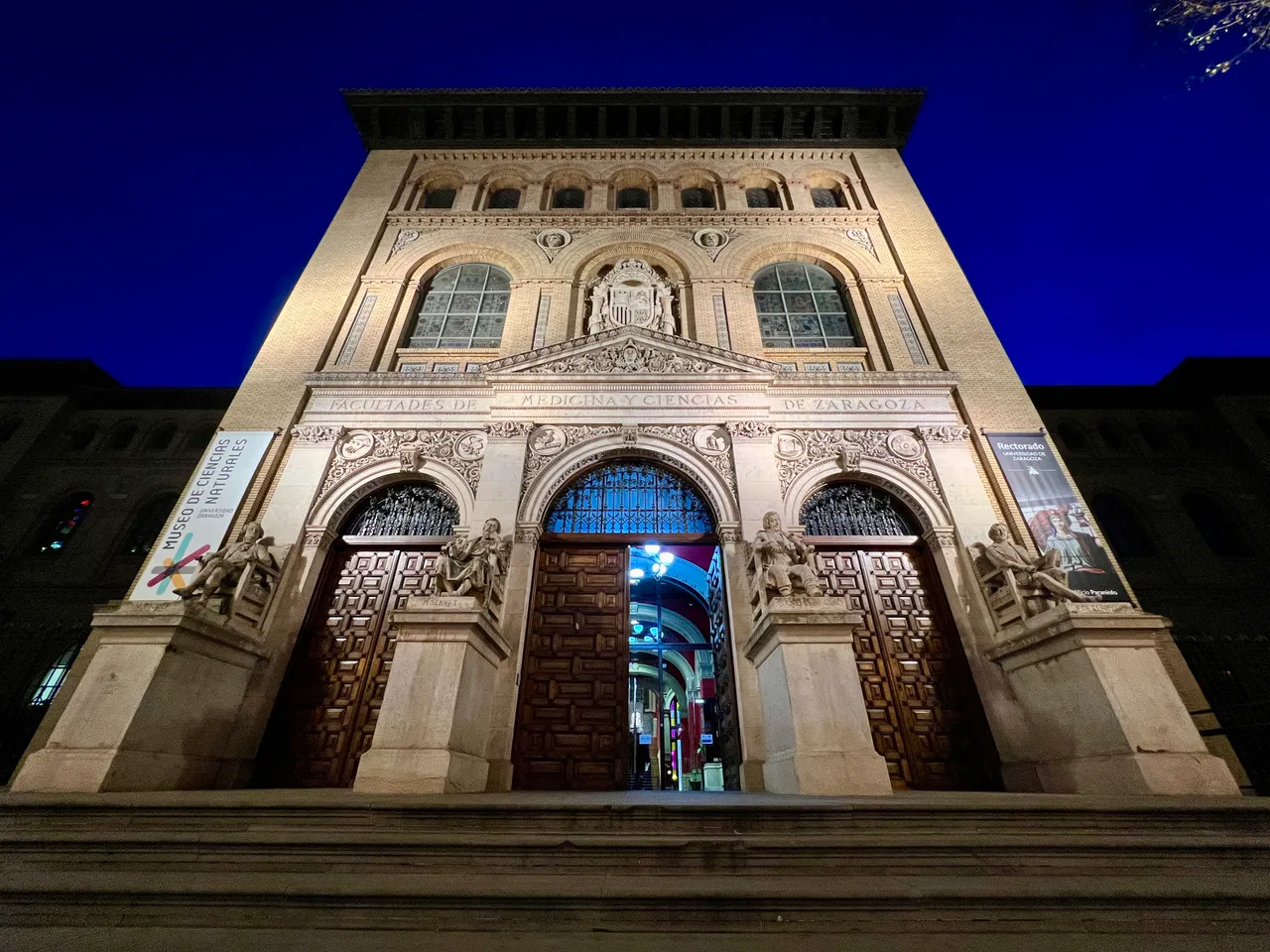

¡Logré foto de la puerta sin nadie a la espera!
Hasta la próxima publicación. Mientras tanto, ¡cuídate!

Herramientas: Cámara iPhone 13 Pro, editor de fotos Mac.
Mis publicaciones en Worldmappin pinchando aquí
Si te gusta lo que publico, únete a mi Fanbase pinchando aquí

©️Copyright 2024 Paloma Peña Pérez. Todos los derechos reservados.

Hi, dear hiver.
Today I am taking you on a visit to the Paraninfo Building of Zaragoza University. It is located right in the centre of the city of Zaragoza and stands out from the surrounding buildings for its neoclassical style, so characteristic of this area.
The building was inaugurated in 1893 as the Faculty of Medicine and Science and the architect responsible was Ricardo Magdalena, who designed other emblematic places in Zaragoza, so it will surely be mentioned again in this blog in the future.
Today this building has multiple uses and houses the Museum of Natural Sciences of the University of Zaragoza, a library, cafeteria, exhibition halls and conference venue, among others.
The main entrance is located in the Plaza de Basilio Paraíso, at one end of the Paseo Independencia. It is really difficult to get a daytime photograph of its façade without someone waiting at its doors. It is one of the points that the people of Zaragoza use to meet other people.
The façade is rich in symbolism and decorations, the central figure being the goddess Minerva, as science was one of the areas under her protection for the Romans.
In addition to the four seated statues at the entrance to the building, there are medallions with the heads of other scientists around the building.
We go to the right side along Doctor Cerrada street. Moving to the rear, we find that the building is part of a larger complex and that it is complemented by other buildings that follow it in style.
A passageway leads to what was once the Forensic Anatomical Institute. I got to know it in operation. Now it is... a toy library! I don't need to tell you that it's much more pleasant to walk through there now.
If we turn to the left we see the current Faculty of Economics and Business Studies, and in front of it, in a more modern building, its library. In this part of the building, the student atmosphere takes you back to your own university years.
We retrace our steps and cross the passageway again until we reach the back of the Paraninfo. We continue around it to come out onto the Gran Vía. I don't know how long this curious garden has been there, but I promise you it's the first time I've seen it. Nor have I ever seen so many species of cactus in such a small space.
We finish our walk and almost back on the façade we find a small stand that allows a close-up view of the decorative tiles. In the rest of the building they are too high to be appreciated.
Before entering the Paraninfo, I invite you to stop at the door to admire the decorative details. I particularly love the wrought ironwork.
As we cross the threshold, we are struck by the explosion of colour that contrasts with the sobriety of the exterior. The first thing you notice on your right is the entrance sign to the Royal Academy of Medicine and a large plaque commemorating the building's first centenary. Next on the left is the bust of the Cuban poet José Martí.
A few steps further on, we reach the foot of the staircase leading to the next floor, which cannot be climbed except in certain cases. At the end of the first flight of steps there is a statue of Santiago Ramón y Cajal, the neuroscientist who discovered neuronal connections and who studied in this very place. I was here to visit Cajal Space, a permanent exhibition dedicated to his life and works, which I will show you another time.
The rectangular design of the floor plan resembles an enclosed cloister, so the inside of the building has large windows that illuminate the long corridors. At that door with a sign I stopped to visit what I had come to see.
When I finished seeing the exhibition it was getting dark, so I took the opportunity to take some night photos that enhance the beauty of this place.
I managed to get a picture of the door with no one waiting!
Until the next post. In the meantime, take care!
Tools: iPhone 13 Pro camera, Mac photo editor.
Translated with DeepL
My publications in Worldmappin by clicking here
If you like my content, join my Fanbase clicking here

©️Copyright 2024 Paloma Peña Pérez. All rights reserved.
