
Usually 
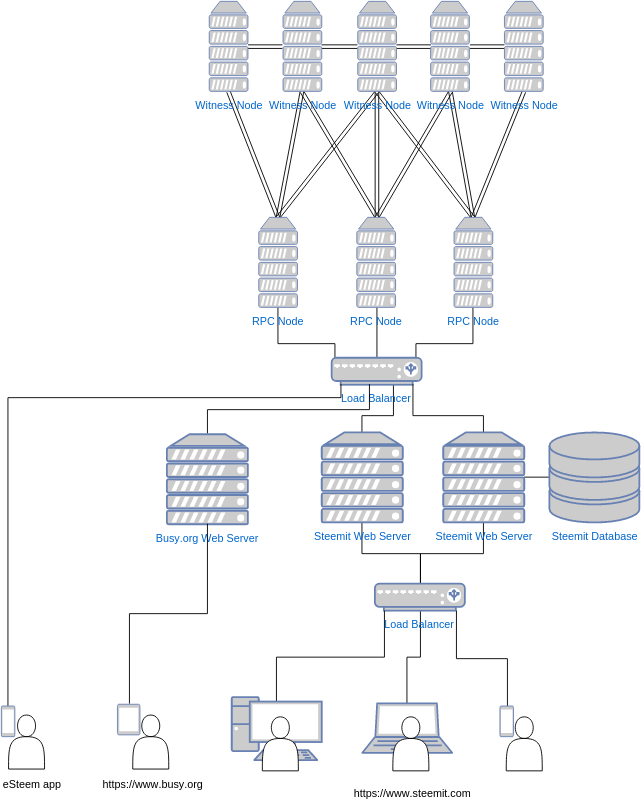
When somebody uses their PC, Tablet or mobile phone to visit steemit.com, their browser asks for the web pages to be sent across the Internet so they can be displayed. Because there are now 300,000 accounts, something called a Load Balancer shares the large number of page requests that are received every second between several Steemit Web Servers so none of them are overloaded. More of these web servers can be added as steemit.com grows.
The steemit.com web server does not hold the articles and comments though, the web server itself asks for this information from any of the several RPC nodes which are powerful computers that, together with the dozens of Witness Nodes each hold a copy of all the data in the blockchain. Currently there is around 22GB of data in the blockchain, and this grows every time an article or comment is posted, a vote cast, or a currency transfer made. Of course, with the growth of information and users, the RPC and Witness network also needs to grow over time.
Running these computers can be expensive, which is why as well as paying authors and curators, 15% of the reward pool is used to pay the people who install and run these computers.
Anyway, as well as sending the article text back to the user's browser, the Steemit Web Server also sends back some information about how many views an article has had, and allows unread articles and comments to be shown in bold for your convenience. This 'meta-data' is collected in the Steemit Database, and this is the only part of the system which is private, and is why neither
The diagram above also illustrates the cases where people use other 'front-end' services such as busy.org (and in fact steemreports.com) to view the blockchain data. We have separate web servers, which also interact with the RPC nodes.
Apps such as eSteem may access the RPC nodes more directly, without going though a web server. Their more specialised software makes this possible.
The diagram is slightly simplified, but I hope this helps you to understand a little more about how the Steem platform works. Feel free to ask any questions below, and I'll do my best to answer them where I can.
Disclaimer: If anyone with more knowledge has any corrections to make to what I've presented here, please let me know. I'm also on an educational journey, and I haven't actually used busy.org or eSteem yet!
Please vote, resteem and follow us to for more reports and services, and visit our website:
http://www.steemreports.com