
Genuine Ghanaian African Achacha Mattes 201229
[permanent updates Pastebin link]:
https://pastebin.com/edit/FjVJCUF8


Places to watch this video:
3speak:
Bitchute:
LBRY: https://lbry.tv/@dailyeagle:8/Genuine-Ghanaian-African-Achacha-Mattes:7
Rumble: https://rumble.com/vca3dj-genuine-ghanaian-african-achacha-mattes.html
Youtube:

ABOUT DAILY EAGLE NEWS:
http://dailyeagle.news
https://tinyurl.com/dailyeagle
Screaming, Squealing Talons of Truth...
Support Daily Eagle News: BUY CRYPTO!
We're affiliated with major Cryptocurrency Exchanges:
Coinbase (San Francisco): http://dailyeagle.news/coinbase
Gemini (New York): http://dailyeagle.news/gemini
Binance (Malta): http://dailyeagle.news/binance
(*) This is a funding mechanism, NOT "financial advice."
+++
Show Notes:
ISAAC CLAYTON TRAWICK IN CHICAGO, IL
https://www.bizapedia.com/people/illinois/chicago/isaac-trawick.html
https://trakmallincorporated.com/index.php/team
Isaac Clayton Trawick graduated from the famous Oral Robert University with honors in Church Administration and Business Management. He is responsible for all of the company’s worldwide sales and operations, including end-to-end management of Trakmall supply chain, sales activities, and service support in all markets and countries.

Isaac also spent over 5 years with the management of Dina Engine where he implemented his skill set before going into full time travel ministry and the founder and Lead Pastor of Christ Business Center in Chicago, USA.
Origin & History of Ghana Mats
Ghana Mats started in the USA when longtime friends and new friends Fatima Aidoo, Issac Trawick, Joseph Adjani and Mike Wofsey came together to build a new kind of company, the world's first E=C Granite Employee Equity Company, where every employee is an owner, and every owner works hard to bring wealth and prosperity to their fellow employee-owners. We started with the standard Employee Stock Ownership Plan (ESOP) for an American company, and then we did what everyone told us would be impossible; we fixed every employee salary to the same standard. So if this Kickstarter is successful, every Ghana Mats employee will make the same salary. The Ghanese employees have their Dollars converted to Ghana Cedis through the mobilemoney system, and with each paycheck, every employee receives the same number of company shares, in compliance with U.S. ESOP standards, they can also buy additional shares in compliance with the same standards. Isaac, Fatima, Mike and Joseph have deep ties to social activism. It's the way we live. And Ghana is home to one of the world's last pristine, virgin wildernesses. Unfortunately, Ghana is currently experiencing a rush of exploitation from foreign developers who want to pull the valuable minerals from Ghana's ground, and the valuable coffee and cacao beans from on top of the ground. Some developers are ethical, but many are not. In many cases, these developers extract the wealth of the Ghanese people and leave them with polluted rivers, denuded forests, and broken people. Children who deserve healthy, happy lives, are instead left as orphans, or sick and in poverty. The people, the land, the animals and the plants of Ghana need protection from the industrialization that would extract the wealth from above and below the soil, and leave little for future generations. Ghana's future isn't just in coffee beans, and cacao, and minerals, but it's in the unspoiled wilderness that can become a global destination and a potential protected global heritage site, for the future use of all people, to see both the cradle of human civilization and the destiny of human hope. And the best way to protect that, is by building a company from within Ghana, with deep ties into the United States, Europe, Asia and Australia.

11 Things You Can Only Buy In Ghana
https://theculturetrip.com/africa/ghana/articles/11-things-you-can-only-buy-in-ghana

10 Top Things To See And Do In Ghana
https://theculturetrip.com/africa/ghana/articles/10-top-things-to-see-and-do-in-ghana

11 Top Artisan Workshops in the Whole of Ghana
https://theculturetrip.com/africa/ghana/articles/11-top-artisan-workshops-in-the-whole-of-ghana

https://pastebin.com/edit/FjVJCUF8
https://ghanamats.com/wp/wp-content/uploads/2020/12/GHANAMATS-PREVIEW.pdf
test cut Ghana Mats main vid

Republic of Ghana, is a country along the Gulf of Guinea and the Atlantic Ocean, in the subregion of West Africa.
https://en.wikipedia.org/wiki/Ghana
An 1850 map showing the Akan Kingdom of Ashanti within the Guinea region and surrounding regions in West Africa

Traditional chiefs in Ghana in 2015

Ghana is bordered by the Ivory Coast in the west, Burkina Faso in the north, Togo in the east, the Gulf of Guinea and the Atlantic Ocean in the south. Ghana means "Warrior King" in the Soninke language. The first permanent state in the territory of present-day Ghana dates back to the 11th century, the Bono State. Numerous kingdoms and empires emerged over the centuries, of which the most powerful were the Kingdom of Dagbon and the Ashanti Empire.
A postage stamp of Gold Coast overprinted for Ghanaian independence in 1957

Regional Administrative Divisions of Ghana in 2019

https://en.wikipedia.org/wiki/Volta_Region

Volta Region (or Volta), is one of Ghana's sixteen administrative regions, with Ho designated as its capital. It is located west of Republic of Togo and to the east of Lake Volta. Divided into 25 administrative districts, the region is multi-ethnic and multilingual, including groups such as the Ewe, the Guan, and the Akan peoples. The Guan peoples include the Lolobi, Likpe, Akpafu, Buem, and Nkonya (now part of Oti region) people, et al. This region was carved out of the Volta Region in December 2018 by the New Patriotic Party.

The Volta region was formed by the state union of the former British Togoland which was part of the German protectorate of Togoland. It was administered as part of the Gold Coast by the British and later renamed Trans-Volta Togoland.
Districts of the Volta Region

The native and largest ethnic group of the Volta Region (Togoland / British Togoland) are the Ewe people (68.5% of the population). They consist of several sub groups such as the Anlo Ewe, Tongu Ewe, Wedome and Avenor Ewe. Other ethnicities include the Guan people (forming 9.2% of the population), the Akan people (8.5%), and the Gurma people (6.5% of the population).
Aerial view from the north of the Adomi Bridge

A Bono dancer from Ivory Coast

https://en.wikipedia.org/wiki/Bono_state
Bono State (or Bonoman) was a trading state created by the Bono people, located in what is now southern Ghana. Bonoman was a medieval Akan kingdom in what is now Bono, Bono East and Ahafo region's respectively named after the (Bono and Ahafo) and Eastern Ivory Coast. It is generally accepted as the origin of the subgroups of the Akan people who migrated out of the state at various times to create new Akan states in search of gold. The gold trade, which started to boom in Bonoman as early in the 12th century, was the genesis of Akan power and wealth in the region, beginning in the Middle Ages.
Northern territories chiefs and elders at the Volta River project travelling exhibition(1950)

https://en.wikipedia.org/wiki/Kingdom_of_Dagbon
The Kingdom of Dagbon is one of the oldest and most organised traditional kingdoms in Ghana founded by the Dagomba people (Dagbamba) in the 11th century. During its rise, it comprised, at various points, the Northern, Upper West and Upper East regions of present-day Ghana. Since Ghana's independence in 1957, the Kingdom just like all of Ghana's kingdoms and tribal states has assumed a traditional, customary role.
Oral histories of the Kingdom tell that it was founded by a warrior named Tohazie (c. 1250), who arrived in present-day northern Ghana in the 11th century with his cavalry men from east of Lake Chad, stopping in Zamfara, present-day northern Nigeria, and in the Mali Empire, before settling in northern Ghana. These histories tell of numerous conflicts with neighbouring peoples throughout this early period until the early 18th century, when the capital of the kingdom was moved to the city of Yendi. Around this time, Islam arrived to the kingdom, and a period of peace and increased trade with neighbouring kingdoms began.
In 1888, the Kingdom of Dagbon was partitioned between the German and British empires, and in 1899 this split became organised into the territories of German Togoland and the Gold Coast. Following World War I, eastern Dagbon became part of British Togoland. The Gold Coast achieved independence in 1957 as Ghana. The result of interference of British and German imperialism significantly was a kingdom that was robbed of its once invaluable traditional artifacts, beautiful way of life and a divided Kingdom whose wounds would not completely heal till the second decade of the 21st Century.
Region of the Kingdom of Dagbon (black rectangle)

https://en.wikipedia.org/wiki/Dagomba_people
The homeland of the Dagombas is called Dagbon and covers about 20,000 km2 in area. Much of the area was occupied by Konkombas before the formation of Dagbon Kingdom. It forms part of the Northern Region of Ghana, which includes the Mamprusi, Nanumba, Gonja, Mossi, Gurunsi (in particular the Frafra and Kusasi peoples), the Wala people and Ligbi. The area constitutes fourteen administrative districts in present-day Ghana. These are the Tamale Metropolitan, Yendi, Savelugu and Sagnerigu municipals, and Tolon, Kumbungu, Nanton, Gushegu, Karaga, Zabzugu, Saboba, Sang, Tatale and Cheriponi districts. The king of the Dagbon Traditional Kingdom is the Ya-Na, whose court and administrative capital is at Yendi. Dagbon as a kingdom has never been subjugated until it was incorporated as a territory of the Gold Coast government. The Dagbon Kingdom has traditional administrative responsibilities hitherto acephalous groups like the Konkomba, Bimoba, Chekosi, Basaari, Chamba, Wala, Gurusi and Zantasi. The seat of the Ya-Na or king of Dagbon (literally translated as "King of Absolute Power") is a collection of lion and cow skins. Thus, the Dagbon or its political system is often called the Yendi Skin (not throne or crown or stool). Another characteristic of the Dagomba is that their houses are arranged in a certain order, where the chief or elderly man has his hut built in the center.
Map of the Kingdom of Ashanti

https://en.wikipedia.org/wiki/Ashanti_Empire
The Asante Empire (Asante Twi: Asanteman) was an Akan empire and kingdom from 1701 to 1957, in what is now modern-day Ghana. It expanded from Ashanti to include the Brong-Ahafo Region, Central Region, Eastern Region and Western Region of present-day Ghana as well as some parts of Ivory Coast and Togo. Due to the empire's military prowess, wealth, architecture, sophisticated hierarchy and culture, the Ashanti Kingdom has been extensively studied and has more books written by European, primarily British authors than any other indigenous culture of Sub-Saharan Africa.
Golden Stool (Sika dwa) in the Ashanti Kingdom, 1935.

Starting in the late 17th century, the Ashanti king Osei Tutu (c. 1695 – 1717) and his adviser Okomfo Anokye established the Ashanti Kingdom, with the Golden Stool of Asante as a sole unifying symbol.
Flag of Asante

National Emblem of Asante

Today, the Ashanti Kingdom survives as a constitutionally protected, sub-national traditional state in union with the Republic of Ghana. The current king of the Ashanti Kingdom is Otumfuo Osei Tutu II Asantehene. The Ashanti Kingdom is the home to Lake Bosumtwi, Ghana's only natural lake. The state's current economic revenue is derived mainly from trading in gold bars, cocoa, kola nuts and agriculture.
Asante Mountains and Lake Bosumtwi natural lake.

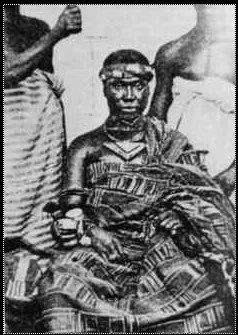
Grand Chiefs of the Ashanti Empire, c. 1873

Ashanti yam ceremony in the Ashanti Kingdom, 19th century

Ashanti Kingdom family and city neighbourhood, c. 1873.

Ashanti Military Field Marshal, c. 1819

Prempeh I, Asantehene from 1888 to 1931.
https://en.wikipedia.org/wiki/Soninke_language

How to Analyse Soninke Ajami Manuscripts
https://ajami.hypotheses.org/983

https://en.wikipedia.org/wiki/West_Africa

The talking drum is an instrument unique to West Africa.

Mansa Musa depicted holding a gold nugget from a 1395 map of Africa and Europe

https://en.wikipedia.org/wiki/Mansa_Musa

Musa I (c. 1280 – c. 1337), or Mansa Musa, was the tenth Mansa (a military title meaning "conqueror"or "emperor") of the Mali Empire, an Islamic West African state. He has been described as the wealthiest individual of the Middle Ages and of all of human history.

At the time of Musa's ascension to the throne, Mali in large part consisted of the territory of the former Ghana Empire, which Mali had conquered. The Mali Empire consisted of land that is now part of Guinea, Senegal, Mauritania, Gambia and the modern state of Mali. During his reign, Musa held many titles, such as "Emir of Melle", "Lord of the Mines of Wangara", and "Conqueror of Ghanata".
Musa conquered 24 cities, along with their surrounding districts. During Musa's reign, Mali may have been the largest producer of gold in the world, and Musa has been considered one of the wealthiest historical figures. However, modern commentators such as Time magazine have concluded that there is no accurate way to quantify Musa's wealth.

Musa was a devout Muslim, and his pilgrimage to Mecca made him well known across northern Africa and the Middle East. To Musa, Islam was "an entry into the cultured world of the Eastern Mediterranean". He would spend much time fostering the growth of the religion within his empire.
Musa made his pilgrimage between 1324 and 1325. His procession reportedly included 60,000 men, all wearing brocade and Persian silk, including 12,000 slaves, who each carried 1.8 kg (4 lb) of gold bars, and heralds dressed in silks, who bore gold staffs, organized horses, and handled bags. Musa provided all necessities for the procession, feeding the entire company of men and animals. Those animals included 80 camels which each carried 23–136 kg (50–300 lb) of gold dust. Musa gave the gold to the poor he met along his route. Musa not only gave to the cities he passed on the way to Mecca, including Cairo and Medina, but also traded gold for souvenirs. It was reported that he built a mosque every Friday.

Musa's journey was documented by several eyewitnesses along his route, who were in awe of his wealth and extensive procession, and records exist in a variety of sources, including journals, oral accounts, and histories. Musa is known to have visited the Mamluk sultan of Egypt, Al-Nasir Muhammad, in July 1324.
God's Way: 7. Musa & the Law - ٧- موسى & الشريعة - Soninke Language Animation

Because of his nature of giving, Musa's massive spending and generous donations created a massive ten year gold recession. In the cities of Cairo, Medina, and Mecca, the sudden influx of gold devalued the metal significantly. Prices of goods and wares became greatly inflated. This mistake became apparent to Musa and on his way back from Mecca, he borrowed all of the gold he could carry from money-lenders in Cairo at high interest. This is the only time recorded in history that one man directly controlled the price of gold in the Mediterranean.

Some historians[who?] believe the Hajj was less out of religious devotion than to garner international attention to the flourishing state of Mali. Al-Umari who visited Cairo shortly after Musa's pilgrimage to Mecca, noted that it was “a lavish display of power, wealth, and unprecedented by its size and pageantry".
The creation of a recession of that magnitude could have been purposeful. After all, Cairo was the leading gold market at the time (where people went to purchase large amounts of gold). In order to relocate these markets to Timbuktu or Gao, Musa would have to first affect Cairo's gold economy. Musa made a major point of showing off his nation's wealth. His goal was to create a ripple and he succeeded greatly in this, so much so that he lands himself and Mali on the Catalan Atlas of 1375.
https://en.wikipedia.org/wiki/Gulf_of_Guinea

Old French map of the Gulf of Guinea


https://en.wikipedia.org/wiki/Ivory_Coast
https://en.wikipedia.org/wiki/Togo
https://en.wikipedia.org/wiki/Burkina_Faso
https://en.wikipedia.org/wiki/Mali
https://en.wikipedia.org/wiki/Benin
https://en.wikipedia.org/wiki/The_Gambia
https://en.wikipedia.org/wiki/Senegal
https://en.wikipedia.org/wiki/Sierra_Leone
https://en.wikipedia.org/wiki/Guinea-Bissau
https://en.wikipedia.org/wiki/Guinea
Greetings well met fellow, hail! A list of our Portals appears below;
The Daily Eagle [tm] home Portal is at Hive: @dailyeagle

Daily Eagle News
http://dailyeagle.news
Established July 4, 2019
Read Daily Eagle News:
https://tinyurl.com/dailyeagle
"Screaming, Squealing Talons of Truth..."
Bitchute: https://www.bitchute.com/channel/Mu3jw5cF3r6i
LBRY: https://lbry.tv/@dailyeagle
Rumble: https://rumble.com/user/DailyEagle
Youtube: https://www.youtube.com/channel/UC0wGuEIhhPiAQk9xWYfGkTA
Facebook: https://www.facebook.com/DailyEagleNews
Flote: https://flote.app/DailyEagle
Gab: https://gab.com/DailyEagle
Hive: @dailyeagle
Leo: @dailyeagle
MeWe: https://mewe.com/i/dailyeagle
Minds: https://www.minds.com/dailyeagle
Parler: https://parler.com/profile/DailyEagle
Pocketnet: https://pocketnet.app/dailyeagle
Raging Right (Politichatter): https://politichatter.com/DailyEagle
Twitter: https://twitter.com/DailyEagle1
WeGo: https://wego.social/DailyEagle
Wimkin: https://wimkin.com/DailyEagle
XEPHULA: https://xephula.com/DailyEagle
YoRE: https://yourfreehere.com/DailyEagle

Support Daily Eagle News: BUY CRYPTO!
We're affiliated with major Cryptocurrency Exchanges:
Coinbase (San Francisco): http://dailyeagle.news/coinbase
Gemini (New York): http://dailyeagle.news/gemini
Binance (Malta): http://dailyeagle.news/binance
(*) This is a funding mechanism, NOT "financial advice."