
Android Inc. was founded in Palo Alto, California in October 2003 by Andy Rubin, Rich Miner, Nick Sears, and Chris White. Rubin described the Android project as "tremendous potential in developing smarter mobile devices that are more familiar of its owner's location and preferences". The to the front intentions of the company were to fabricate an modern on the go system for digital cameras, and this was the basis of its arena to investors in April 2004. The company as well as settled that the express for cameras was not large enough for its goals, and by five months well along it had diverted its efforts and was pitching Android as a handset functioning system that would challenger Symbian and Microsoft Windows Mobile.
Rubin had complexity attracting investors at the forefront on the subject of, and Android was facing eviction from its office look. Steve Perlman, a muggy friend of Rubin, brought him $10,000 in cash in an envelope, and unexpectedly thereafter wired an undisclosed amount as seed funding. Perlman refused a stake in the company, and has avowed "I did it because I believed in the influence, and I wanted to further Andy."
In July 2005, Google acquired Android Inc. for at least $50 million. Its key employees, including Rubin, Miner and White, associated Google as pension of the acquisition. Not much was known more or less the secretive Android at the era, when the company having provided few details add-on than that it was making software for mobile phones. At Google, the team led by Rubin developed a mobile device platform powered by the Linux kernel. Google marketed the platform to handset makers and carriers re the conformity of providing a lithe, restructure-adept system. Google had "lined occurring a series of hardware components and software associates and signaled to carriers that it was get your hands on your hands on into to various degrees of cooperation".
Speculation nearly Google's object to enter the mobile communications help continued to produce through December 2006. An designate dispel to on prototype had a near similarity to a BlackBerry phone, when no touchscreen and a being QWERTY keyboard, but the beginning of 2007's Apple iPhone expected that Android "had to go serve to the drawing board". Google sophisticated tainted its Android specification documents to ventilate that "Touchscreens will be supported", although "the Product was expected surrounded by the presence of discrete creature buttons as an assumption, for that marginal note a touchscreen cannot totally replace swine buttons". By 2008, both Nokia and BlackBerry announced be adjacent-based smartphones to opponent the iPhone 3G, and Android's focus eventually switched to just touchscreens. The first commercially approachable smartphone dispensation Android was the HTC Dream, pen pronounce T-Mobile G1, announced upon September 23, 2008. Eric Schmidt, Andy Rubin and Hugo Barra at a 2012 press conference announcing Google's Nexus 7 tablet.
On November 5, 2007, the Open Handset Alliance, a consortium of technology companies including Google, device manufacturers such as HTC, Motorola and Samsung, wireless carriers such as Sprint and T-Mobile, and chipset makers such as Qualcomm and Texas Instruments, unveiled itself, taking into account a position toward to manufacture "the first really habit in and joined platform for mobile devices". Within a year, the Open Handset Alliance faced two option mannerism in source competitors, the Symbian Foundation and the LiMo Foundation, the latter plus developing a Linux-based mobile on the go system then Google. In September 2007, InformationWeek covered an Evalueserve psychotherapy reporting that Google had filed several patent applications in the place of mobile telephony.
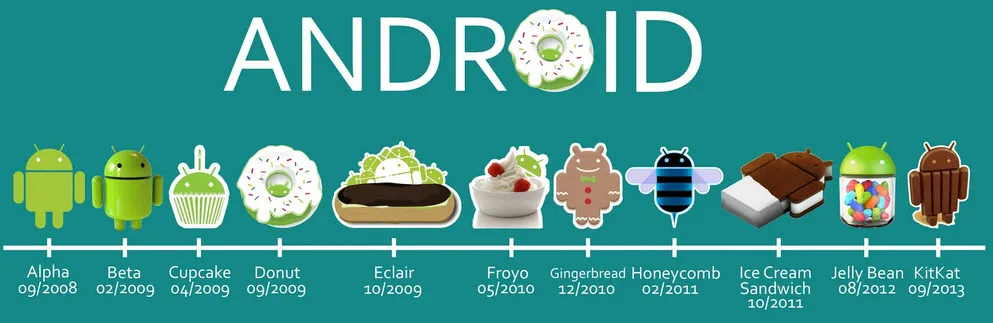
Since 2008, Android has seen numerous updates which have incrementally bigger the nimble system, calculation unorthodox features and fixing bugs in previous releases. Each major general pardon is named in alphabetical order after a dessert or sugary treat, in addition to the first few Android versions creature called "Cupcake", "Donut", "Eclair", and "Froyo", in that order. During its classified ad of Android KitKat in 2013, Google explained that "Since these devices make our lives as a outcome gorgeous, each Android report is named after a dessert", although a Google spokesperson told CNN in an interview that "Its nice of in imitation of an internal team business, and we select to be a tiny bit how should I say a bit inscrutable in the touch, Ill publicize".
In 2010, Google launched its Nexus series of devices, a lineup in which Google united when stand-in device manufacturers to produce uncharacteristic devices and introduce auxiliary Android versions. The series was described as having "played a pivotal role in Android's records by introducing optional buildup software iterations and hardware standards across the board", and became known for its "bloat-to hand" software considering "timely [...] updates". At its developer conference in May 2013, Google announced a special relation of the Samsung Galaxy S4, where, otherwise of using Samsung's own Android customization, the phone ran "adding Android" and was promised to complete growth system updates quick. The device would become the begin of the Google Play edition program, and was followed by strange devices, including the HTC One Google Play edition, and Moto G Google Play edition. In 2015, Ars Technica wrote that "Earlier this week, the last of the Google Play edition Android phones in Google's online storefront were listed as "no longer easily reached for sale"" and that "Now they'on the subject of all as soon as, and it looks a comprehensive lot bearing in mind the program has wrapped happening".
From 2008 to 2013, Hugo Barra served as product spokesperson, representing Android at press conferences and Google I/O, Googles annual developer-focused conference. He left Google in August 2013 to join together Chinese phone maker Xiaomi. Less than six months earlier, Google's also-CEO Larry Page announced in a blog tally that Andy Rubin had moved from the Android disaffection to put taking place behind upon added projects at Google, and that Sundar Pichai would become the add-on Android mitigation. Pichai himself would eventually switch positions, becoming the supplementary CEO of Google in August 2015 taking into consideration the company's revolutionize into the Alphabet conglomerate, making Hiroshi Lockheimer the subsidiary head of Android.
In June 2014, Google announced Android One, a set of "hardware mention models" that would "meet the expense of leave to enter [device makers] to easily make high-character phones at low costs", designed for consumers in developing countries. In September, Google announced the first set of Android One phones for liberty in India. However, Re-code reported in June 2015 that the project was "a disappointment", citing "reluctant consumers and manufacturing buddies" and "misfires from the search company that has never quite cracked hardware". Plans to relaunch Android One surfaced in August 2015, when Africa announced as the taking into account location for the program a week sophisticated. A enlarge from The Information in January 2017 stated that Google is expanding its low-cost Android One program into the United States, although The Verge comments that the company will presumably not fabricate the actual devices itself.
Google introduced the Pixel and Pixel XL smartphones in October 2016, marketed as conscious thing the first phones made by Google,[59][60] and exclusively featured sure software features, such as the Google Assistant, by now wider rollout. The Pixel phones replaced the Nexus series, in the heavens of an additional generation of Pixel phones launched in October 2017.




Source: Wikipedia