
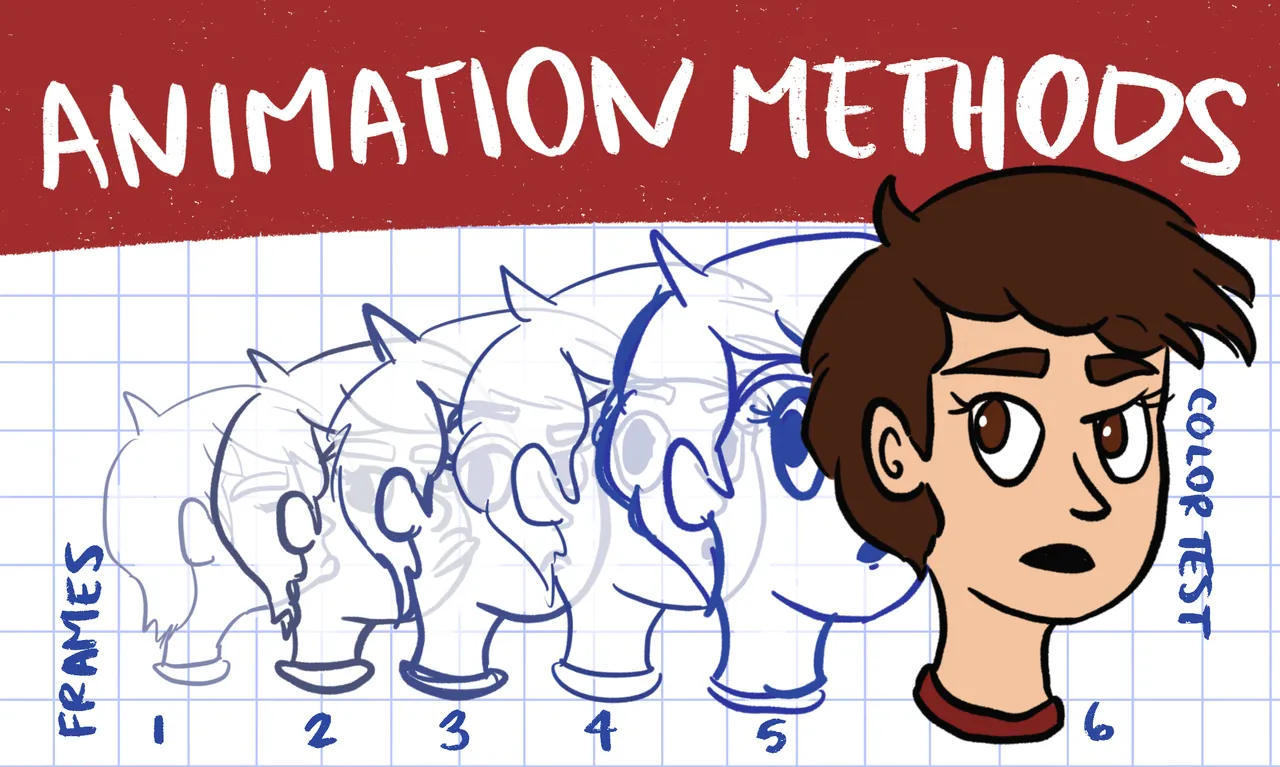
Welcome to animation study #2! If you’re interested in my previous animation study on planning the spacing and timing of a simple animation, check it out here.
I’m again using the excellent Animator’s Survival Kit by Richard Williams as the main source of this study.
The 3 methods of animation explained here are systems for organizing your thought process during animation, with the “best” option depending on what the project expectations are.
Option 1:

Straight ahead animation is when you draw the frames in the order they’ll occur with no exact plan of what the last frame will look like.
First, you draw the first frame. Next, you draw the second frame. Then, you draw the third frame... and on and on.
This does not mean the animation can not have ANY planning in order to be straight-ahead.
Going in, you could have some initial planning of how many frames you’ll animate or the movement’s general direction. For example, you could say I want 3 seconds of rushing water at 12 FPS - so I’ll animate water rushing by from left to right for 36 frames, straight ahead.
It works exceptionally well for objects that may move unpredictably, like fire, water, clothing, or hair (and more).
Straight Ahead Advantages and Disadvantages (per The Animator’s Survival Kit)

Option 2:

Pose to pose animation is when you have planned when and where the action will start and end, and you draw those frames first. In the above example, frame 1 and frame 3 are drawn first for a simple expression. Frame 2 is drawn third, as an inbetween of frames 1 and 3.
In this example, frames 1 and 3 are extremes, and frame 2 is an inbetween. In a longer example, there may be many extremes, all marking different important moments in an action.
This method is useful for anything that requires a planned action (in other words, almost all narrative animation). It provides a structure that’s both easy to adjust before finishing and easy to collaborate on.
Pose to Pose Advantages and Disadvantages (per The Animator’s Survival Kit)

Compared to the straight ahead method, pose to pose seems like a better fit for any larger scale or collaborative animation environment - at the sacrifice of the organic looking animation.
Luckily, a third option provides both the structure of pose to pose and the creativity of straight ahead.
Option 3:

Mixed straight ahead and pose to pose animation is a blend of the best of both worlds. Pose to pose to forms a structure for the animation and straight ahead animation builds upon the structure with organic movement.
In the above example, pose to pose animation is used to craft a (rough) walk. Frame 1 is drawn first, then frame 3, and then frame 2 is draw between them.
Straight ahead animation is used to animate the hair on top of the figure’s head. The first frame first, then the second, then the third. By controlling the movement of the walk but allowing the hair to move more organically, the character has a better balance of fluidity and structure.
Mixed Advantages and Disadvantages (per The Animator’s Survival Kit)

My lesson:
Though there are appropriate places to use exclusively straight ahead or pose to pose animation, mixed animation best suits my narrative animation goals.
This animated head turn I did, for example, could’ve been improved by using this method:

I used strictly pose to pose animation everywhere but the ear swirl and the eyelashes, which only were left to be done straight ahead because I forgot them originally.
If I had made the structure using pose to pose and then done a separate straight ahead run for the hair, it probably would’ve ended up less wobbly and more organic.
Overall, a great learning experience for me.
Thanks for reading!