
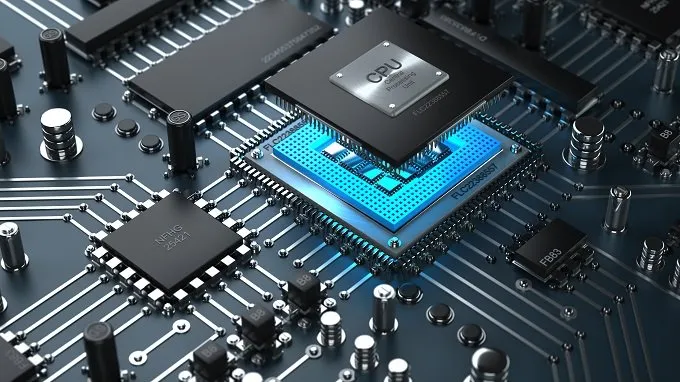
Today we're going to continue our adventures in computer literacy by talking about the heart and soul of the computer, the CPU (often referred to simply as the central processor or processor).
CPU stands for Central Processing Unit. Without the CPU, nothing else in the computer can function in a way that is useful. You can be missing any other component (aside from maybe the motherboard) and still have a functioning if not useful machine. Not so of the CPU.
The CPU functions like the brain of the computer. It basically handles all communication between the various internal components installed into the motherboard (such as sound card and video card) and between all external peripherals hooked into the motherboard via ports (such as monitor and keyboard). It does all of the main "thinking" of the computer.

In modern computers CPU's handle the basic "...arithmetic, logical, control and input/output (I/O) operations specified by the instructions." (wikipedia - CPU) Everything that happens on your computer can be reduced to simple operations involving 1's and 0's, the basic units of computer language. We'll get more into that in a different article.
The CPU interprets instructions using a series of tiny components etched into the chip called transistors. A transistor is a type of logic gate that allows either a high or low energy pulse to pass through it. High pulses are 1's, low pulses are 0's. Think of a CPU as a super quick calculator, complete even with it's own basic onboard memory to keep track of instructions and calculations. In our restaurant analogy the CPU is the chef, doing all of the coordination and much of the 'cooking' that takes place.

A computer actually can only do an instruction at a time (or, in some CPU's a few instructions at a time at most). So how does it do so much different stuff at once? Simple, it doesn't.
The CPU just calculates so fast that to humans it can look like it's doing it all at the same time.
Now, the GPU or graphics card is almost the exact opposite. It does many relatively simple calculations in parallel. We'll get into that another time.
The CPU sits in the motherboard. Generally speaking it's separate from the motherboard and is cooled using a fan or cooling system. You see, the CPU does so many complex calculations and does them so quickly that heat can quickly become an issue. The reason your laptop can become hot is almost exclusively because of the CPU, GPU, and power supply (depending on your model and whether its a laptop).
I'm Jenkinrocket, and I love computers. My hope is to get enough Steem from these posts to do a series of posts on building my own computer. If you enjoyed this please upvote, resteem, and follow!

