
It refers to an ancient legend that is told in these lands of Villalcázar de Sirga and referred to the magnificent Pantocrator of the unsurpassable church of Santa María la Blanca, that on the day of the spring equinox, if the exact point is hit in which a ray of sun reaches the bull, symbolic animal that represents St. Luke, then the heads that are on either side of Christ in Majesty, will reveal the place where the Templars hid their formidable treasure.
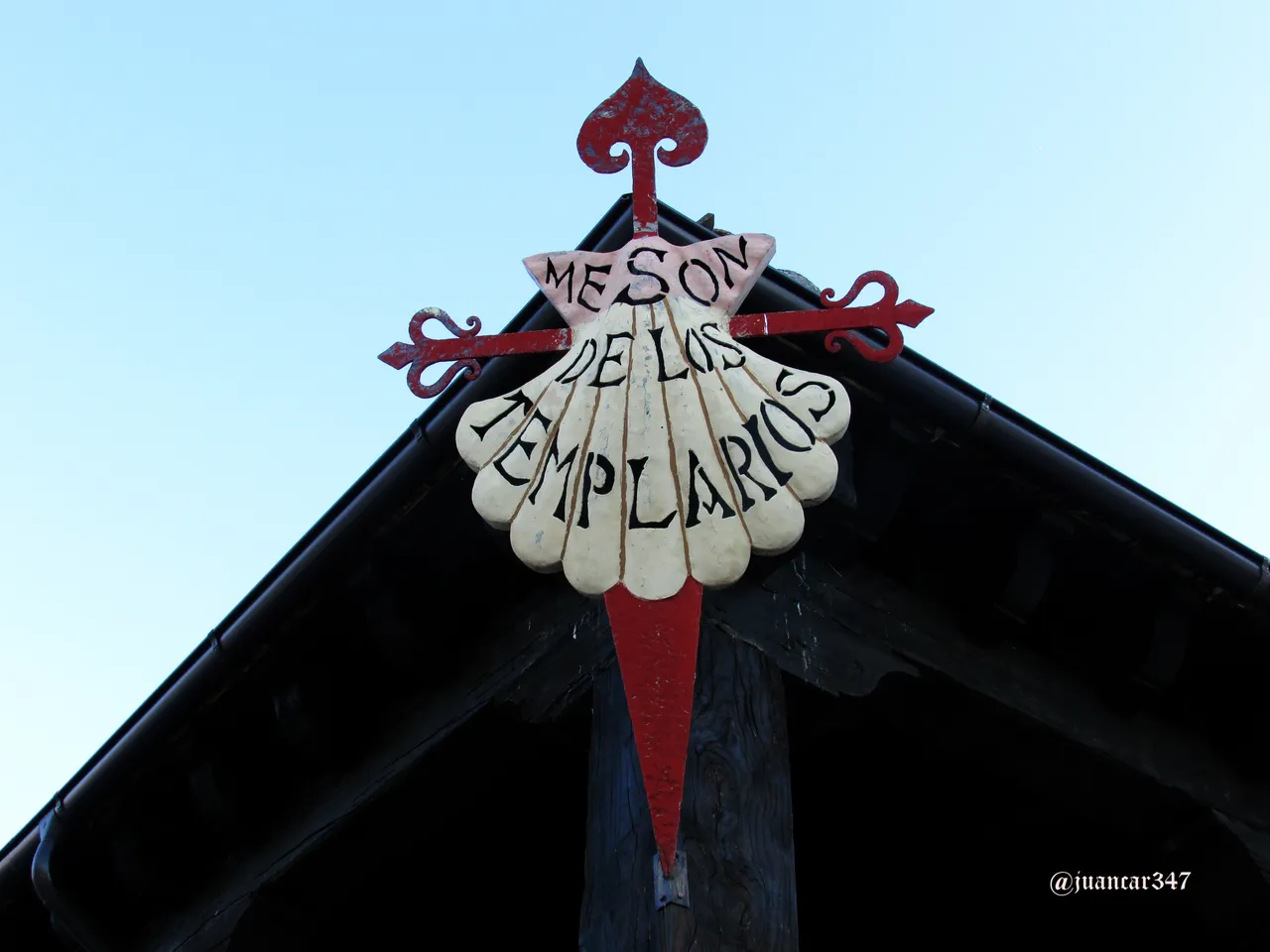
Actually, and if we talk about treasures, it will not be very difficult to arrive at the certain conclusion that the greatest Templar treasure that can be found in these lands of fields -or by any other land related to them-, is none other than the own church, the only surviving remnant, along with the former hospital and now converted into an inn but retaining the name of its former owners, the Templar encomienda established in the place, located not far from Frómista and in full itinerary of the Camino de Santiago.
The only one from the Kingdom of Castile, apparently, located north of the border of the Duero and which is also recorded, at least one of its commanders -Frei Gómez de Patiño, who was present at the Ceheguín Charter of 1307 - as well as the last brothers of the Order that lived there, before it passed into the hands of the Knights of Santiago: Freires Johanni, Luce and Roderico; or what comes to be the same: Juan, Lucas and Rodrigo.
Declared a National Historic Monument in 1919, and although very affected by the effects of the impressive earthquake that shook the city of Lisbon in 1755, this formidable temple, with a patriarchal cross plan, according to Rafael Alarcón Herrera (1), is, after all, and as it was affirmed at the beginning, an authentic compendium of wisdom that, well looked at, gathers the greatest legacy and at the same time the best treasure that can be found.
But far from treating in the present entry the many aspects that make this temple a lavish place in keys and riddles -which are postponed for a better occasion-, there is the intention to admire and consider some other question related to part of that immeasurable artistic treasure, as undoubtedly are the polychrome sarcophagi that can still be seen, in good part of its primitive splendor, in the so-called Chapel of Santiago, work, apparently, also attributable to the extraordinary medieval workshops established in Carrión de los Condes and surroundings, whose best exponents would be located in the temples of Santa María del Camino, Santiago, the almost unrecognizable monastery of San Zoilo, and even beyond Carrión, in places such as Moarves de Ojeda and its church of San Juan Baptist.
The sarcophagi in question, there are three, which placed in a row and made, it is believed, by one Peter the Painter, is supposed to belong, in the following order, to Infante Don Felipe, son of Fernando III el Santo and de Dª Beatriz de Suabia and brother of Alfonso X el Sabio, author, as we know, of the famous Cantigas a Santa María, of which at least a dozen refer precisely to the miracles attributed to the White Virgin, owner of this ancient Church of Villalcázar de Sirga (2).
Died in 1274, he studied at the University of Paris, being a student of St. Albert the Great and companion of St. Bonaventure and St. Thomas Aquinas. His first wife, was the princess Cristina of Norway, whose memory is still alive in another Castilian city, near the surroundings of Santo Domingo de Silos and the ruins of the monastery of San Pedro de Arlanza, where she was buried: Covarrubias. The sarcophagus that is found below is believed to be that of Dª Inés Rodríguez Girón, lady who was the second wife of the Royal Infante, although there has always been some confusion in this regard, and numerous sources have been advocated by Dª Leonor Ruiz of Castro, who, apparently, was buried, as requested in his will, in the monastery of San Felices de Amaya, near Burgos (3).
Following the alleged sarcophagus of Doña Inés, the burial of a mysterious character is located, of which it is not known for sure who he was, but whose personality also revolves around history and legend. Although generally, it is thought that the remains of a santiaguista knight, named Juan de Pereira, rest on it, there are many sources that consider it as the tomb of a Templar knight, and even with the sepulcher of the master stonemason or magister murii who built the church.
It is significant, however, at this point, to observe that the character carved on the lid of the sarcophagus keeps a bird in his hands. While it is true that the metal gate that protects the access to the chapel of Santiago, barely allows to see what kind of bird is in question, is equally significant, the presence of a very special bird, the goose, representative of the old brotherhoods canteriles and closely related animal, likewise, with the Camino de Santiago and the transit to the underworld, its symbolism being rich and varied. This animal, appears at least in two nobiliary shields that are located, one in the own external facade of this church of Santa Maria the White, and the other, right opposite, in an old palace, reconverted in Town Hall. Along with the shield, there are also some head dogs, which probably belonged originally to the temple.
Given the relationship of the rebel Infante Don Felipe with the Order of the Temple, in which he found refuge after prolonged confrontations with his brother, King Alfonso X, it may not be so significant, however, the detail that among the characters that so abundant and richly offer a detailed anthropological set of customs -including the mourners, figures still existing until relatively modern times-, situations and rituals of the time, are located several brothers of the Order of the Temple, accompanying the deceased brother in the burial.
Nor would it have been strange, that such gentlemen had also appeared in the tomb of his wife, Doña Ines, by virtue of the close contacts the Templars had with the oldest and most powerful families, from which they not only obtained succulent rents, but also those that were also required to safeguard and defend their territories, as happened in Galicia, with the mysterious bailía de Faro. And I say mysterious, because despite its proven historical existence, remains to be determined the exact place where it was, not ruling out, even, the famous Tower of Hercules, a Roman precedent and strategic observation point.
In any case, and independently of the numerous enigmas that still exist in this old encomienda, there is no doubt that still, no matter how you look, it poses not only numerous challenges for the researcher, but innumerable historical-artistic details and cultural, as to make a visit one of the most attractive attractions of the Camino de Santiago as it passes through the province of Palencia. And one more fact: are they my imaginations, or is there a certain reasonable resemblance between the cover that gives precisely to the Chapel of Santiago and that other that can still be seen, although hardly, in the ruins of the convent of San Antón, in the not too distant population of Burgos de Castrojeriz ?. Good subject to meditate in the future.
With regard to the symbolic figure of the Pantocrator, let us not forget that in Palencia there are sublime backgrounds, as everyone who has visited the church-museum of Santiago, in Carrión de los Condes or the one of San Juan Bautista, in Moarves, knows very well. Ojeda In addition, and also for its reasonable resemblance, one could mention the similarity between these and another that is located in the cathedral of Lugo, subject that, of course, can lead to speculation about the origin of stonemasons and their making and another side of both provinces.




Notes:
(1) Rafael Alarcón Herrera: 'The Other Spain of the Temple', Ediciones Martínez Roca, S.A., 1988, pages 256-257. On page 257 and at the end of the photo, Alarcón, likewise, comments, and I quote it as a text for anyone who wishes to investigate more on the subject of the legend of the treasure of the Templars: 'The fabulous Templar convent of Villasirga (Palencia) ) preserves the memory of a treasure whose secret only knows the animal of the Pantocrator, popularly called "wise pig of San Lucas" '.
(2) Another of the mysteries added to the place is, precisely, the difficulty to identify what it is, among the varied Marian images that can be found in the church, including the one that is located in the magnificent main portal of access to the temple, underneath, precisely, the Pantocrator referred to as legend as container of the key to locate the alleged treasure of the Templars, although it is true that most researchers tend to point to a beautiful Gothic carving, which finds inside the enclosure of the Chapel of Santiago, in front of the sarcófagos and terribly mutilated, since it lacks the right arm, carrier of the attribute, being the damage, nevertheless, much greater in the case of the Child, because apart from the same arm that the Mother, also lacks the head.
(3) Information obtained from part of the conference that Cristina Partearroyo offered on March 10, 1994 at the National Archaeological Museum and that can be consulted in the following blog; http://tomasalo.blogspot.com.es/2010/09/sepulcro-de-dona-leonor-ruiz-de-cartro.HTML
Related movie:

NOTICE: originally published on my blog ARTE, MITOS Y ARQUETIPOS. Both the text, photographs, and video (with the exception of music, reproduced under a YouTube license) are my exclusive intellectual property. The original entry can be found at the following address: http://artemitosyarquetipos.blogspot.com/2016/11/arte-funerario-los-sepulcros-de.html


