

In this second part, we will analyze the difference in the animations between walking and running, describing step by step each frame. In addition, we will begin to see how an animation is framed in a scene, this is a fundamental aspect because it loads the action of dynamism and allows us to obtain a feeling of depth much more credible to the human eye.
I am still fascinated to see, after several hours of drawing, the final result. I hope that if you are accompanying me in this learning process you will find it just as satisfying.
Let's start ...
The difference between walking and running

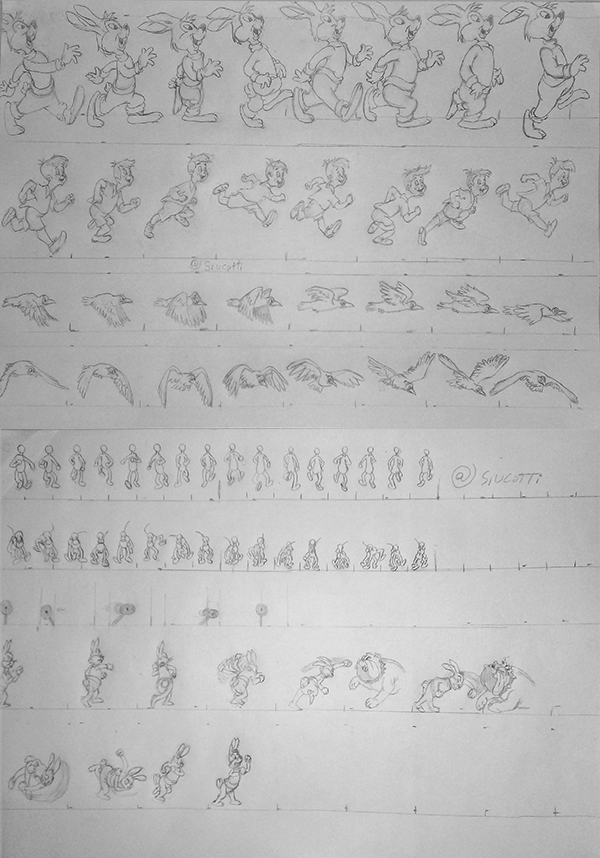
The first drawing in each sequence is the one used to build the rest of the action.
On the walk, the forward foot is stretched and the body is straight, which marks the low speed. When running, the body leans forward and the foot that leads the action is further behind.
The arms move in opposition to the legs. The left arm is shaken with the right leg and vice versa. The arms move more violently when running.
If we compare the actions of walking and running, the arms are more stretched to step when walking while in the race the stretch occurs when the figure is in the air, at the highest point of the action.
The walk

1.The left foot touches the ground
2.It sinks in a recoil position.
3.The right foot is raised, start to take the step.
4.The high point of the step, the right foot is raised.

5.The right leg is stretched in position to touch the ground
6.Recoil position. The leg is bent.
7.The rabbit is raised again while the left leg is raised.
8.High position, then go back to step 1.

The run

1.Right foot in position of contact with the ground.
2.The right foot takes the weight of the body.
3.The right foot pushes against the floor to raise the body.
4.The body is at the highest point of the race.

5.The left foot touches the ground.
6.In recoil with the right foot coming forward.
7.The left foot is stretched for recoil.
8.The arms and legs are stretched, go back to step 1.

Flight of the birds

Here the author teaches us two flight cycles of birds. The first, flying sideways and then a flight in front. Step 8 is followed by 1. In figure 1 of the side flight the position of the wings is the same as in step 1 of the front flight, he asks us to notice how the wings bend upwards while rising in the wings in drawings 2, 3 and 4. This part of the action is slower and therefore more drawings are necessary. In drawings 5, 6 and 7, the wings enlarge to catch more air. Then, in drawing 8, they quickly fall open (just one drawing) to give the bird the thrust that carries it through the air.

Not all the actions of bird wings are as violent as this one, but the one illustrated here can be modified for smaller birds.


Anticipation - Action - Reaction

An action like the swing of a pendulum is a movement between two extreme positions, a drawing of a pendulum in a centered position has little visual value to represent the action. It is the extreme positions of the pendulum that describe the action-and measure it. The first extreme is anticipation: get comfortable, take a breath, retreat, contract or get up, or push up (for a downward movement). The second extreme is the reaction: the recovery of movement, be it a shock or a stretch and accommodation that generates vibration.

The minimum movement in any direction can be reinforced with a movement in the opposite direction, in an anticipation before the act, and then the process of recovery is advanced. The author points out a curiosity, the contact drawing of the action is of such low importance to describe the action that it is usually best to eliminate it from the sequence, as we can see in the action of the rabbit.


In the action of the rabbit we do not see the contact with the bulldog, it is not a trick; it is an exaggeration of the rhythm of the sequence.

I hope you liked it, in the next installment we will analyze the difference between the straight-ahead animation, where each drawing represents each instance of the action and the animation of where "the pose is planned", a style where both ends are drawn and the action is filled with drawings between them.
"How to draw cartoon animations" Part 1
"How to draw animals" Part 1 Part 2 Part 3
"How to draw manga" Part 1 Part 2 Part 3