

Ahhh, so we're back again here with one of the most important animation principle. A few weeks back, I've posted a post about the 12 animation principles and it's different uses. How to properly apply all the principles in every project you're being thrown at. The animation principles are like the basic necessity of every thing animation. If you've missed it, I'll link you the post below but please don't upvote it! It is way passed it's payout time.
The 12 Animation Principles
But today, I would want to narrow in on a very specific animation principle which I still often struggle in properly applying it in my animation works. So what I'm about to share here are some of the lessons I've learned from mentors and also some methods that I used to improve on my animation.
Exaggeration - How much is TOO MUCH?

I've searched the web for this particular principle and many times the question 'How much is too much?' pops out. Apparently, I'm not the only animator that tries to answer this question myself everyday as I'm animating.
When I was in university working on my projects, I often get told by my mentors that my animations are too stiff. Their movements can be bigger, more dynamic, and exaggerated. These were the words often used to describe my animations. Nodding my head, I walked back to my desk to do the necessary amendments, realizing that I had NO CLUE how big, how dynamic and how exaggerated they wanted my animation to be. The worst part was, I thought I exaggerated the actions and poses enough when submitting to them.
I was left there clueless for hours trying to maybe tweak a miracle.

After the first few years in my animation journey, this question comes up every now and then. "How much is too much?". Of course, I did find some tips which i would love to share with you guys who are also having this problem.
It is too much when it becomes confusing
First of all, we have to understand why we use Exaggeration in our animation. We must also understand the situation it's being used in. The plot or the story that is trying to be delivered. As an animator, you are given the task to create art that delivers the message to the audiences through moving picture frames. To emphasize or reinforce a key storyline or pose to tell the story.
It also depends on the project you're also working on. Does it carry the slapstick cartoon-ish style like Despicable Me? Or is it a more realistic animation?
As I've mentioned in my previous post before, "Exaggeration done right would still make the scene believable at the same time evoking a point across."
But 
Ah yes, after you've FULLY understood your story and the style given by the art director for your animation. One of the most effective way I've found to be able to answer this question of yours and mine is to ask feedback/critique from someone.
I know, it's that simple. You can ask your peers and people who are NOT in the animation industry. It will be easier for your peers to understand your story because they might be working on the same project with you. Thus, understanding the full story before they look at your scene. But on the other hand, the challenge comes when your sister, brother or friends do not understand what your scene is trying to tell.

When your shot is overkilled with exaggerated poses and timings, it becomes really messy and confusing. Most of the times, really painful to look at. It is always good to let your friends watch the scene without telling them the plot, to see if they get it after. If they do, then you've done a good job.
A good job exaggerating a realistic scene is when it is believable that it doesn't take your mind off for a second from the story. Instead, it enhances it and makes it more beautifully dynamic.

If you remember this scene in 'The Greatest Showman', where they were dancing on the rooftop with sheets all around. The sheets were animated to accentuate the dance flow. If you noticed, there was a part in this scene where the sheets flutter along with the camera tilt and dance moves.
That is exaggeration.

Other ways of exaggeration can be seen in a totally different style of the movie "The Mask". "The Mask" often over-exaggerates his actions to get a message across strongly. Like when he sees a hot girl walks into the bar. Or when in this scene, his heart beats fast when he sees the girl. Which of course, impossible to show if the style was realistic.
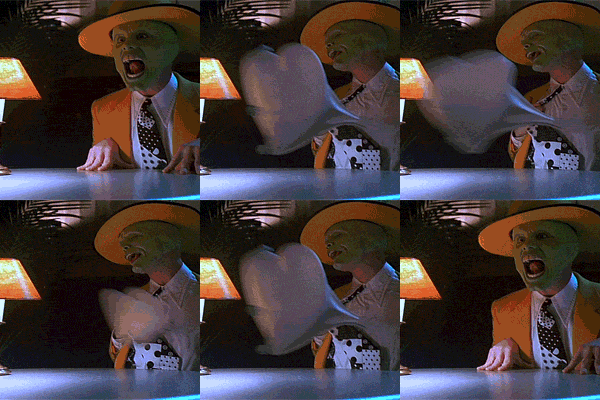
"Don't make it real, make it believable" - Oliver Martin Johnston, Jr.
Oliver Johnston, an american animator, who is also recognized as a Walt Disney Legend. Who has done works for Pinnochio, Bambi, snow white and the seven dwarfs and many more.
And this applies to all the animation when you're about to use exaggeration. It all depends how much do you need to use. Check the story again, the characters, the style that is wanted from the director. And when you've done your animation passes, always remember to get feedback from your peers.
Make sure they understand the story, and every movement of it, subtle and big. That it doesn't look like the whole scene is being taken up by a hurricane. Get a few eyes to look at your shot over and over again.
"How much is too much exaggeration?"
SHOW IT TO SOMEONE
GIFs are taken from www.giphy.com
Thank You
If you like what I do, check out my other posts on my artworks, photography & animations.
I'm also open for
Personalized Steemit Profile Banner,logos & GIFs
DM me on discord : zord189#7776

Credits to 


