

The Orion constellation is one of the most familiar groups of stars in the night sky and is host to a similarly well-known star forming region known as the Orion complex. This region is well suited to study star formation and evolution due to the variety of clusters and interactions with other objects. The oldest part of the Orion complex was previously thought to be around 13 Myr old (Briceno et al. 2018). In crowded star fields (see figure 1), it can be difficult to determine which stars belong in which clusters. As instrumentation and data reduction becomes more precise and powerful, astronomers are able to make better and better estimates of cluster ages by using techniques to improve these boundary lines. Kos et al. 2018 have discovered a 21 Myr (millions of years) old stellar population in the Orion complex.The research team was able to come to this conclusion by using photometry data from Gaia DR2 along with radial velocities from GALAH DR2. Photometry is the measure of brightness of an object and radial velocity is the measure of an object's speed towards or away from Earth. These parameters were put into a computer model to look for clusters in the Orion complex as shown below.

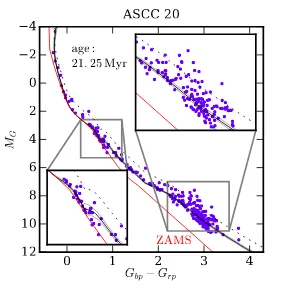
The researchers then fit isochrones to the Gaia DR2 Hertzsprung-Russell(H-R) diagram. Essentially, a H-R diagram is a plot of magnitude versus color that shows all the stars in a given cluster at different points in their evolution. Similarly, an isochrone is a curve that can be used in conjunction with a H-R diagram to determine the age of a cluster. As shown in figure 3, the oldest cluster was dated at approximately 21.25 Myr. As astronomers continue to refine these techniques, their estimates will only continue to improve and provide better data upon which to base their models of how the universe works.
References:
Briceno, C. et al. 2018, https://arxiv.org/abs/1805.01008
Kos, J. et al. 2018, https://arxiv.org/pdf/1811.11762.pdf