

This autobiography is written by Chris Frantz, a musician who is notable for having been in the bands Talking Heads and Tom Tom Club, for being married to Tina Weymouth for 43 years, and an intense and severe dislike of David Byrne.
To be fair, Frantz spends considerable time in this book writing about why he liked Byrne enough to be in a band with him for a few years, but having read this book (and seemingly not communicated with Byrne about writing it), I must say, it seems like dealing with Byrne was a prolonged nightmare; at the very least, the book is so sprinkled with Byrne-related anecdotes—most of which are indicative of Byrne's destructive ways—that I get why Frantz would want to exorcise it all by writing about it. On the other hand, I'd love to speak with Frantz and find out why he's writing about all of that in the way he has, more than four decades after having formed Talking Heads with Byrne (and others).
I had the great fortune to not only be a founding member of one of the most unique and exciting rock bands of all time, but to do so alongside the love of my life, Tina Weymouth. Together with David Byrne, and later Jerry Harrison, we created a new paradigm we called “Thinking Man’s Dance Music.” The name of the band was Talking Heads. We found inspiration in the bands we loved—the Velvet Underground, David Bowie, James Brown, Al Green, Otis Redding, Booker T and the MGs, Kool & the Gang, the Stooges, and the psychedelic garage bands of the sixties—but we didn’t sound like anyone else. We didn’t copy anyone’s style. And no one could copy ours.
That claim is true.
Talking Heads came a very long way in a very short time, and if one believes what Frantz writes in this book, it's quite obvious that lyrics and music were largely a band effort and not what's written in the album-credits section.
This book reminds me a lot of Stephen Morris's book, Record Play Pause, which is about his life growing up and playing drums in New Order. In Remain in Love, there's a bit about Frantz's growing up, and I'm glad that he settled for short paragraphs with quite rudimentary info:
At school I was happy to have some excellent and challenging teachers. Several come to mind, like David Britton, a graduate of Middlebury College, who skied, rode a motorcycle, and taught English, including a course called Adolescent Rebellion. The latter was of great interest to me. We read Aldous Huxley, Ken Kesey, James Baldwin, Tom Wolfe, Allen Ginsberg, John Knowles, J. D. Salinger, Eldridge Cleaver, and Malcolm X. My parents were mystified by some of these selections, especially by a book called Summerhill: A Radical Approach to Child Rearing by A. S. Neill, about a progressive “free” school. But they were pleased with my enthusiasm.
Some of the info could have been edited out, in my opinion. For example:
I had a very interesting French teacher named Antoine Cordahi, an Egyptian Jew who had fled Nasser’s regime to come to the USA. Mr. Cordahi was something of a dandy who wore black silk suits with purple shirts and Beatle boots. He also taught Music Appreciation, which I loved. This was the first time I heard Debussy, Satie, Herbie Hancock, and the first rock opera, Tommy by the Who. The course was a real turn-on.
Sure, I get it, those things had some kind of relevance to Frantz, but context should have existed to serve a higher meaning; I'd much rather have read about his ideas about things, his inner thoughts that shaped his life, his family circumstances.
There's something to be said about musicians who have been seasoned by decades of being interviewed.
He does write lovely things about Tina, his wife:
One night I screwed up my courage and knocked on Tina’s door. Her apartment was only a block away from mine, so I made up the excuse that I needed some dog food. Tina was sweet and kindly offered me some. I said thanks and good night. When Tina closed the door, I stood there with Lucy wondering how to say what I had really wanted to say. I knocked again. When Tina opened the door I confessed, “I didn’t really come here for dog food. I came here tonight because I want to sleep with you.”
Tina looked at me with big blue eyes, smiled, and said, “Chris, I like you, too, but you know I already have a boyfriend whom I love very much. I couldn’t do that!”
I paused and finally said, “Well, I’m a very patient guy. If for any reason that doesn’t work out for you, I’ll be waiting.” Tina said, “We’ll see,” smiled again, and closed the door.
Whew. I had never been what you’d call a smooth operator with the ladies, and now my heart was pounding. As I walked back to my place with Lucy, I felt a great sense of relief having made my real feelings known to Tina. She had not completely shot me down. There was hope.

Tina Weymouth and Chris Frantz.
The early days of Talking Heads made way for far more collaboration than what came subsequently.

After writing 'Psycho Killer':
The next song written during this early period was called “Warning Sign.” The song was built around a drumbeat I was playing in rehearsal one day.
Much later, when we recorded this song for Talking Heads’ second album, More Songs About Buildings and Food, David added the words in parentheses and took credit for writing the entire song. It appears that he had forgotten that I wrote these words and when I confronted him, he said he would correct the credits on future pressings.
This is where warning flags start to show up. I thought the two paragraphs above indicated that something bad would turn up later, and it did, much like a relationship that turns sour, especially when one part starts talking badly about the other behind that person's back.
If we—for a moment—focus on the other stuff that the book contains, there's some reminiscing of what New York City used to look like.
Did I forget to mention the dead bodies? It was not unusual to have to step over or around a body that was no longer breathing as you walked down the street. Most of these corpses were men who drank themselves to death or toppled out of a flophouse window. The long history of the Bowery is one of crime, misadventure, debauchery, desperation, and death. Pickpockets and thieves hung out in every bar. People were drugged, robbed, and kidnapped. Muggers lurked in the shadows. It was a challenging scene for some nice kids from the suburbs like us. I had to keep telling myself that I would never end up a bum and, if things got bad, my family would surely look after me.
But there was another side of the Bowery. I could walk down the street and bump into Debbie Harry in one of her kooky thrift shop outfits. Debbie and Tina were like roses in a rattlesnake nest. Our friend from RISD, the designer Stephen Sprouse, lived just a block away in the same building as Debbie and her boyfriend, Chris Stein. I could cross paths with Johnny Thunders and his girlfriends of the moment, wondering why he looked like such a mess and yet his girlfriends looked so fine. Robert Rauschenberg lived and worked one block over on Lafayette Street in an old orphanage he had bought and restored. It still had the painted mural of young orphans on the side of the building. Ornette Coleman had a loft and rehearsal space on Bowery. The gorgeous gap-toothed model Lauren Hutton had a place near the corner of Bowery and Bond. Willem Dafoe was living there, too, as did Robert Mapplethorpe, the conceptual artist Vito Acconci, the pianist Charlemagne Palestine, and the feminist writer Kate Millet. The poet John Giorno, who we met at RISD when he did a reading from his book of poems, Cancer in My Left Ball, had lived on Bowery for years. In 1966, William S. Burroughs moved into his “Bunker” in the same building and Mark Rothko painted his Seagram murals there. There was a huge artistic community, not that it was ever visible from the outside.
Frantz writes of a highly experimental, lively, lovely, mixed, and inspirational environment. He delves into CBGBs where he and fellow bandmates see artists like Television, Blondie, and Lou Reed play and decide they want to be in on that shit.
One time I walked into the Tin Palace for a drink and saw Mick Jagger sitting alone at the bar wearing a huge quilted pimp-style newsboy cap. I did admire the Stones. He was high as a kite. The jukebox was playing Roberta Flack’s “Killing Me Softly” and Mick was singing along at full volume but changing the lyrics to, “Blowing me softly with his lips. Blowing me softly . . . with his lips.” I decided I would wait until another time to introduce myself.

As we cleared the stage to make way for the Ramones, Hilly said we had passed the audition. I heard Johnny Ramone, the guitarist, say to him, “Yeah, they suck, so they can open for us. They’ll make us look good.”
Yeah, Johnny Ramone has never come off as a sympathetic person; I remember The KKK Took My Baby Away, a brilliant track by Ramones, having been written by Joey (the singer) as a response to Johnny 'taking' his girlfriend. Johnny was a republican who supported Ronald Reagan, so that's where the KKK side came in.
CBGBs was some place:
They say Wayne County—later Jayne County, after she transitioned— played CBGB first and that may be. Wayne grew up in Georgia and still had a strong Southern accent. Her band was first called Wayne County & the Backstreet Boys and later changed to Wayne County & the Electric Chairs. She had a wild sense of humor and had been part of the downtown underground scene for years. She wrote songs that were almost parodies of rock songs and were vulgar in the extreme. My favorite was “(If You Don’t Want to Fuck Me, Baby) Fuck Off.”
She taunted the homophobes and everyone else at CBGB. One famous night when Tina and I were watching, Handsome Dick Manitoba of The Dictators was heckling her and she said that if Handsome Dick didn’t stop he would be sorry. Handsome Dick continued to yell obscenities at the stage and Wayne stepped forward and swung her microphone stand like a battle-ax onto Handsome Dick’s neck. That was the end of the heckling.
An ambulance was called and Dick was carried off to the hospital. Dick survived and later, in CGBG style, a benefit concert was staged to help with Handsome Dick Manitoba’s medical bills. I’m pretty sure Wayne County was one of the performers.

Talking Heads with Andy Warhol.
Talking Heads' time with Andy Warhol seems to have been lovely.
Later, Andy would even do a radio commercial for us, saying “Buy The new Talking Heads Record and tell them Warhol sent you” and he continued to be a fan of our band, although he sometimes mistakenly referred to us as the Talking Horses. He was the most famous and quite possibly the greatest artist of our time, yet he always treated us like we were way more important than he was. He was there for many of our shows in New York, too, and I felt very fortunate to have spent some time in his Factory.
Talking Heads were nerds; they were deeply into arts, music, and wore clothes that their parents might have given them.
Ramones were a different band. Not only did they appear in uniform but their demeanour was entirely different. Talking Heads grew up middle class. Members of Ramones were victims of abuse, had sold themselves to men for money, and were deeply addicted to drugs.

Talking Heads loved Ramones and very quickly jumped at the opportunity to open for them during their first European tour:
As we arrived at the airport, I saw Dee Dee Ramone very carefully getting out of a cab and then walking painfully, with the help of a cane, to the terminal. I asked him what had happened and Dee Dee said, “Oh, Connie Ramone stabbed me! She stabbed me in the ass!” Connie, as mentioned earlier, was Dee Dee’s girlfriend at the time and evidently they’d had a fight.
While I was making a stop in the men’s room, Dee Dee came in, followed by Monte. They were having a bit of an argument. Monte said, “Give me that cane, Dee Dee!” and Dee Dee said, “No, Monte! No! Leave me alone!”
As I washed my hands, they had a scuffle, and Monte eventually prevailed, grabbing the cane away from Dee Dee. He unscrewed the handle and proceeded to pour all kinds of painkiller pills and downers into the toilet, while Dee Dee looked on in horror. To be fair, he did let Dee Dee keep enough painkillers to last through the flight, and by throwing the rest away he probably saved Dee Dee from being arrested at customs in Switzerland, where they were no doubt wise to hollow canes. Swiss customs were notoriously vigilant and hard on rock stars.
As stated, Johnny Ramone was a real bitch:
When the time came for Talking Heads to go onstage, David, Jerry, and Tina needed to tune their guitars. There was only one strobe tuner for both bands to share and Tina went to look for it. Johnny Ramone was sitting at a table with the tuner in front of him and when Tina asked for it, instead of giving it to her, he said in a loud whine, “Somebody bring me my guitar!”
There was no response and the dressing rooms were not very large so Tina, who was not afraid of Johnny, suggested, “Why don’t you go get it yourself?”
Tommy Ramone came over to Tina and said, “Don’t talk to him like that. He’ll hit you.”
One of the crew must have had a talk with Johnny after that because we got the tuner moments before we went onstage and everybody was able to tune up. Neither Tina nor I were afraid of Johnny. The other Ramones were cool, but he was not. He was a classic bully.
On the other hand:
Johnny was still angry at us about our love of art, history, and culture. He said so as if this was ruining his life. I just looked at him and said, “Johnny, this tour will be over soon. Let me just say, in spite of all your bad moods, we are very happy to be here with you guys and one day you will realize that we are the best opening act you have ever had or ever will have.” Johnny would never be what you would call a nice guy, but years later, after some punk kicked him in the head, fractured his skull, and put him in the hospital, his attitude improved and we actually became friends.
I'd love to have known how they became friends later on; this is glossed over.
The Ramones rocked the crowd so hard that the kids didn’t want their show to end. When it did, we heard cries of “Revenez sur la putain de scène! (Get back on the fucking stage!)”

Ramones live, l-r: Johnny, Tommy, Joey, Dee Dee.
Also, nay, Manchester:
In Manchester at the Electric Circus, the kids wore black plastic “bin bags”—what we in the USA call garbage bags—over their clothing like ponchos, and we wondered if this was a new punk fashion statement. We found out soon enough that the bin bags were protection from a disturbing new trend in the UK known as “gobbing.” Gobbing was the act of spitting high into the air with the goal of landing the gob somewhere on the band onstage. In the bizarro world of punk rock, gobbing was considered a sign of approval. It was something new and ultra punk. The more a band was loved, the more they were gobbed upon.
We got our fair share of gob, but when the Ramones hit the stage there was a veritable blizzard of gob. I felt badly for the band, but even more so for the crew who had to wipe the drums, guitars, and other gear down after the show. Besides being just plain gross, the gobbing was a real health hazard. Joe Strummer from the Clash got hepatitis from being gobbed at. After the show we talked about how punk had become a kind of ugly club and wondered how much uglier things could possibly become. The Punk movement was really picking up steam.
Even though Talking Heads really evolved by incorporating African rhythms and sounds into their music, churning out complex and very different soundscapes than most of their peers, Frantz recants stories of hanging out with or just playing with other musicians.
Even though there's a billion anecdotes here, they're sometimes very entertaining:
Back in the dressing room, the great Charlie Mingus was getting ready to play. He was getting old and not feeling very well. I introduced myself and reminded him of a gig of his five or six years earlier at the Encore Club on Walnut Street in Pittsburgh, where I was working a summer job as bartender. It was a jazz brunch and my job was to keep the Bloody Marys flowing. Charlie and his band were playing and some ladies in the back were talking very loudly. Charlie cut the band and asked, “Will you all please keep it down over there? We would appreciate that.” The ladies quieted down and the band started playing again.
This was some serious jazz, you know, not background music. Then the ladies started talking over the music again. It sounded like a hen house. In between songs, Charlie looked over at me and said, “Pass me one of those Bloody Marys.” Charlie took one sip, leaned back, and threw it across the room, where it landed with a big red splash right in the middle of the noisy ladies’ table. The room went very silent then, and the band resumed its set. Charlie looked up at me with a smile, slowly shook his tired head, and drawled, “Oh, yeah.”
Some parts of the book intertwine musical success with the pains of working with David Byrne:
ne of the first tracks we cut was a rocker called “Life During Wartime.” This track grew out of a funky bass part that Tina created during a day off from touring on an otherwise-unproductive one-day recording session in New Orleans at Allen Toussaint’s Sea Saint Studio. Gary knew Allen’s manager, Marshall Seahorn, and got us a very reasonable rate, but we didn’t have our mojo workin’ that particular day—except for Tina. She and I remembered her bass part and when that tour was over she worked on it in our loft while I worked up a drum part. We presented this groove to David and Jerry, who then came up with their parts.
The entire song, including the vocal melody, is based on Tina’s part. It’s also interesting to note that, though he did come up with fantastic lyrics, David later credited himself as the sole writer of the song. This happened to us all the time with David. He couldn’t acknowledge where he stopped and other people began. This song about urban guerillas became the hit of what would become the album Fear of Music.

The album cover for Fear of Music.
There's quite a lot to be said about Talking Heads' songwriting process and from how many places they drew inspiration:
The album begins with a song called “I Zimbra.” The basic track was recorded as an instrumental. There were no words yet. This particular track with it’s Nigerian High Life influences and the way it came into being though jamming was the template for composing our next album, Remain in Light.
When I say the influences were from Africa, that is for sure. But none of us were African. We were rock musicians who were looking for a way out of what had become a very predictable formula for playing and performing rock and roll. The African music we liked had the energy and the passion of rock and roll, but with one big difference. It was not based on Chuck Berry licks. I played my most minimal drum part ever, consisting of only bass drum and high hat playing a funky disco beat. I did this not only because I liked funky disco, but because I was loathe to tread on Tina’s, Jerry’s, and David’s beautifully intertwining guitar parts.
Dance music, or “Disco,” was wildly unpopular with the punk set, but we never shared this feeling. This song was a giant breakthrough for us, and not a style that I think anyone outside the band had anticipated. We just needed some lyrics. Eno also saw this song as an important move forward for us and suggested we use a sound poem by Dada poet Hugo Ball called “ Gadji Beri Bimba.”
Hugo Ball, a German poet who wrote the Dada manifesto and founded the infamous Cabaret Voltaire in Zurich, had performed this poem there in 1916. We adapted parts of the poem to chant over our recorded track:
Gadji beri bimba clandridi Lauli lonni cadori gadjam A bim beri glassala glandride E glassala tuffm I zimbra Bim blassa galassasa zimbrabim Blassa glassala grandrid A bim beri glassala grandrid E glassala tuffm I zimbra Gadji beri bimba clandridi Lauli lonni cadori gadjam A bim beri glassala glandride E glassala tuffm I zimbra...
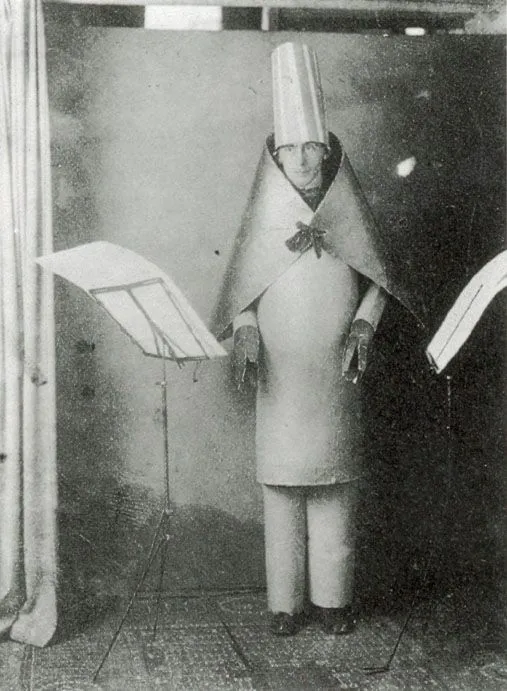
Ball, reading "Karawane", Club Voltaire, 1916.
There's a lot on how the schism between Byrne and Frantz/Weymouth grew, e.g. by Byrne refusing to tour and touring issues, not to mention how Brian Eno seems to have become a diva, e.g. by requiring that he only travel to the USA via Concorde.
Regardless of whether that's true or not, Talking Heads died. For a while.
Frantz and Weymouth started Tom Tom Club that had multiple successes, notably the tracks Genius of Love and Wordy Rappinghood, which propelled Tom Tom Club into focus with the growing hip-hop movement.
There's also the production of Happy Mondays in Barbados:
The following day, we waited for the band’s gear to be delivered from the airport. While we were hanging out, trying to get to know each other and understand the band’s Mancunian accents, we heard screaming from outside the studio. The studio was very private, surrounded by sugar cane fields and located way back from the main road.
What the ruckus was about was that Mark “Bez” Berry, the band’s dancer and maraca shaker, had been doing donuts with his newly rented open-air Jeep in the sugar cane field and flipped the car, which landed right on his upper arm, shattering it and nearly cutting it off completely. Somebody brought Bez into the studio lounge while we tried to get an emergency doctor on the phone. I remember Tina staying with Bez and trying to hold his arm together while everyone else tried not to freak out. Tina was a steady presence no matter what was happening.
His arm looked really, really bad. Eventually, an ambulance arrived and took Bez to the hospital. When he returned later that evening his arm was held together with some contraption resembling the Brooklyn Bridge. Of course, Shaun wanted Bez’s painkillers.
All in all, this is a book that's filled with anecdotes and other types of fragments, all glued together by two things: Frantz's love for Weymouth and his severe dislike of Byrne. I recommend it for reading if you want a fairly terse glib insight into Talking Heads and to read gossip about celebs.
Remain in Love is published on 2020-07-21 by St. Martin's Press.
Posted from my blog with SteemPress : https://niklasblog.com/?p=24875