

For nearly a month, the number of daily transactions has been between 150,000 and 200,000. So approximately at the level we had in early 2016. Is it Segewit, Batching, Lightning - or did people just stop using Bitcoin?
There was a time when I saw the number of daily transactions as the most important indicator of Bitcoin. If I remain faithful to this perspective, the current trend is not exactly pleasing: The number of daily transactions has fallen from more than 300,000 in December - peaked at 375,000 - to less than 200,000. Thus, the activity on the Bitcoin blockchain ranks at a level that was so low at the beginning of 2016.
The number of daily transactions for about 2.5 years. Source: Blockchain.info

Sure, you could of course say, and rightly so, that not the number of transactions is the important indicator, but the value of the Bitcoins sent in dollars. Then the chart looks very different.
The volume of daily transactions in dollars. Source: Blockchain.info

However, it is a little questionable what the hen and what the egg is. Is the increase in price a consequence of people sending more value to Bitcoin - or are people sending more value because Bitcoin has become more valuable? Who knows how Bitcoin transactions work, understands that it is not possible to send more money when the price rises. You could certainly discuss this further. Here, however, we focus on the variable of the number of daily transactions, for the sake of simplicity. So, what is it? Let's look at the possible explanations.
Is it due to SegWit? No definitely not. Although around 30 percent of all transactions now involve SegWit transactions, which increases the average block size to about 1.1 to 1.2 megabytes, SegWit does not reduce the number of transactions, so it has nothing to do with the issue itself.
More realistic is the assumption that the Lightning network is effective. Because Lightning brings offchain transactions, which means they are not included in the count of daily transactions. With Lightning, it would be possible for the statistics to persist in 150,000 transactions, while in truth several millions of transfers take place. It would be a good explanation, but it is unlikely. Because the Lightning network stagnates for several weeks at a little less than 2,000 channels. In some parts, it is even declining. It is unlikely that this activity will be significant on the whole.
Let's have a look at the topic of batches. Batching means that exchanges and other platforms do not send transactions individually, but bundle them into packages. In the course of the extreme fee peaks in December and January, more and more exchanges have begun to do that. For batching, the size of the blocks, unlike the number of transactions, is much higher than it was at the beginning of 2016. The correct value, which is why some people say, is no longer the number of transactions, but the total number of outputs, since each output is in one batching transaction is equivalent to a single transaction.
The number of outputs per block for one year. Source: outputs.today
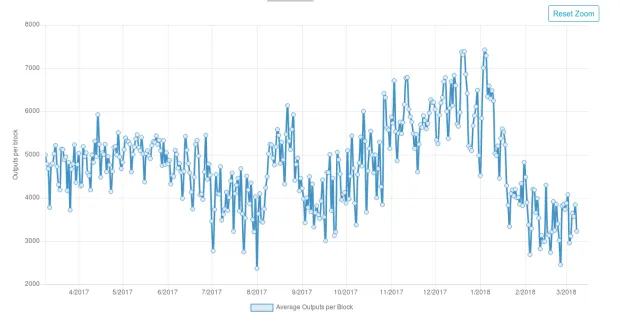
However, this value is not much sunnier. Also in terms of outputs Bitcoin is currently at a low point. When you make transactions, in the simplest case you take an input and transform it into two outputs - one for the receiver, and one for the change. So, if you make five payments individually, you'll get 10 outputs. If you batch the five payments, you only get 6 outputs.
This darkens the actual effect of batching. However, one may like to assume that it turns out to be significantly larger than can be seen in the charts. In theory, the approximately 500,000 outputs available today could equal several million outputs without batching. It is possible that the true number of Bitcoin transactions is currently at an all-time high, but not in the charts.
Batching is certainly part of the answer - but probably not all. Because it is undeniable that the high fees and the hard-to-calculate time for confirmation, which have shaped the user experience of Bitcoin in December and January, but also repeatedly broke out in the months before and after, led to a decline in actual use to have. For example, Steam has stopped accepting Bitcoin, and many people have stopped using Bitcoin as a common currency to order pizza or print products, for example, after some very negative experiences. At the same time, Monero seems to be taking Bitcoins first place, in the Darkweb which is not surprising as Monero transactions are faster, cheaper and more anonymous.
This decrease in Bitcoin usage is far less negative than you might expect for many in the Bitcoin scene. Why use a power money like Bitcoin to buy games on Steam or have pizza delivered? If the blocks stay small, it will keep Bitcoin decentralized, and if this has the effect of displacing business models earlier than late, which in the long run have no place on the blockchain, then that is welcome.
However, how much of a decline in actual transactions really is can be as hard to quantify as the effect of batching. So, as is often the case, in the end we end up with the answer that it is a little bit of this, and a little bit of that, but we can not even begin to say which parts. We can only say that there may be an actual decline in economic activity, but it is probably much smaller than one might think at first glance.
Image Sources:
- Post header created by myself
- Blockchain.info
- outputs.today
Have a nice day!

LOVE&LIGHT
