
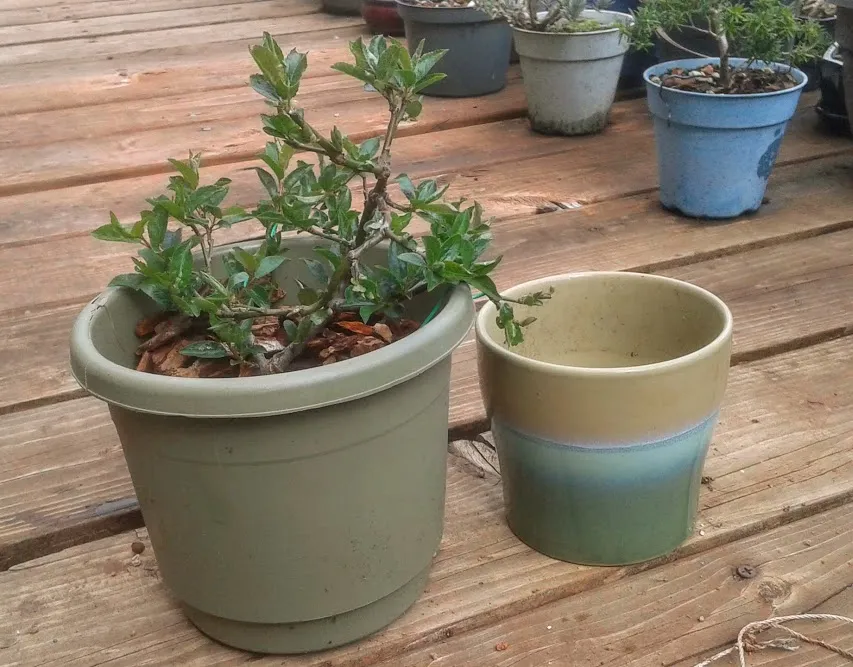
Today I share one of my bonsai trees as I prepare it for Spring transplanting.
This young cherry tree has grown very quickly over the past year. It has not outgrown the pot, but the pot is showing signs of cracking. Also I think the soil I used for this tree will not be rich enough to nourish this tree for the growth it wants to build. I'd like to get under the soil and see if the roots are healthy or rootbound.
For me, that is reason enough to transplant the tree.
Historical Information
ID: 0031
Nickname: Unnamed Tree
Type: #Cherry
Age: 3 years
Grown: cutting from branch
Last repotting: Martch 29, 2020 (featured in this article)
Wired: June 16, 2019
Past articles featuring this tree:

Front View

This tree has been wired a few times. I've been encouraging the trunk and branches to turn outward as much as possible. These will become the thick low branches for what will one day become a taller, majestic old tree.
Top View

The interesting thing about the shape of this tree is the S-curve which makes a balanced Yin-Yang symbol.
Trees do not normally grow this way in nature. I was able to force the tree to grow branches into these directions by using the wire to train to follow around the rim of the pot.
Now that the plastic rim is cracking, clearly this pot is no longer functional to support the tree.
Preparing the New Pot

The new pot is a ceramic pot with one single hole in the bottom. This is a smaller pot, but more proportional to the actual shape of the tree. It will provide better strength and insulation from extreme temperatures. A good home to last for years.

To prepare the pot, a simple screen material and a wire is looped through it. Making the mickey mouse ears in the wire is a method for keeping the screen flat against the pot, while also securing it with the wire bent underneath so it does not shift around.
I used a larger screen material for this pot because it only has one hole. It needs lots of open space for water to drain. The soil will also need to be super fast draining to prevent the hole from clogging up.
Looking at the Roots

Upon releasing the tree from the pot, I noticed a different strata of soil layers were used in planting this tree.
The entire bottom third of the soil fell apart into a loose mound. All dark gray smooth rocks.

This layer of rocks is not supporting any root life. It is providing a good function though. We call this the aeration layer. Since the rocks are smooth edged, they hold no moisture or nutrients. Water simply slides right through the air spaces between them.
I'll probably reuse some of these rocks again, as they appear to be very effective at preventing the tree roots from becoming bound and spiral at the base of the pot.
Root Pruning

The upper layers of soil appear to be mostly pumice and tiny pine bark pieces.
Now that the tree is becoming more developed, I do not need to hold back. I can give it a better quality bonsai soil which will give the roots more nutrients and structure.
Normally I do not rake away the soil completely, but in this case I think I will, to replace the old soil with a better quality bonsai soil. This will also facilitate root pruning. Root pruning allows me to train the roots to grow into the solid directions that will support the most sturdy strength to hold the tree upright.

Just under the trunk of the tree, I notice an intersting situation.
Here we can see where the original cutting was made. The old branch it was cut from has rotted away into a stumpy end under the soil surface.
Since there is a bizarre diagonal root already trained to head backwards, it makes sense to cut off this old stump end, and allow the new root to support the tree on this side.
But I'll also need to rack out the clump of roots underneath. At this moment I have no idea what all these little roots are attached to. They could also be coming out of the right root, the left roots, or more likely, they are all criss-crossing and mixed up all together.

Here I show the tree after the soil has been raked out, and the roots have been separated.
Some long, thin roots were also trimmed off. The idea is to keep the roots proportional to fit inside the space of the new pot.
About a fifth of the total root mass was removed in the soil raking process, which I do gently using a chopstick. These are likely to die anyway, as they were the weakest roots that fell off with minimal touch. Then about a fifth more of the roots were strategically removed. Anything too long or crossing through and weaving through other roots removed.

The old root stump I removed was mostly dead anyway. I cut it off against the trunk where the living tissue was green. Maybe new roots will grow out from this fresh cut mark.
Replanting

This is the fun part.
Like I said, I reused some of the old aeration soil on the bottom layer. I had enough for a good 1/2 layer at the base. Then I held the tree inside the pot will backfilling with fresh bonsai soil. A chopstick is used to pack the soil in tightly around the roots. This shrinks the air pockets, and holds the tree in tightly. Cherry tree roots are made of very strong flexible wood, so it is okay to be aggressive.
Even my fresh soil, I mixed in some old bonsai soil from past projects. Old soil can be dried out and sifted, and it works fine. Any old soil with a good balance of pumice, akadama, and lava rock went into this batch. A few little bits of moss, pine bark, or dirt mixed in isn't going to be a problem as long as the soil is mostly aggregate gravel in structure. Too much organic material, and it will rot the roots because it will not release the moisture between waterings.
This new soil contains akadama and lava rock which the tree did not have access to before. My hope is this will help hold more nutrients and moisture to nourish the roots.

The old wire marks have left a gnarled edge on the bark. I expect as the tree swells with growth, these wire marks will likely disappear over time.
For now it gives the tree a nice aged look, and a clear focal point near the open nebari.
A Week Later

This tree has had a happy transition. It's full of life and and health. Looking forward to seeing what this tree will become.
Happy Easter


Photos in this post are all #originalworks by 
Find me on discord and chat with other tree growers, bonsai enthusiasts, and gardeners.
No memberships. Love trees. Make friends. Grow together.
#root #roots #branch #branches #pruning #root-pruning #bonsai-wiring #cherry-tree #spring #diy #hobby #how-to
