
English is not my first language. That's why I use https://www.deepl.com/translator. I write the text first in my native language and then again simplified for the translator. That's why the two texts are slightly different and the Czech one contains more information. But I want to present mainly my photographs.
Before the Second World War, there were approximately 120,000 Jews living in the territory of the former Czechoslovakia. About 90,000 were sent to concentration camps by the Nazis, 30,000 escaped abroad or went into hiding. Of those sent to concentration camps, barely 5,000 survived.

Před německou okupací v roce 1938 žila v Československu početná židovská menšina. Je těžké napsat, kolik zde žilo Židů a židů přesně. Kdo byl nacisty označen za Žida, vůbec se jím nemusel cítit. A naopak.
Československo bylo zbaveno Sudet. Slovensko vyhlásilo samostatnost. Jeho část si uzmulo Maďarsko. Včetně Zakarpatské Ukrajiny. Část území obsadilo Polsko. Na našem území se ocitli židovští emigranti z Rakouska a Německa. Někteří si stačili vyřídit naše občanství. Žili tu i jiní státní příslušníci považovaní za Židy. Zmatek.
Uvádí se, že tu žilo asi 120.000 osob považovaných nacisty za Židy. Asi 90.000 bylo nacisty deportováno do koncentračních táborů, z toho bylo zavražděno na 80.000, asi 5.000 holokaust přežilo. Asi 25.000 stačilo emigrovat nebo uprchnout, skrývat se nebo jinak uniknout.

Rather than big numbers, a concrete example is better. Forty-three inhabitants of the town of Bechyně were sent to the concentration camp. One returned. In memory of these citizens, this memorial plaque has been installed in the town.
Jak říkával J.V.Stalin:"Smrt přítele, to je tragédie. Smrt milionů, to je statistika." Z města Bechyně bylo do koncentračního tábora odvezeno 43 osob. Vrátil se jeden muž. Na paměť toho je před hřbitovem umístěna tato deska.

Jews settled in Bohemia from the 10th century onwards. They established synagogues and cemeteries here. Later they were enclosed in ghettos. They were only allowed to move out of the ghettos during the reign of Joseph II, 1780-1790. They formally became full citizens in 1848.
Židé procházeli Českými zeměmi zaručeně od 10.století. Usazovali se tu. Zakládali si své modlitebny a hřbitovy. Časem byli zahnáni do ghett, ve kterých byli drženi do osvícené vlády Josefa II. Tehdy získali nějaká občanská práva. Plného občanství dosáhli v roce 1848. Formálně.

They were selling land to Jews that nobody wanted. It was rough, rocky, barren, far from the cities. The Bechyně cemetery is a bit of an exception. It is located just outside the city walls. It was built sometime after 1650.
Židovské hřbitovy bývaly umístěny na místech, která se nikomu k ničemu nehodila. A tak tyto pozemky prodali Židům. Zpravidla to bývalo daleko od měst.
Bechyňský hřbitov je výjimka. Vzikl v polovině 17.století těsně za městskými hradbami, které jsou vidět na mnoha mých fotografiích.

The Jewish community gradually bought the area of the filled-in ditch and in the 19th century also the old barn, which was demolished. Burials began there as well.
Židovská obec si postupně odkoupila část zasypaného hradebního příkopu a dokonce i selskou stodolu, na místě které se začalo pohřbívat v roce 1876.

The cemetery is maintained by the town of Bechyně and the Jewish Religious Community in Prague. But most of the graves have no one to visit them. The Nazis murdered entire large families and old families.
Hřbitov je udržovaný městem Bechyně a Židovskou náboženskou obcí v Praze. Na většinu hrobů ale nemá kdo chodit. Nacisté vyvraždili celé velké rodiny a staré rody.

Every time I visit a city on vacation, I try to visit the local cemeteries, including the Jewish cemetery. Christian cemeteries are comforting. The people here died mostly of natural causes. But the Jewish ones remind me of the tragedy of an entire nation and of individual families and people.
Vždycky, když o dovolené navštívím nějaké město, snažím se navštívit i místní hřbitovy, včetně židovského. Křesťanské hřbitovy mě spíš uklidňují. Lidé tu zemřeli většinou přirozenou smrtí. Ale ty židovské mi připomínají tragédii celého národa i jednotlivých rodin a lidí.

In Jewish cemeteries and graves, I look for and find the familiar symbols and requisites required by Jewish religion and tradition.
A common symbol is the "teapot". It means that a member of the tribe of Levi, who maintained the ritual purity of the priests and the Jerusalem Temple, is buried there. Another common symbol is the blessing hands. Here lies someone from the tribe of Cohen, the priests of the original temple.
Na židovských hřbitovech a hrobech hledám a nacházím známé symboly a náležitosti, které vyžaduje židovské náboženství i tradice.
Častým symbolem je konvička. To znamená, že tu je pohřben příslušník kmene Levi, kteří pečovali o rituální čistotu kněží i Jeruzalémského chrámu. Dalším symbolem jsem jsou žehnající ruce. Tady leží někdo z kmene Cohen, z kněží původího chrámu.

This is the "crown of wisdom". Here is buried a wise, respected man, a Torah scholar. There are other symbols here.
You can tell from each inscription on the grave whether a man or a woman is buried here. (The first word is "ben" = son, or "bat" = daughter.)
By the length of the inscription you can tell how respected he was in his community. You can see symbols of grapes, mourning willows. Each of these representations has its own meaning.
I admit that my ability to read Hebrew inscriptions is very limited. I have to carry a tablet of letters with me. If the writing is very ornate, I cannot read it completely and correctly.
Koruna moudrosti. Někdy je pouze vytesaná, jindy tvoří tělo hrobu. Tady je pohřben moudrý, respektovaný člověk, znalec Tóry.
Jsou tu i další symboly. Z každého hrobu vyčtete, jestli je tu pohřben muž nebo žena. (Bat - dcera, Ben - syn.) Podle délky nápisu poznáte, jak byl vážený ve své komunitě. Můžete tu vidět symboly hroznů, smuteční vrby. Každé takové zobrazení má svůj význam.
Přiznávám, že moje schopnost číst hebrejské nápisy je velmi omezená. Musím s sebou nosit tabulku s písmeny. Pokud je písmo velmi zdobné, nedokážu ho přečíst úplně a správně.

The oldest graves, here preserved from the end of the 18th century, bear inscriptions only in Hebrew. Later inscriptions are German-Hebrew. The very last inscriptions are Czech-Hebrew. The graves in the newer parts of the cemetery are placed in lines.
Nejstarší hroby, tady jsou zachované z konce 18.století, nesou nápisy jenom v hebrejštině. Pozdější nápisy jsou německo-hebrejské. Úplně poslední nápisy jsou česko-hebrejské. Hroby v novějších částech hřbitova jsou umístěny do linií.
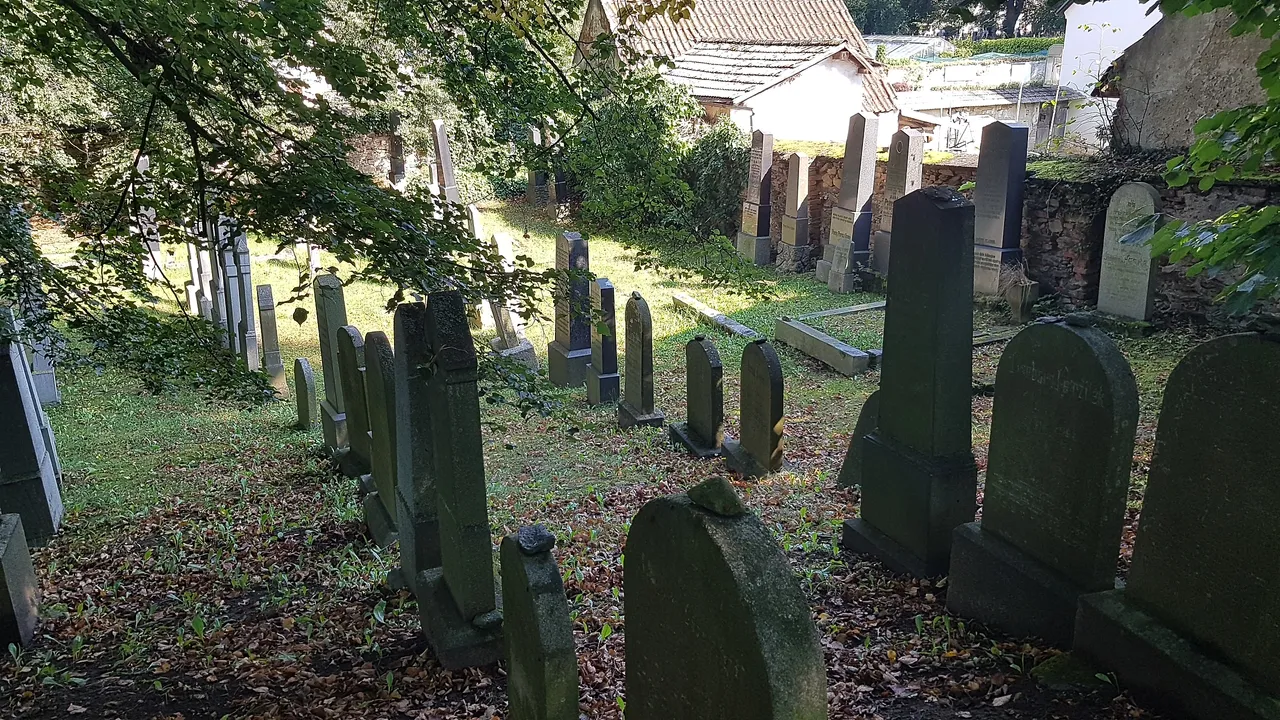
In total, we can identify 250 graves here. Visitors place stones on them. Jews once lived in the desert. When they put their dead in the sand, they put stones on the graves so that wild animals wouldn't dig up the dead. Passing by the graves, they would repair them, put more and more stones on them to protect them. Over time, this became a tradition.
The last burial here was in August 1942. But you won't find a headstone here. According to tradition, the Jews don't place the tombstone until a year after the burial. And a year after the burial of Mrs. Theresa Popper, all the Jews of Bechin were already moved east. Which is an ephemerism for their murder.
Celkem tu můžeme identifikovat na 250 hrobů. Návštěvníci na ně pokládají kameny. Židé kdysi žili v poušti. Když ukládali své mrtvé do písku, kladli na hroby kameny, aby divoká zvířata mrtvé nevyhrabala. Procházející kolem hrobů je opravovali, kladli na ně další a další kameny, aby je ochránili. Časem se z toho stala tradice.
Poslední pohřeb tu proběhl v srpnu 1942. Ale náhrobek tu nenajdete. Podle tradice umisťují židé náhrobní kámen až rok po pohřbu. A rok po pohřbu paní Terezie Popperové už byli všichni bechyňští Židé odsunuti na východ. Což je efemismus pro jejich vyvraždění.

I usually fall into melancholy at the Jewish cemetery. I probably shouldn't end on a completely pessimistic note, I noticed this beetle, Pyrrhocoris apterus. Probably there to make me realise that life triumphs over death. Thanks for that.
Na židovském hřbitově zpravidla propadám melancholii. Asi abych nekončil úplně pesimisticky, všiml jsem si ruměnice pospolné, Pyrrhocoris Apterus. Byla tam asi proto abych si uvědomil, že život vítězí nad smrtí. Díky za to.
This is the first time I am using the tags #travel, #pinmapple and #photographylovers . I hope I have complied with the conditions under which I can use the tags. If not, please enlighten me on how to do better next time. Thank you for reading the article.
Je to poprvé, co používám tagy #travel, #pinmapple a #photographylovers . Doufám, že jsem dodržel podmínky, za kterých mohu tagy používat. Pokud ne, poučte mě prosím, jak to příště udělat lépe. Děkuji vám za přečtení článku...
