
Nowadays printed music for keyboardists like organists, pianists, harpsichordists, etcetera uses almost exclusively the treble clef and the bass clef. Anyone who has had even the most basic music training, should be familiar with these clefs. The treble clef denotes the position of the note g in the onelined octave (C4 octave) and looks like this:
The bass clef denotes the note f in the small octave (C3 octave) and looks like this:
The treble clef is used for notes higher up the keyboard, generally from the central c of the piano keyboard and upwards. The bass clef is used for notes on the lower part of the keyboard, generally from the central c and downwards.


The alto clef denotes the position of the note c in the onelined (C4) octave and it looks like shown in the first image of this post. When we take as an example the central c of the piano (the c of the onelined octave, or C4 octave) it can benotated on the music stave by means of each of these three clefs, as shown below:
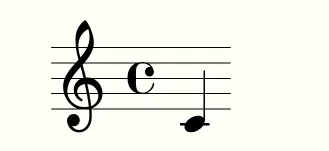


This example shows clearly that notes higher than the onelined c (C4) perfectly fit on the stave with the treble clef, and that notes lower than the onelined c perfectly fit on the stave with the bass clef. So, why is there an alto clef? The alto clef comes into play when you want to notate a melody or a part that moves around the onelined c and you want to notate it in one stave. Take for example the next few bars:

These are the first four bars of the second verset of a partita on the melody of "Ich ruf zu dir, Herr Jesu Christ". It is an anonymus piece that can be found in the Luneburger manuscript KN 209. It will be published on my website, but I have yet to make a decision that is part of the subject of this post.
The upper stave in the example above is for the right hand, the lower stave is for the feet. The middle stave is for the left hand. The notes of the left hand part range from d in the small octave (C3 octave) to the c of the two lined octave. It can be perfectly notated with the alto clef, with hardly any ledger lines necessary. In this way the music takes up less space on paper and the overal image of the music is easy and balanced. If every organist could read the alto clef, my work as an editor would be done. As it is, however, hardly any organist can read the alto clef, so I have to find a way to notate this music using only treble and bass clef. How does this music look if the left hand part is notated with the treble clef? Let's see:
As you can see, the fourth bar is already very hard to read because of all the ledger lines. And all those ledger lines push the pedal stave down, leaving an ugly gap between the lower two staves. Such a large distance is not only ugly, it is difficult to read as well.
What happens if we render the left hand part with the bass clef? Let's see:
Now, that's hardly an improvement. The problems are the same, only this time they manifest between the middle and the upper stave. The result is the same, ugly and difficult to read. An intermediate solution could be to switch clefs when appropriate. If the part is above the onelined c, use the treble clef. If the part is below de onelined c, use the bass clef. What could possibly be wrong with that? Well, have a look:
As it is two part writing, there never is a clear cut distinction between 'above onelined c and below onelined c'. So you have to compromise and seek spots to cleverly insert a clef switch in such a way that not more than two ledger lines are needed in either direction. Those spots are not always available and the result is an unneccesary gap between both the upper two and the lower two staves. Sometimes this solution works, but in this case, it really doesn't.
Luckily we're not yet out of tricks. It is also possible to use a transposing treble or bass clef. The idea is to use either a treble clef or a bass clef and tell the player that the part is to be played an octave higher, or an octave lower. When we use a transposing treble clef, the result would be (note the little eight below the treble clef: it means 'play an octave lower than notated'):
Okay, acceptable, though personnaly I am a bit irritated about the transposing bit. The result with a transposing bass clef is more or less the same (note the litlle eight above the bass clef, it means 'play an octave higher than notated'):
Graphically, the result is acceptable in both cases, though there is always the risk that a player overlooks the little 8 and plays entirely the wrong notes.


Of these two tricks I favor the 'play an octave lower than notated' solution. It seems a little bit more natural though I have no real arguments for it. So, I am still undecided which is the best one, and which I should use in the version I'll eventually publish. If anyone has a good reason to chose for either one, I'd love to hear it.
Now, if the only reason to learn the alto clef would be to make my life as an editor more easy, it would be a meagre one. There are however, more reasons. For a large part of musical history, musicians could easily read all existing clefs. A large body of existing manuscripts is therefore notated more often in alto clef or some of the clefs I'll mention below than in treble of bass clef. And a large body of existing manuscripts is still unedited. If you want to play them, you can either send them to me and ask for a transcription in treble and bass cleff, or you can learn to read the alto clef and play directly from manuscript. Bach uses these clefs in his organ music as well. There is nothing more inspiring than playing Bach from a copy of his autograph. But in order to do that, you have to be able to read the alto clef.
And not only the alto clef. The alto clef is just one of five possible clefs to indicate the position of the onelined c on a stave. Going from the upper stave line to the lower, there is the
Baritone clef
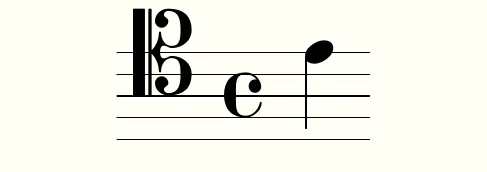
Tenor clef

Mezzosoprano clef

Soprano clef

If you've mastered to read the alto clef, these other four are easy to read as well. And that opens yet another large body of manuscript music to play. Or, to stay with Bach, consider the fact that his choir music is almost entirely written without treble clef. It is again very inspring to read his music in his own handwriting, but you can only do so, if you can read all these different clefs.
And there is a final reason, perhaps the most important one for any keyboardist. Suppose a onelined g, written with the treble clef on the second line of the stave (counting from below). What happens if you imagine a mezzosoprano clef at the front of the stave instead of a treble clef, and you read the same note? It is suddenly a c instead of a g. And you play the same music a fifth down. In other words: instant, a prima vista, transposing!
As an organist this is really a very valuable capability. It becomes for example possible to use a Quint 2' 2/3 as a solo stop: just imagine a mezzosoprano clef an easily play the same part one and a half octave down.
To all organists and other keyboardists out there who happen to read this: do yourself a favor and learn to read the alto clef!!
And as an apetizer for a next post: do you know why in English the onelined octave is called like that?
[