
Let me begin by acknowledging that this idea is controversial. I have had many friends and acquaintances give me feedback, and now I am about to see if the concept can stand up to the criticism of a much wider, and likely, more knowledgeable audience.

I am not a Luddite, having lived my entire working career in the shadow of computers. We were told back in the 70's, that Technology would give us the Golden Years at the Millennial change, truly believing Technology would triumph, and life be wonderful, as we all hoped. I saw little of that – oh sure our phones got smaller, and more powerful, the Internet spanned the globe, but why did the Wealth/Poverty gap widen? Why does the number of wars/conflicts continue to increase since we began the Agriculture period? The trends I see, are worsening not improving as we had hoped and expected.
It is frivolous to assume Governments, National Special Interest Groups, Big Business, the Financial Industry, or even groups of Scientists and Engineers will rise to all the challenges we face today. I list 26 world problems here:
that individually have much activity on-going from the above-mentioned groups, but I see no Collective plan, one where are each of the these issues are brought together for a common solution - one where they collectively foster Synergy. Yes Philanthropists will eradicate diseases, improve health, develop new untested technologies that are calculated to reduce global warming, extend the nutrition or volume of crops grown, and so on.

But I think we can do better.
My solution is based on Practical concepts everyone can relate to.
Occam's razor suggests that often the simplest solution is the best one - and so we have SIMPLE. Mahatma Gandhi, practical in his wisdom, created what now approaches 700,000 small villages across India,
Village on a hill near Ooty in Tamil Nadu, India (ROYALTY-FREE STOCK PHOTO - Dreamstime)
with an average size of about 1,300 people - and so now we have SMALL.

It is not necessary to be trained as a Scientist, preparing to send a human to Mars to understand our Spaceship Earth[1] has a limited on-board supply of life-sustaining materials - and so we add SUSTAINABLE.
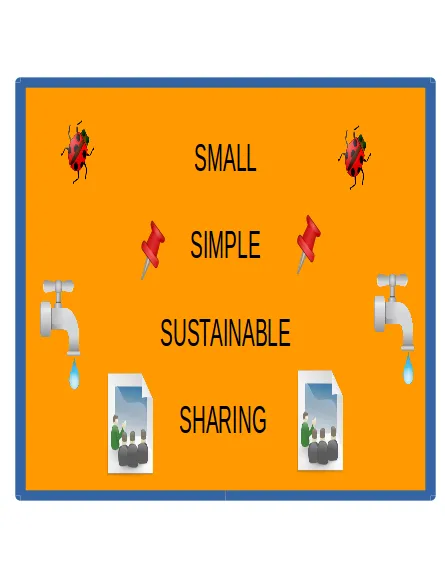
In summary at this point, I suggest we need a Small, Simple, and Sustainable lifestyle.
Most understand at the most basic level - that the Physiological Needs must be met - Clothing, Shelter, Food, Water and Energy - for each human.
The Simplest way to provide these Basic Needs is by having the target group ('the Poor') produce these things themselves.
My research, computer models, and simulations suggest the minimum sustainable Community size is about 200 people and the maximum should be around 1,000 individuals. A place where there is sufficient arable land for a 30 hectare community Farm and about 20 hectares for the people, services and lite Manufacturing.

Does this seem feasible?
A Small community with about two hundred or so houses - for Families and Singles. A community where about 40% of the working-age adults work - growing food and fiber, maintaining services and making the Basic Needs for their Village.
One more letter 'S' word to complete the picture.
The Small community fosters Cooperation, builds Compassion, Caring and Trust. No need for Insurance - your neighbors will be there to help in emergencies and in a disaster.
So why not revert to Total SHARING as we did before the start of the Agricultural Period?
As an added Benefit, we get a Bonus when we combine all 4 'S' words - Small Simple Sustainable and Sharing - we get the Synergy of more than the individual parts compared to when each is taken separately. Synergy we could never expect now, because of the way we are currently organized.
Implementation?
A “Sharing Zone” for 'the Poor'. Politicians must, of course help 'the Poor'. Government and Big Business too, even Banks and Philanthropists can relate to the 'Poor' and their Need to “help them, to help themselves”.
So how does this Eliminate World poverty within a generation?
Simple.
Each Village replicates itself, once per year until we have a little over one and one half million Small, Simple, Sustainable, Sharing Villages across the planet - poverty gone!

Do you think this would work?
If not, why not?
If so, let's get started today...
[1] R. Buckminister Fuller
- Operating Manual for SpaceShip Earth(1968):

Main Image (By:© Nevit Dilmen [CC BY-SA 3.0 (http://creativecommons.org/licenses/by-sa/3.0) or GFDL (http://www.gnu.org/copyleft/fdl.html)], via Wikimedia Commons)
Doc: created with StackEdit.