
Kari Qalamdane

Hello Dear Friends,
This is my eighth article in my series of Crafts Unparalleled where I discuss incredible Indian craft; artists of these should be celebrated. Today I bring to you a beautifully handcrafted art from the so-called ‘jannat’ (heaven) in India.
Papier Mache is a Kashmiri handcraft that uses paper pulp as a base and then it is richly decorated with drawing with a pen. A range of products are made like boxes, vases, lamp stand, trays, frames, bowls, coasters, and home decor. The art is driven by a dual process of creation of papier Mache products and clearing of forest pine. The word Paper Mache is an adaptation of French Papier Mache, which was used by French trader to define the Kashmiri decorative boxes in which Pashmina was sold.
History of Papier Mache

This craft like many other Indian crafts has its genesis in the 15th century and it hails from Persia. The Indian contact with Persia during this time was crucial for the cross-fertilization of art forms. During the 15th century, Kashmir was under the reign of Zainul-Ab-Din, his reign saw the light of Sufism. There are two anecdotes for the origin of this craft; one where it is believed that Mir Sayyed Ali Hamdani, one of Sufi mystic arrived in Kashmir in the 14th century with several craftsmen who were experts with pulp art. The second anecdote is about Zainul-Ab-Din’s detention in Samarkand in Central Asia, when he returned to kashmir; Iranian artists accompanied him. They settled in Kashmir with the patronage of the king.
The craft is called Kari Qalamdane in Persian and it means pen stand. Initially making of pen stand was the main artifact but later the range of products increased. The craftsmen are called sakhtas. The craft gained popularity as it was replacing the art of drawings on wood with art covering made of pulp. During the Mughal era rule over Kashmir; the craft expanded as a decorative to cover furniture, architecture, and goods of exchange; papier mache was used on woodwork. The few architectural decoration with papier mache are the Madin Sahib Mosque, Shah Hamdan Mosque in Kashmir and the Shalimar Garden in Srinagar.
The Technique
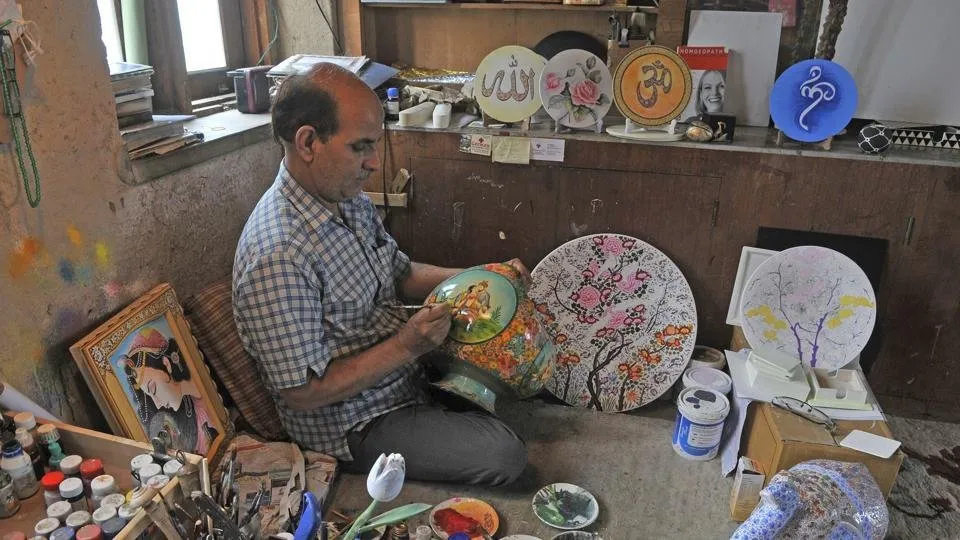
The first step is to obtain pulp for the craft; the main ingredients for this is discarded paper, rice straw, copper sulfate and clothe. Paper is made into pulp by soaking the paper in water for few days then drying it. The dried pulp is then grounded into powder, this power mixed into rice water and then applied to molds. This pulp covering is layered with a muslin cloth and then another layer of plaster (gutchi) is applied to obtain desired surface and shape. The artwork is then removed from the mold and rejoined with a glue. The surface and object are polished for painting.
On this surface, ornamentation is done by naqqahgar, once the surface is covered with a white solution made of gypsum and glue. The colors used in painting are naturally obtained. The object is treated with gold and silver foils along with paste of glue and chalk. The object is dried and surfaces are polished with baked brick. A layer of varnish is used and it is sun-dried and then again painted. A process of repetitive consecutive stages of treatment, ornamentation and sun drying takes place till the final design obtained and painted. Nowadays gems are also etched with pulp.

Sustainable Art
All the colors used are natural, the pen for drawing is made of cat hair or donkey hair. The process involves waste paper. Every piece is a laborious masterpiece with the utmost creativity of the craftsmen. the craft received geographical indication and is also promoted by the government. In Kashmir, schools have courses on this art.
If one visits Kashmir; this is a must-have souvenir.
Image Source:
http://www.kashmirresourcesexposition.com
https://jtdytravels.files.wordpress.comhttp://www.hindustantimes.com