
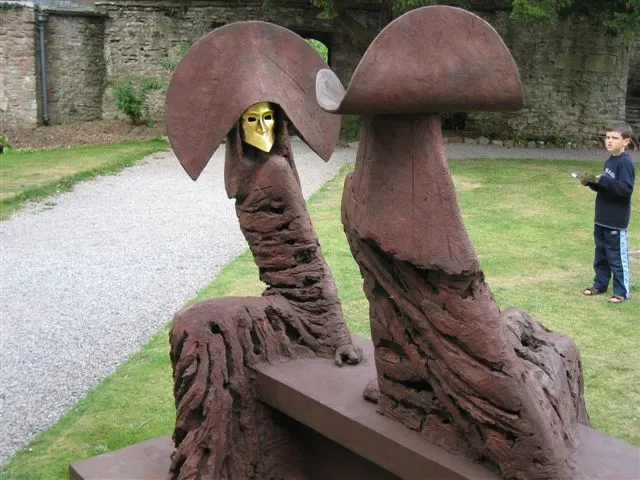
(That's Ping in the corner)
Image Credit: By Steve Lee from England - IMG_0774, CC BY-SA 2.0, https://commons.wikimedia.org/w/index.php?curid=19961430
Han, Reign of Gaozu year 1, Outskirts of Luoyang, Cemetery
“Good evening, sage of Tao. Contemplating mortality amidst our ancestors?”
“Good evening, scholar of Confucius. Life and death are one; it is only our perspective that shifts. My perception detects an uninvited company, hidden amidst the bushes over yonder.”
“Oh, Ping? An imperial . . . escort shadowing my movements; no doubt, for my protection.”
“It seems that the king suspects much.”
“They call themselves emperors now.”
“Bah! Truly, the arrogance of men knows no limits! Given time, they will confer upon themselves even divine titles.”
“Ha ha ha! Most men are overly concerned with appearance, rather than substance. Our good emperor honors me greatly by assigning an acolyte of our organization to accompany me to our meeting.”
“Ping is one of us?”
“A lower acolyte with limited training and abilities, but one who possesses the virtue of loyalty.”
“Unlike the traitor . . .”
“Yes, the nameless one. Even from beyond the grave, he nearly derailed me from our purpose.”
“Then the fool king has agreed to your suggestion of . . . reforms.”
“Oh ye of little faith! To think that you had doubts as to my success against an untrained Qin captain!”
“That fool . . . Ping was it? He is harassed by mosquitoes. Is he not even proficient at qi projection?”
“Not all men are so gifted in the internal arts, as you my apprentice. For Ping, it would take several of his lifetimes to master the qi arts, as you have so effortlessly accomplished.”
“Hmf! It was not effortless, master. Yet, how is he to offer protection, when he has not even grasped the basics of the internal arts?”
“Ha ha! You are an ambitious one! Do you think yourself a match for my skills?”
“Perhaps your overconfidence is your weakness.”
“Aha ha ha! Strike me down, and I shall ascend to a plane of existence beyond your comprehension.”
“. . . has that Taoist bluff ever worked to your favor, master?”
“No, every time one of my apprentices had to be personally . . . corrected for their hubris.”
“If there is a flaw in our organization, it is this profligate waste of resources in internecine conflict of advancement. Since the catastrophe due to the betrayer, you have . . . corrected five, six apprentices?”
“Eight. And two inner circle challenges.”
“Eight including the betrayer?”
“Ah! Then nine apprentices were corrected, since his defection. Qin Shi Huang was indeed a formidable adversary.”
“Yet, the Qin emperor remained mortal. Your apprentice did not gift his new liege with longevity, or was that knowledge denied him during training?”
“Ha ha! Your . . . yes, Li Si was my failure; I did not discern the flaw of idealism bubbling within Li Si, when assigning him to undermine the Qin system. Li Si’s apostasy, we suspect, has been more influenced by the force of Qin Shi Huang’s personality than Li Si’s deficiencies.”
“Such perspective fits your narrative that exculpates you from your failures, master.”
“Ha ha! It is the narrative that matters. Besides, who within our organization will dare challenge the established narrative?”
“. . . for now, master. Death comes for us all; even gods must live their allotted time and pass away.”
“Indeed, but once I am dead, what would I care how the new narrative is constructed?”
“So, you don’t actually believe in the Taoist theory about ascension or oneness.”
“Aha ha ha! Have you been masquerading as a Taoist for so long that you have gone native? Did you forget that we basically invented Taoism from the tattered remnants of Laosi’s musings? Or did you actually believe in my Taoist bluff from earlier?”
“. . . there are two other inner circle members, master. Are you all in agreement regarding the . . . narrative concerning Li Si and the Qin emperor?”
“Do you remember Lue Buwei?”
“Of course. His life is a lesson that not even the inner circle is infallible.”
“Aha ha ha! Such a veiled threat, apprentice. You will be elevated to master at your allotted time; eventually, I will commit errors for you to exploit.”
“Ha! Do you also have an illegitimate child around whom you would design dynastic ambitions?”
“Perhaps. My flaws are for you to discover and exploit. Besides, how would you access the new emperor without my intervention? Who would recommend a mediocre Taoist, such as yourself, for the portion of imperial spiritual advisor?”
“And our acolytes will infiltrate the critical positions of Lu Bang’s kingdom. What of the king? Is he a fop or a threat?”
“The emperor is cautious without being paranoid, curious yet restrained, confident but courteous. He is intelligent enough for our purposes without being too clever. His greatest flaw is his near obsessive focus on accumulation of power without purpose.”
“He is no better than a merchant who compulsively hoards shiny things that clink; a perfect tool for our purposes. The . . . emperor has no grander vision for his polity other than holding on to his political position?”
“Yes. Sad, isn’t it? What use is power for he who has no understanding of its use?”
“Better a fool on the throne, than an idealist, master. Lue Buwei and Li Si nearly extinguished the flames of our organization.”
“Ah . . . the narrative states it is Qin Shi Huang, not his ministers, who doused the fire of civilization.”
“Of course, master. The untrained Qin emperor somehow cleverly out maneuvered the inner circle and even turned your apprentice against us.”
“Ha ha! What is the fundamental character of man?”
“. . . you insult me with such a basic question fit only as an instruction for a stage one acolyte?”
“Oh, I thought I was speaking with Ping, since you fail to grasp the primacy of the narrative.”
“Ha! I refuse the primacy of your narrative, master. I do comprehend the value of maintaining a useful narrative.”
“I am well rebuked. Lue Buwei and Li Si forgot this central quality of man, in their mad quest for utopia.”
“Discontent.”
“Yes. Man’s lot is to be discontented. Stable political order is merely a fiction to organize this turbulent impulse towards something more constructive.”
“After centuries of longevity, Lue Buwei became convinced of his own godhood, deluding himself into thinking he can change human nature.”
“Indeed, though we can train men to mitigate their base impulses towards societal disintegration, we must always be cognizant of men’s persistent discontent with their very being.”
“Mortality can be disconcerting to those gifted with consciousness.”
“Most men are unconscious, thus, their constant petulance towards their environment, society, and station. In truth, their rebellion is against the cold touch of death.”
“How would most men use longevity, if granted? For nearly all, discontent has been their defining identity. Their ignorance and cognitive bias governs all their actions and decisions. Even if they are presented with the waters of truth, they will prefer to drink the sand of lies. That these men are mortal is a blessing upon all of creation.”
“Discontent even afflict the trained.”
“So too, violent deaths, master.”
“Ha ha! By the time of your ascension, apprentice, the Han society will have been bound by the dogma of Confucian rituals and convention. When the inevitable political dissolution occurs, reunification would no longer last centuries. With our unification of the Xiongnu as a constant northern threat, the Han will not dare look beyond their shores, lest the horde march over the Qin wall. Kingdoms, like men, must also understand their limits and station in life.”
“And so, in this, as well as in thousand other journeys, we shall fare well.”
—fin—