
One of the things I love about gardening is that it requires creative practice for problems. In my post on water a few days ago, I mused about water as a resource, and how I was thinking about ways to prepare my garden for coming dry weather. I wrote that:
I was determined that I was right - that there was FAR more water wasted on products and services than would be wasted on my vegetables. Research found that for every dollar spent at the supermarket, you could count on 28 litres of water being embedded in these products. Production, agriculture, packaging, transport - they were using far more water than I was using to grown my own organic vegetables. Agricultural is response for about 80 percent of all water used.
These reflections on water as a precious commodity, and worry about the possibility of drought, led me to something I'd never heard about before - ollas!
Ollas are unglazed clay - or terracotta - pots used for water irrigation. They're used most often in Brazil, Iran and India, and I'm wondering why we don't use them here! You'll find a really comprehensive article here if you'd like to hear more about their use in permaculture.
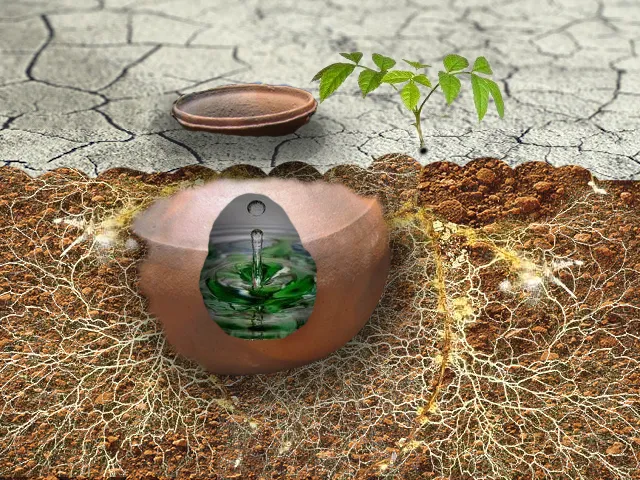
Image Source
The article informs us that:
The microporous (unglazed) walls that do “not allow water to flow freely from the pot, but guides water seepage from it in the direction where suction develops. When buried neck deep into the ground, filled with water, and crops planted adjacent to it, the clay pot effects sub-surface irrigation as water oozes out of it due to the suction force which attracts water molecules to the plant roots. The suction force is created by soil moisture tension and/or plant roots themselves.” (AE Daka – 2001.) The plant roots grow around the pots and only “pull” moisture when needed, never wasting a single drop. “Ollas virtually eliminate the runoff and evaporation common in modern irrigation systems, allowing the plant to absorb nearly 100 percent of water.” (City of Austin Water Conservation, 2006.) To use ollas in a garden or farm, one buries the olla in the soil leaving the top slightly protruding from the soil (ideally the neck of the olla is glazed to prevent evaporation or it should be reasonable to apply a surface mulch that covers the neck of the olla without spilling into the opening). The olla is filled with water and the opening is then capped (with a rock, clay plate or other available material to prevent mosquito breeding, soil intrusion and evaporation).
Wow. That's pretty cool! It means that you can ensure a water supply to your plants, especially young seedlings which can really suffer if you get a dry day and forget to water! You can also add fertilizer to the ollas for slow release nutrients. The use of ollas and their size will depend on whether you're using a container or what type of plants you have.

Image from Permaculture News online.
Of course, not living in Brazil or India, I wondered how I'd get access to ollas pots, whereupon I stumbled on this brilliant little gem:

She uses ordinary terracotta pots with the saucer as a lid, and blu tac to prevent the water coming out. This did NOT work for me - perhaps I didn't clean the bottom of the pot very well. In the end, I took three old terracotta pots that were lying around, and mixed up some concrete and placed at the bottom of the pot.


Too easy, right? Then, I dug holes and placed them where I was planting some eggplant and capsicum. I didn't have saucers, but I used lids from some gallon buckets that worked well. I imagine a rock or any kind of covering would work fine, and as the plants grow up, I'll mulch over the top of it to prevent further evaporation.

I'm really interested to see how long water will last in these pots on a hot day, and I'm interested to see how this will go in comparision to the wicking beds (I'll talk about these in another post) - basically, I'm setting up a garden experiment so that I have the same plant growing in 3 situations - no method (just mulch and the hose), the ollas, and the wicking beds. By the end of summer, I'll be able to tell you how they went!
This particular post was written in response to  's Earth Deeds initiative, which you can find here. writes:
I challenge everyone to start documenting their Earth conscious efforts on Steemit in a short post AT LEAST once a week. The more of us that show the rest of the world how easy it is to help the environment, the more people will also start taking action in their every day lives, and the impact you have with your otherwise "small" eco-friendly actions, will become even greater.
It's a great initiative and I encourage you to consider what you are doing to make a small difference on both local and global environments, write about it, and use the hashtag #earthdeeds so we can all find each other.
https://gateway.ipfs.io/ipfs/QmU9f4FK9j91cnUGYk9hnMXuYdAFcnF6ekkpXZ5DfiByfG


If you're a supporter of all things natural healing, you might like to read our introductory post here. We'd also love to welcome you on Discord here!!

 |  |
|---|


