

Yesterday @calaber24p published a very successful post on steemit, where he argued, that the coming mass automation movement will have the potential to start a class war. Some hours ago @kyriacos published already a reply to 

The fear of job stealing by machines is 200 years old
First I want to remind the reader, that the fear of machines that stealing jobs from humans is a least 200 years old. When the Cotton Gin was introduced in the US at the end of the 17th century, it could do with one man the work of twenty men. So, nineteen men were not needed anymore and had to find another job. Some of the men that were replaced by the machines in the textile industry began to destroy the machines. This „Luddites“, as they were called, had a strong belief, that technological progress will lead to mass poverty. That didn’t happen, but the fear of the job stealing machines lasts.
Louis Anslow gave in a lovely essay on timeline.com some examples of this fear from the last 100 years. He showed, that even Albert Einstein and John Maynard Keynes blamed the machines. The latter coined this phenomenon into to a handy term: „We are being afflicted with a new disease, technological unemployment“. The term was then widely used in the 1930s. Anslow showed, that Henry Ford had to defend the use of technology in an article in The New York Times in 1939. In the 1940s this fear was the subject of a debate between US President Franklin D. Roosevelt an the President of the MIT, Karl Compton, which was covered by The New York Times at Februar 25, 1940 with the thrilling headline: „DOES MACHINE DISPLACE MEN IN THE LONG RUN?":

Another nice example of this fear Anslow had found in the issue of THE NEW YORK TIMES from May 13, 1956: „AUTOMATION IN BRITAIN STIRS UNREST IN LABOR; Workers see ‚Robot Revolution‘ Depriving Them of Jobs“:

Louis Anslow provides in his worth reading essay more familiar looking examples of this fear of job stealing machines from the 1950s till the 2000s.
In the recent years the number of such articles did explode after two influential books to this topic were published. In 2009 the book „The Lights in the Tunnel“ by Martin Ford opened the debate. Ford was the first that examined the potential problem of a totally automated production. In 2015 he continued his arguments in „Rise of the Robots: Technology and the Threat of a Jobless Future“. Much more influential was „Second Machine Age: Work, Progress, and Prosperity in a Time of Brilliant Technologies“ by Erik Brynjolfsson and Andrew McAfee. The two MIT Scientists argued that because of the acceleration of technological progress, greater efforts had to be done in rapid updating our skills, organziations and institutions.

Many other books followed these. Some were rather pessimistic, some were more optimistic. I only want to mention here the 2012 published book „Robots Will Steal Your Job, But That’s OK: How to Survive the Economic Collapse and Be Happy“ by Federico Pistono - because he is a fellow Steemer: @federicopistono.
Why is there a fear of machines stealing jobs?
First of course: because they do. In the production sector machines are replacing men since the inventing of the Cotton Gin.

But this constant rationalization of production does not explain, why some people have a really deep fear of machines. In my opinion this is caused by a simple fact: machines can do many things way better than humans:

Machines can solve a Rubic’s Cube in 0.9 seconds:

They can beat humans at Chess, at Go and even at Jeopardy:

Ok, there are some things, were machines suck like humans:

Overall machines are better in all processes, were constant repetition, precision and calculation is needed. But this leaves plenty of room for things were humans have an advantage. Humans are particularly good in one thing: dealing with other humans.
To explain why I’m strongly thinking that robots will create more jobs, than they could ever destroy, I will present here a simple model, that explains the impact of technological change for the job market.
Why robots create more jobs than they could ever destroy
Let’s start with an illustration that shows how the technological progress had changed the US workforce from 1940 till 2010:
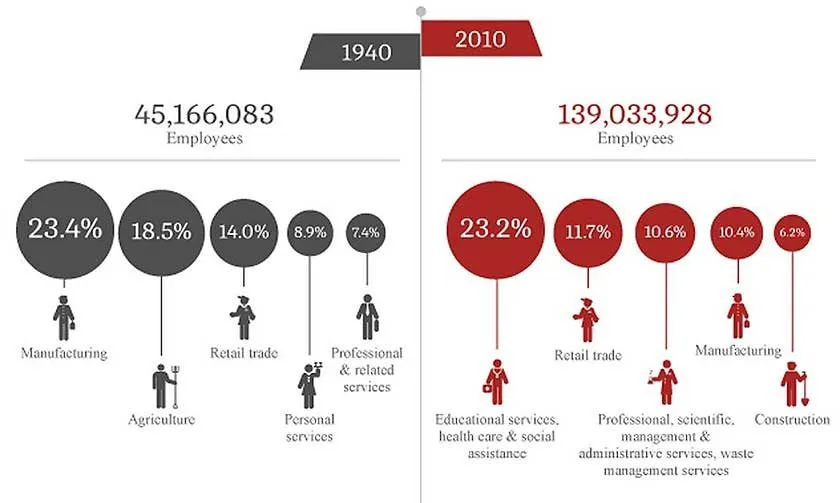
In 1940 the biggest part of the US workforce - nearly a quarter - was engaged in the manufacturing sector. In 2010 the manufacturing sector did only required 10.4 % of the workforce, whereas the biggest part of the workforce was engaged in educational services, health care & social assistance. Several assumptions can be made from this fact: First, the manufacturing sector became more productive. Less workers can 2010 provide the same or more products for a much bigger population thanks to the use of more and better machines. Second, education services are more important in 2010, because the workforce needs a higher skill level to work with more and better machines. Third, because of the higher productivity, the society has the wealth to finance a bigger health care and social sector. Agriculture, the second biggest sector in 1940, had in 2014 only a share of 10 percent of the workforce in the US.
Now let us create a different and very simple model of the economy to explain, why robots will bring new jobs. This simple model divides the economy in only two sectors. The first sector covers all the stuff, that is really necessary for living. Like housing, food, healthcare and everything that is needed to ensure this. Let’s call it the sector of essential needs. The second sector of the economy covers all the stuff that is a kind of luxury. Like very special goods and entertainment. Let's call it the luxury sector. To this second sector belongs a big part of the fashion and electronics industry. Also the entertainment industry which consists of the audiovisual media industry, the travel industry and of course the sex business. We can also add the cosmetic and longevity medicine sector, special and high cuisine food and some other stuff. There is much more, but you had get the point already.

Of course in both of these sectors there is constant automation taken place. But the second sector is different compared to the first. There are many businesses, where people-to-people interaction is a crucial part - and I’m not speaking about the sex industry. Creativity is crucial in this sector, as well as personality. People like to see people in movies or see they singing and dancing, they like to talk about people with other people, they like to met new people. The people-to-people relations could be assisted by machines, but it’s not possible to put a human long time in a fully automated environment and expect him to be happy - maybe with exception of some Japanese Otakus. The point of argument is: in this second sector there is a ever growing demand of jobs for humans. This could be creative jobs, service jobs or even jobs that are totally useless. And this second sector is growing every year.
Why is the second sector growing constantly? Because new demands can be created. Think of PokemonGo or a new fashion trend. And because the economy can effort to finance such (actual) unnecessary luxuries. Why that? It’s only because of the higher productivity of the economy and of the workforce. And where does this higher productivity comes from? From the the usage of more and better machines. That’s why robots create more jobs than they can ever destroy.
The society as a whole is becoming richer. Of course there is a chance, that few become very rich an many become poor. And there is absolutely the chance of a class war, that
But good governance assumed the robots will bring many new jobs. Especially in the luxury sector. And maybe some day, even some robots will enjoy some luxuries like Bender does:
