
It took me at least the first 5 years in Thailand to stop ranting about the endless structured respect rituals. What was charming as a tourist frankly irritated and upset me as I began to understand it, after the initial gloss and romance of being here had worn off.
Thai "respect" falls into three distinct categories:
- Respect that one is entitled to by birthright (ie royalty, nobility etc)
- Respect that one is entitled to through age or seniority (which really means accumulated experience)
- And respect that one earns through the merit of one's actions.
Respect is shown through a "wai" or the even more submissive-respectful "krub".

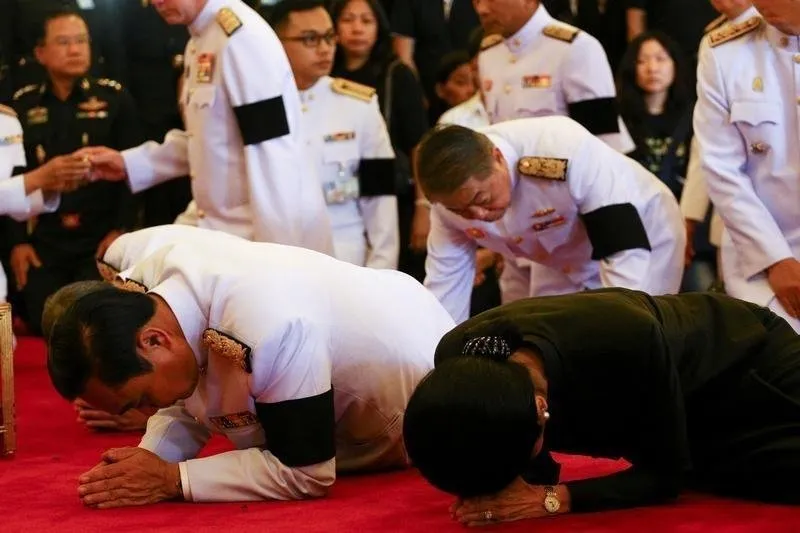
I remember once, many years ago under the reign of His Majesty Rama IX when things were stricter here, being late for an appointment and being pulled off the road as they cleared the highway of literally all traffic and pedestrians to clear the way and show respect for a Royal Entourage. Not only did we have to vacate the road, but as the motorcade approached, the policeman firmly insisted we remove our shoes and kneel on one knee and perform a high "wai" with the palms joined above the forehead. Most of the Thai people performed the full prostrated "krub"right there on the bitumen.
My western brain struggled with showing respect simply due to birthright or position, and somehow felt diminished by subjecting and subjugating myself to a person or authority I did not personally know. Likewise, each year the students at schools all over Thailand "Wai Kru" (Honour the Teacher). How do they do that? They remove their shoes and approach the teacher to honour them for sharing their wisdom and guiding the students.
Yes, that's my sweet little girl Ploi (with the plaits) in maybe grade 2 or 3, approaching the teachers to offer flowers and a "wai". 😍

Over time, I have somehow been changed by Thailand. I have partaken in respect rituals, observed them, and "wai" to people every day as a mark of respect. And what has slowly seeped into my Being is the fact that I am not diminished by overt displays of respect to anyone. Indeed, au contraire. I am enriched in my appreciation of others, and of myself, when I remove ego from the equation and can come from a pure place of simply honouring the humanity of the other, regardless of whether I believe they have earned it. It is the ultimate arrogance, no, to think one only shows respect to the other one deems worthy? Worthy in whose eyes? Do we not set ourselves up above the other when we resist the formal display of respect for someone we perceive as lacking?
And so how does that inform the way I nurture my own self respect?
Being a seriously lapsed convent girl, I am, nevertheless, well trained to flagellate myself for "not being good enough" and "not earning it." I am my own worst critic.
The formal structures of Thai respect have taught me this:
- that I deserve displays of respect from myself simply by nature of BEING here - my birthright as a human woman, a sensual being, a mother.
- that I deserve displays of respect from myself for my experience - for my failures and "less thans" and "not quite good enoughs" as well as my degrees, my victories and my successes.
How do I actively nurture that?
- Reflection. Meditation on the true nature of who and what I am.
- Solitude. Time simply spent alone away from other people.
- Self care. Foot massages, the punctuated rituals of eating and cooking and sharing nourishment, self pleasure, bathing, enjoying the moments when clean sheets brush my skin.
- Beauty. Thailand has taught me the appreciation of Beauty. For its own sake. Surrounding myself with it.
- Quiet. Thai life involves a lot of down time, without stimulation of music or visual input.
- Rest. Thai people sleep, rest, nap, take "sabai" time and then some. Every. Single day.
Mostly I have come to appreciate that one nurtures self respect by Knowing Oneself. Knowing One's Journey. Knowing One's Place - in family, community, karmically. One comes to Know Oneself through quiet, reflection and being mirrored by others. And allowing their respect of you.
As I sit here at 7.28pm on a Thursday evening, I hear the monks respectfully chanting the prayers for the dead at Wat Duang Dee, the Buddhist temple about 500 metres from our house.

It is the third full day of prayers and chanting and offerings. I am reminded as night falls that learning to respect oneself is a lifelong journey; and that the measure to which we are able to pour out and demonstrate our respect to others, is the measure that we ultimately are able to respect ourselves.