
The water cycle in nature, or the hydrological cycle, is the process by which water moves continuously between the geographical layers of the Earth, moving from one state of aggregation to another.
Source
Without it, plant growth is impossible, and the existence of life in its usual way. Almost all (about 97%) of Earth's water is in the oceans. A small amount of water is enclosed in glaciers.
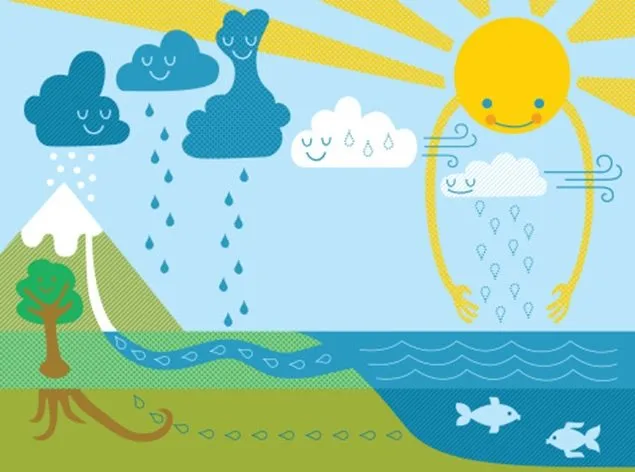
To simplify the understanding of the water cycle in nature, it is divided into four main stages, which are shown in the diagram of the figure.

Source
1 - Evaporation
The hydrological cycle begins in the ocean, where solar heat converts seawater into steam. Steam: small drops of water flying in the air. This process is called evaporation. The evaporation of water from other bodies of water and plants due to heat also affects the global water cycle throughout the world.
2 - Condensation
Water vapor rises to the sky and, as the air temperature drops with altitude, it condenses. This is how clouds form, which we often see in the sky.
3 - Precipitation
The wind chases the clouds through the sky, and when they can no longer contain the accumulated humidity, the precipitation falls, in the form of rain or snow.
4 - Collection
The water that falls to the ground from the clouds allows plants to grow and gives us water to drink. Most of the water flows to lakes and rivers, and returns to the ocean. Then the process of the water cycle in nature begins again.
The water cycle at home.
One of the best ways to learn about the water cycle is to see it in action. The demonstration can show the four stages of the hydrological cycle: evaporation, condensation, precipitation and collection. Although we see some of the stages of the water cycle in our daily lives, demonstrating this process in a container provides a better understanding of this. The experience will be of interest not only for schoolchildren, but also for preschoolers.
Create an artificial water cycle in the home.

Source
The following is a simple way to create an artificial water cycle in the home.
Take a large plastic bowl and 1/4 filled with hot water. (Hot water is not an important condition, but it contributes to rapid evaporation.) Add a few teaspoons of salt to mimic the salinity of the oceans. Place another smaller container in a large container of water. Organize the smaller one so that it is taller than the surrounding salt water and remains empty. This container will eventually collect the sediments.
Close the container tightly with a transparent film. The film plays the role of clouds floating on Earth and creates a place for condensate collection. Put some ice cubes on top of the film. The ice cools the "clouds", so that the evaporated water will condense better.
Wait for the ice to melt. The amount of waiting time depends on how hot the water was at the beginning of the experiment, as well as the room temperature. This can take from a few minutes to an hour. After a while, you should see the condensation under the film. Then the precipitation begins. Through the transparent sides of the container, you can see small condensed "raindrops" that will drip into a smaller container. This will be the precipitation.
Reference_


¿Quieres saber más sobre @Steemiteducation y @ Edu-venezuela? Únete a la discordia Aquí
Do you want to know more about @Steemiteducation and @Edu-venezuela? Join the discord Here