

Finally, I am posting the text that was supposed to be posted on the blog at the beginning of autumn. Due to the fact that I cared about this text, and the topic itself was not easy, I delayed its completion, correcting this and that for a few months. I hope you will like it and encourage you to see it.
Years ago, when I was a young teenager who saw only a few popular anime and bought Kawaii (when it was still on the level), it was a fashion to make fun of anime fans that they were watching Chinese cartoons. For example, some people thought that the characters of DBZ and other cartoons spoke Chinese. A dozen or so years have passed and Poles and our neighbors from Eastern Europe have understood that anime is not only about killing, fairy tales based on competition, but also great robots with a relatively simple storyline, such as DBZ, "Tosho Daimos", "Captain Tsubasa", "Pokemon". There were, among others "Ghost in the Shell", "Akira", "Neon Genesis Evangelion", "Perfect Blue" and other titles that gradually changed our consciousness. It is the same with the awareness of anime fans, who are much less likely to be caught by troll baits, calling Japanese cartoons "Chinese fairy tales". In today's text, I will cover the only Chinese cartoon I have seen. I have had contact with a few animations before, but they were either very simple series or feature films. But I have never seen them in full. Not because they looked bad or had a bad storyline. The reasons were much simpler - I didn't feel like it, I didn't have the right motivation, and even if I did, with titles that do not convince me at first, I need someone who will stand over me with a whip or motivate me in an unbearable way. That someone was Filip, my friend, who visited me at the end of the summer holidays, and I dedicate this text to him.

Before I move on to describing the plot, I will outline the cultural context a bit. Many Chinese take full advantage of American or Japanese pop culture (and not only). They love and absorb their comics, high-budget films, sports and culture. Some couples love weddings inspired by excerpts from "Titanic" and other romantic movies, and given the population of this country, these are huge numbers. There are also very poor regions, people who completely do not embrace today's world. Some people leave their villages for the first time and do not embrace modernity - relatively new technologies, shopping malls, etc. For example, I do not know how it is now, but about 10 years ago I heard that there were often people who defecated under a tree in the middle of a large store. Or from less extreme examples, agriculture is at the level of eastern Poland from about 20-30 years ago.

Europe was shaped to a large extent by Christians, the Catholic Church, Greek and Roman culture, a few other important countries (e.g. England, Germany, Russia, France), philosophers or thinkers from the above-mentioned countries, and China, among others Sun Tzu, Confucius and his Confucianism. Of course, there are several other factors, such as the experiences of individual countries, the evolution of religion, technology, etc. but I don't want to break down into prime factors. One of such aspects is, for example, the approach to brutality, treating others with dignity - in our case it was toned down (sometimes better, sometimes worse) by religion, in their due to the number of people there is much less respect for human life. I didn't notice too many noticeable references to Confucianism (although this may be due to my ignorance), but definitely to Sun Tsu. We have lots of references to the book "Sztuka Wojna" or his famous quotes. This can be seen in the form of conversations between the characters or their actions. For example, they talk about being ready when the time comes, being tricky, hiding your true strength, etc. There are also many references to the communist party, reminiscent of films by Stanisław Bareja (famous polish movie director), who was able to parody the absurdities of life in a country governed by the party in a funny way.

The action takes place mainly on Chicken Island and initially focuses on the problems of its inhabitants. The main characters are Seven, the chicken Dai Bo and his adopted son Xiao Fei. Seven is an ordinary 21-year-old boy who has lost his memory and is looking for any job, as long as he has something to eat. He trades in food, works as a hairdresser, works as a mercenary for dirty work. As Philip rightly pointed out, when we watched the first or second episode, we can identify with such a character much more easily than with Naruto, Luffy or any other Goku. His problems and thoughts, despite several elements straight from a more technologically advanced country or similar story solutions to the Japanese Shounen (energy orbs, super-durable melee weapons, aura accumulation, transformations) are easier to digest. The world of "Scissor Seven" is ... How to put it, dirtier, less smooth, so closer to our world than "Bleach" and the rest of the manga from Weekly Shounen Jumpa. In turn, the above-mentioned aspects characteristic of Japanese manga were presented in a way that is more understandable to us. For example, referring to technology, there is a nation living on the continent across the ocean that uses high-tech for everything, totally different from the equipment used by the Chicken Island warriors and its other inhabitants. In turn, the tasks that Seven receives (despite the level of absurdity and the mixing of American, Japanese and Chinese cultures) are closer to our reality than the quests received by Naruto, Ichigo or other manga heroes. I am talking here, for example, about the infiltration of a canine environment in which anyone who has ever had a pet will laugh (or embarrass), or interaction with communist officials pursuing the will of the Only Right Party.

The plot did not captivate me, although it was not bad, quite the contrary. It just didn't make a big impression on me ... Contrary to reworking scenes and themes known from anime or American games, pop culture etc. There are plenty of these and we often see them in unexpected moments or presented in quite innovative form. These are not mere alterations or references as in some simple, quickly written parody. You can see that the makers of "Scissor Seven" are creative, have lots of ideas and have seen or played lots of anime and games. Sometimes we have a completely different perspective, e.g. some scenes were drawn as if we were watching the gameplay of some platformers on YouTube. The characters are not self-aware in the same way as, for example, Deadpool, but sometimes they perceive these changes and adapt to new conditions. Maybe it is nothing new and it appeared in some animations or comics, but this is the first time I saw it.
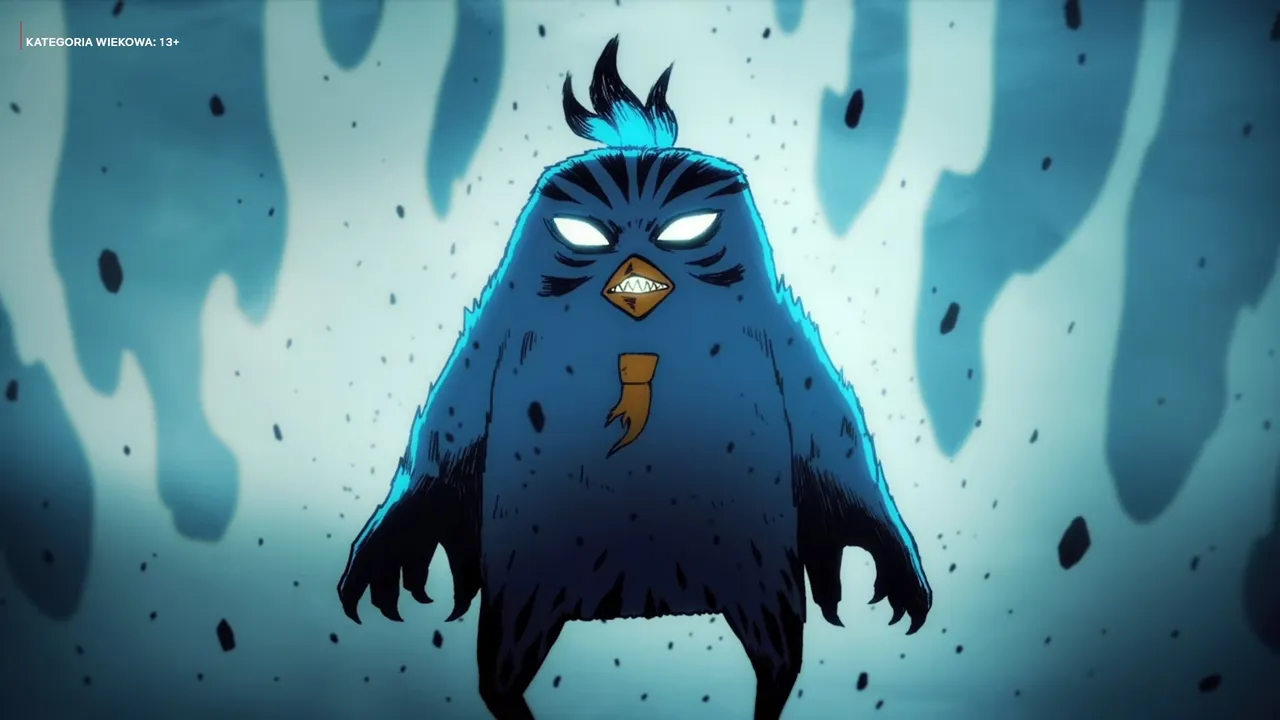
Sometimes I brag about the fact that I like to predict the next events out loud or say what consequences the actions of a character will have. I will humbly say that I succeed more often than not, and it was the same in this case. I'll try to be as general as possible, but there will be micro-spoilers. So we are sitting with Filip with beers in hand, we are watching a fight between two characters. Typical scene for most fairy tales of this type - Virgin main character vs. Chad the opponent. Chad slaps his face painfully, breaks our fins, generally punched him so hard that Virgin's internal organs are bruised. At some point, the hero gets a power-up and does more or less the same, but a few times worse to his enemy. In general, from the very beginning I felt a similar vibe to this fight as in Trunks vs Cyber-Freezer and I did not fail to tell Filip - "If X survives this fuck, he will come back like a Freezer". Filip reacted with a loud laugh, he commented it in some way (I forgot what words he used then), I waited a few episodes and in fact, X is back. They even introduced him similarly to the cosmic Adolf when he flew to Earth with his father. There are more such references, but from what I remember, most of them are remakes of patterns that have been used in shounen for many years. Mainly charging the energy level, increasing the intensity of the aura, taking on strong energy attacks, or wrestling with swords or energy rays. As I wrote in the previous paragraph, the authors of the cartoon like to play with this convention and present well-known cliches in a rare way. They are not 100% unique and unusual, because too many such fairy tales have been published over several dozen years, which makes full originality practically impossible. But I can assure you that you will be surprised by some of the "Wow, can you use it that way?" At least I was surprised that way, and seeing a lot of cartoons like this one doesn't surprise me easily. Summarizing this thread, I think I could compare the approach of the authors of "Scissor Seven" to the author of "Hunter x Hunter". The author of this comic said in one interview that he likes to use patterns known from many manga and to slightly modify them and present them from a different perspective.

When it comes to audio, for the first time in a dozen or so years I understood how people who do not watch anime on a daily basis feel. And referring to the beginning of the text, Chinese is so different from Japanese that it is impossible to confuse them. For example, if you are a US citizen or a resident of Western Europe, despite the audible differences in Polish, Ukrainian or Russian, they can be confused with each other. In the case of Japanese seiyuu or Chinese voices in "Scissor Seven", you can immediately hear the difference. Although I got used to the voice actors in season two, it was hard at first and I was irritated by the sounds. To people who don't understand Chinese, this may sound like gibberish. It's as if voice actors read aloud dialogues written by a screenwriter doing face-roll on the keyboard, but once we get used to it, it's hard to imagine American or Japanese dubbing. As for the music, fans of "Naruto" will feel familiar at times. Some of the song fragments from "Scissor Seven" remind me of some anime ninja songs. However, this is not an inspiration for the creators of the soundtrack, they just draw from the same sources as the musicians responsible for the soundtrack for "Naruto" and "Naruto Shippuuden". As for her level, it's good, but not outstanding, as in the above-mentioned ninja anime or "Bleach". The music fits the atmosphere of the cartoon and the scenes we see on the screen. To be honest, apart from Redtooth fight theme, I haven't listened to any songs other than watching anime, but it's not because of its poor level. I just have no inspiration to listen to such songs recently. Nevertheless, the series has good battle themes and calmer songs that emphasize the idyllic and comedic nature of certain moments. If I had to sum it up with one slogan or assessment, I would give 8/10.

Summing up, although I was a bit skeptical at first, I liked the series in the end. I will definitely watch the whole thing a second time (or at least the second season, which I remember a little less) before Netflix releases its sequel. The line and animation may not be very appealing, but it looks better than in Devilman: Crybaby. I would also risk saying that it presents a higher level than season 1 of "Baki" and "Kengan Ashura", although this is a different style, so they cannot be compared on a 1: 1 scale. Generally, what is supposed to look nice and epic, i.e. important stages in a fight, it looks like this. I recommend "Scissor Seven" especially to those who are a bit bored with the anime style and are looking for a breath of fresh air. I don't know if you like the Chinese cartoon, but it will surely surprise you in some way. I rate it on 8/10.