

I've watched over half of the series and I'm slowly getting to the end, so it's time for a little update. It still holds a high level and while there are more things I do complain about, it has got some nice threads. Quite a good result, as there are so many episodes and repeatability of some ideas. Apart from those boring episodes where little is happening and the heroines can talk to each other about loose things, or a few poorer-written plots (which with each subsequent season, it becomes more and more difficult to avoid in each series), it's basically just one thing for me pissed off. Most of the rest I forgot or their ending was minimally satisfying. Edit: I didn't know where to put it, so I'm throwing it in for introduction. It was faster for us (me and my girlfriend) to watch the show than I did to write about it, so we only had a few episodes left. For this reason I will not change the structure of the text, I will transfer it to my final review and summary of the whole "Orange is the New Black", which will be posted on the blog at the beginning of February at the latest.

That thing, or rather a person, is Chapman. Eh, I don't remember when I saw such an annoying main character ... I think in no series yet. If I had to do a completely subjective ranking of the worst-off female characters, Piper would even outperform Rey Skywalker. Rey is the bigger Mary Sue than Luke, she has no character, has been hopelessly developed, but at least she doesn't piss off. It is true that her remains of character have been written in such a safe manner that she does not stand out either too much in plus or minus, but in such cases mediocrity and blandness are briefly appreciated. Chapman is as brave as any banana child from the rich or at least the so-called "good home" - it only makes an impression. Sometimes it is better, sometimes it is worse, but as long as her friends are not there or she is not in a convenient position, it is easy to push her off the pedestal. She managed a few things in prison, it was her ego that flew off towards the stars. It would be an experience - she's a lovely blonde, so this self-righteousness is sweet in its own way, but I can't digest her idiotic texts, lies and general hypocrisy. As much as I praised her in the early seasons, for a while now, it's been hard to find an episode where she didn't do anything stupid. I was most embarrassed by her speech in which she motivated the prisoners to wear sexy panties. The idea itself was very good - as the example of Belle Delphine and Japanese students shows, there are simps and losers in this world who are able to pay big money for such things, so you have to make money on them. The only problem is that when Chapman started to add ideology to it, I felt embarrassed for a moment watching this series.

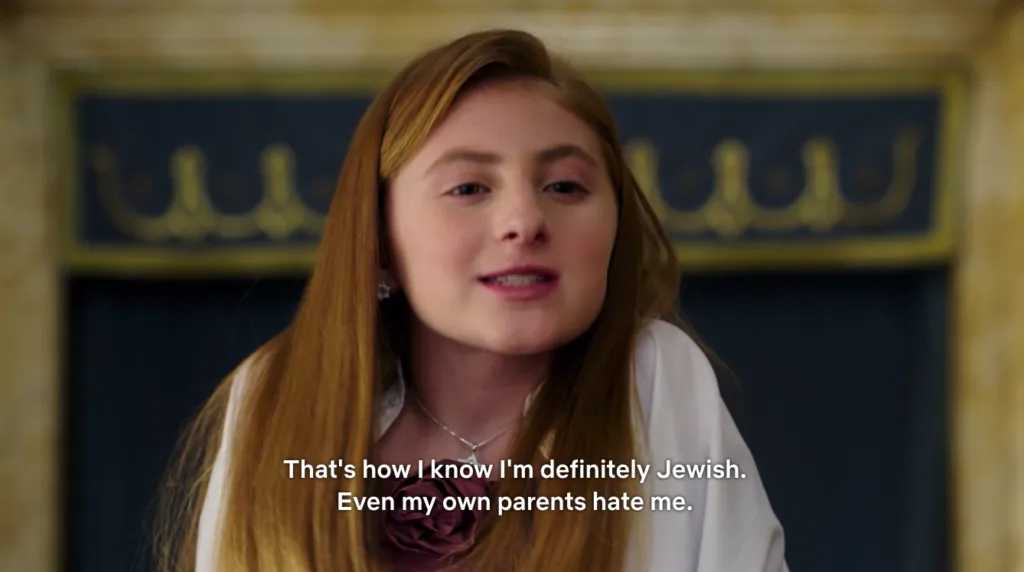
Fortunately, the rest of the characters (or at least most of them) are better led by showrunners, directors and screenwriters. And above all, there is an idea for them. It is difficult to lead a character through many episodes (unless it is a procedural series in which most episodes have a similar pattern), because in the end it will come to the border between meaningful development and stretching its plot by force, often in the direction of increasing greater ridiculousness or repetition. This means that the viewer will be able to gradually, more and more pissed off with a series or will be bored. In such a situation, you can, for example, change the natural environment of a given character to one in which they will not feel comfortable, or put them in some unusual situation that requires them to make an important decision that will significantly affect their plots or relationships with other characters. My favorite thing these days is this lesbian in drug rehab. At the moment, I can say that Nikki is the best-managed character. Gradually, we get more and more information about her, she is developed in a consistent way, and her subsequent behavior is a logical consequence of previous decisions or problems that she has to deal with. For example, a short stay in Max prison, where she ended up in the wrong place at the wrong time and having the misfortune of becoming a scapegoat (I mean the situation before the rebellion). When she returned to her old prison, because of the joy and willingness to celebrate, she returned to her addiction for a while. Or the second example, her flashbacks, in which we found out that from childhood she was a saucy and wayward girl who is not afraid to say what she thinks. The girl and I laughed out loud when she ridiculed her parents at a ceremony in the synagogue. Speaking of dealing with childhood problems, I liked this girl after several abortions, who was jailed for murder. I began to like her through her flashbacks, which clearly showed why she has this and not another character and what results in her indifference to the problems she experiences. Due to the fact that she did not experience too much love, and her mother deliberately used it to obtain as many social benefits as possible, she accepts any bad behavior, as long as there is at least a minimum of love or behavior associated with it. She herself clings to them, although they cause her physical pain, but they are also associated with childhood and well-known poverty. This is a "great" example of how people, although they can move away from toxic patterns, prefer to live with them because they know them well and know what to expect instead of fearing the unknown.
My second favorite character is this old lady who was a scout as a child. He has extensive knowledge, a lot of practical skills, knows how much to talk and what, God forbid, can adapt perfectly to all conditions. He complains very rarely and is equally not happy, but when it comes to one or the other, it is sincere pissed off or unfake joy. With the first one, one can be scared of being in the place of the person he perceives as an enemy, while with the second, his satisfaction is also shared by us, the audience. Besides, I liked the new heroines, not only those depicted in a maximum security prison, but also this conspiracy theorist. I laughed under my breath several times because I had been exaggerating to some extent at some point in my life.

Speaking of Max, for now I won't say much about him, because I'm just getting to know this prison. But what I can say for sure is that Litchfield Jail is a vacation to a maximum security prison. The freedom of inmates is even more limited, there are many more dangerous prisoners, and thus, the punishments are even more severe - not only those from the guards, but also from the "friends" from the cell. Litchfield was also not easy at times, but it was easier to deal with the consequences of your mistakes, to find some kind of soul mate or at least normal prisoners who had been imprisoned for crimes of a smaller caliber. And there weren't too many times when the guards abused the inmates. I liked the leader of one of the blocks, the one who has a conflict with Frieda Berlin. It's true that I haven't seen too many scenes with her so far (we interrupted the show in the episode where Rednikov "accidentally" ended up in her room), but you can feel the aura of a real bitch and alpha female from her. Such a mix of Alex Vause and Red, only devoid of pity and more determined.

Before we saw the maximum security prison, however, we had witnessed a prison revolt following the manslaughter of Poussey. For a moment I felt like during a recent brawl, after killing Floyd (the criminal who was heavily drugged and threatened a pregnant woman with a pistol a little early). As with George, her death was also an accident at work, and the consequences were similar, but on a smaller scale. I was expecting something more from him, as many YouTubers praised this stage on the show. I thought there would be more blood, more dramatic moments, but less comedy of locking prison guards and staff in the toilet, or drugged inmates. It wasn't bad, generally I don't even have much complaints, but it was too stretched. You could easily shorten it by one episode or at least a half of it, and thus remove a few comedy threads to dramatize this plot a bit. The episode with Piscatela (the big guard who brutally murdered the rapist of his chosen one - died as a result of burns) was his best stage. It was dramatic, we got a great closure of his character and interesting consequences in later episodes. My second favorite plot was the murder of this guard by Diaz. Or rather its consequences, the girl screwed her life up to the end and began a quick journey towards the dark. She became an evil character, stopped to care for anything and began to destroy herself. At first I felt sorry for her, because I was defending her with stupidity that she was in the wrong place at the wrong time, but after a few episodes I changed my mind. She has become selfish and extremely selfish, making it an interesting contrast to Nikki's character who turns in the opposite direction.
To sum up, if you are looking for a long series that keeps at least a good level for most episodes, I recommend "Orange is the new black" with a clear conscience. There are better productions, that's true, but this one also maintains a solid level and is great to watch until dinner, lunch or just relaxing.