
Although there are new pictures, I'm reposting images and text from 2 previous posts so this is also tagged #showcasesunday.

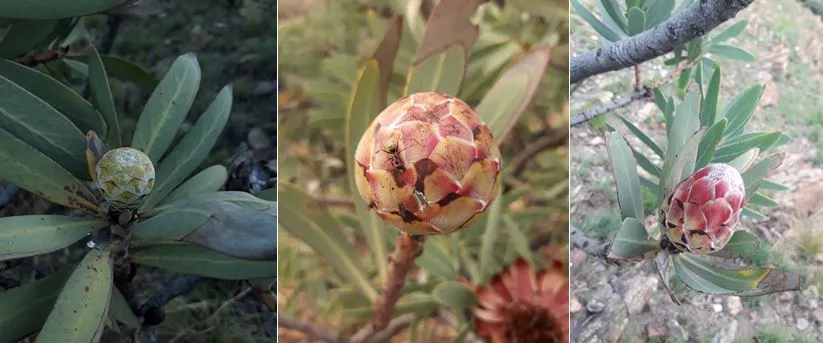
The proteas growing on the hill are Protea caffra, a very common protea species found all over South Africa. they are called Sugar Bush locally because the flowers are full of nectar and very attractive to birds although this flower has some large ant visitors instead: these ants are about 1.25 cm long.
Here are the flowers in various stages of development:
First the bud grows and starts developing colour and elongates as the stamens start becoming exposed

A pollinated flower

After successful pollination, the bract scales slowly close up again while the seeds form.

Here, the bracts are completely closed.

9 to 12 months after flowering, the flower reopens to release the seeds. It is very windy at the end of winter and start of spring and these fluffy seed will be dispersed in the strong winds to wait for the fires and thereafter, rain and hopefully germinate.

A flower bract after all the seeds are gone

These woody flower bracts remain on the tree for many years, gradually turning darker before they finally disintegrate.

Proteas thrive in poor, acidic, soils and can be very difficult to grow in a garden because they need very well draining soil, very little water or fertiliser and will die if their roots are disturbed. They are plentiful on the hillside because the soil is comprised of shale and quartzite and proteas are often a very good indicator of the underlying geology of a particular place. They can withstand freezing temperatures and their corky bark is fire-proof. The seeds germinate only after fire and the bark of protea caffra is used medicinally to treat bleeding ulcers and diarrhoea.
