
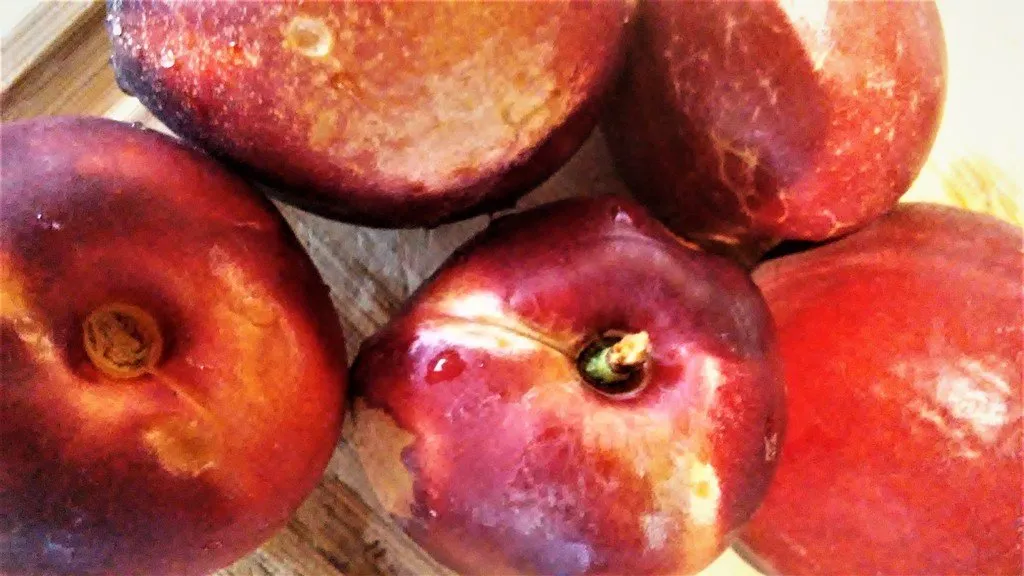
Two years ago, I planted a fruit tree in the backyard. Unable to decide between a peach or a plum, I went with a combination: a Spice Zee Nectaplum (that’s a registered trademark of Zaiger Genetics, but it’s not genetically modified). The Nectaplum is a combination of nectarine, peach, and plum, three closely related fruits which were crossed naturally to create an amazing taste experience. It looks like a nectarine (smooth-skinned peach), but the flavor is more complex.
How do I know? Because today, just two years after planting it, I picked a dozen fruit from this tree. The squirrels, raccoons, and birds already claimed a few more. My family greedily gobbled some of the dozen before I could snap the picture above. The dog got a small piece also.
Note: Pluot, Nectaplum, Spice Zee Nectaplum, Pluerry, and Aprium are registered trademarks of Zaiger Genetics, which we will cover soon.
Nectaplum image courtesy of Raintree Nursery, www.raintreenursery.com.

Nectaplums may not look like a revolutionary taste experience, but I wish I could send you a sample over the Internet. Then you would know that I’m not exaggerating the flavor. It tastes like a sweet white peach or nectarine with a very aromatic late snap of Asian plum flavor. Unlike some of these plums, it doesn’t have a sour ending. The peachy rush of sugar holds right through the sub-acid sensation, building to the floral plum aroma.
It tastes like they took the best of a Santa Rosa or Laroda plum and stuck it in a peach. Adding to its flavor is the beauty of this tree, as its new growth is purple. In springtime, after a beautiful pink bloom, the tree looks like an ornamental red cherry-plum tree of the sort that adorn many suburban neighborhoods in the United States and Canada. But the older leaves gradually turn green, leaving purple pigment on the tips. This tree is a fast grower and very prolific. The Nectaplum is a highly ornamental plant as well as a producer of good fruit.
Photo: Creative Commons via Flickr by starr-environmental.

Author photo.

Pluots, Plumcots, Apriums, Pluerries, Peacotums, and Spice Zee Nectaplums: Helping Nature Engineer the Best Stone Fruit
Stone fruits, so called because they have a pit in the middle, are a family of fruits borne on temperate trees that include cherries, plums, peaches, nectarines, and apricots. In nature, some crosses (combinations) of these fruits have developed naturally, as they are closely related. More recently, plant breeders have created other combinations that are even sweeter and more flavorful.
From the 1890s to the 1920s, plant American breeder Luther Burbank worked to create several new varieties of plums at his experiment garden in Santa Rosa, California. He also managed to cross plums with apricots, creating the plumcot. By today’s standards, it is a rather tart cross, which tastes like a crisp early plum with a hint of apricot flavor. But some backyard orchardists still grow his original plumcot.
In more recent decades, Burbank’s work has been continued and expanded by Floyd Zaiger and his family. While Burbank’s farm was only 4 acres and he could not conduct experiments on a large scale, Zaiger implemented a controlled breeding program on a much larger scale in California’s Central Valley. The Zaigers plant tens of thousands of new trees every year, many of them the result of crosses from the previous season. The vast majority may show no promise. Some trees will not fruit, others are too weak, some fruits will be too sour, too fragile, or too late to ripen. Out of as many as 50,000 each year, only a few are chosen which have potential and the process is repeated again on this very large scale until a very special fruit is created.
Pluots, another interspecific combination, for sale at a Farmers Market. Photo: Creative Commons via Flickr by Wiredwitch.

This is no different from Gregor Mendel’s experiments on sweet peas. These trees are not genetically modified (GMO). They are created by accelerating nature’s process, thanks to large scale breeding and development. Humans simply give nature a helping hand to speed and control the natural process and select the highest-performing fruits.
From the Zaigers’ breeding program has come many new interspecific fruits. The most famous are pluots (some of them popularly known as ‘dinosaur eggs’), which combine the best features of plums and apricots. While the plumcots are tart, these pluots can be sweeter than candy. Their sugar levels test higher than most plums, while their flavor profile is intense and varied. If you are ever travelling on the U.S. West Coast in summertime, please do yourself a favor and stop at a farmer’s market to sample some fresh pluots.
Apriums are similar to pluots, but they are more like apricots than plums. Pluerries bring cherries into the mix also. Then there are peacotums (peach, apricot, and plum) and the object of my latest affection, the Spice Zee Nectaplum. These fruits truly are more than a sum of their parts.
Here is a short video showing how pluots are developed, followed by a CBS News clip of a fruit tasting.


Final Thoughts on My New Favorite Fruit Tree
Pluots get all the fanfare, but this Nectaplum is outstanding. Tasty and ornamental, Spice Zee Nectaplum trees belong in a lot more backyards. When mine grows big enough to produce more fruits than the neighborhood vermin can steal (so that I don’t need to race them for it), I will let some of these Nectaplums hang on the tree for a few more days. I’m curious to see how much sweeter they will be when perfectly ripe. I had to pull these ones off just as they began to soften, which was not ideal. Still, the flavor and sweetness made me a convert to this tasty new fruit.
Further References
Favorite Fruit Trees for Backyards (mainly for western and southern US, Sunset Magazine): http://www.sunset.com/garden/fruits-veggies/fruit-trees
Luther Burbank (Wikipedia): https://en.wikipedia.org/wiki/Luther_Burbank
Floyd Zaiger, Fruit Innovator (SFGate): http://www.sfgate.com/bayarea/article/Floyd-Zaiger-a-fruit-innovator-to-the-world-2368432.php
Breeding Better Fruit (San Diego Union Tribune): http://www.sandiegouniontribune.com/lifestyle/home-and-garden/sdut-breeding-better-stone-fruit-2014oct31-story.html
Spice Zee Nectaplum (Dave Wilson Nurseries): http://www.davewilson.com/product-information/product/spice-zee-nectaplum-interspecific-nectarine
Top photo by the author.