
I was recently asked on this site: "What's the difference between a geode and a thunder egg?"
In all honesty, there is not much difference at all. They are both formed from volcanoes and they both have crystalline structures in them. There are many different interpretations as what makes one a thunder egg and the other a geode. Some say that geodes are hollow and thunder eggs are solid. I have personally seen solid geodes, called nodules, and hollow thunder eggs.
Lets first look at the names.
Thunder eggs were first discovered by natives who believed that lightning broke open from eggs and shot up to the sky. Hence the name.
It is held to some belief that thunder eggs formed under water and the mineral laden silicate ; Chalcedony , seeped into the specimen and filled the void to solidify. There is also belief that thunder eggs were originally fissures (cracks) in the rocks that were again filled with chalcedony. This could explain the consistent jagged formation of the core found in almost all thunder eggs. They can be easily determined by the "star points" found in them


Geode has several definition origins; Latin- precious stone. Greek- earthy or earth like. Standard English- any rock with a hole in it which allows crystals to grow.
While most geodes are hollow:


As I mentioned earlier some are solid. They are called nodules.
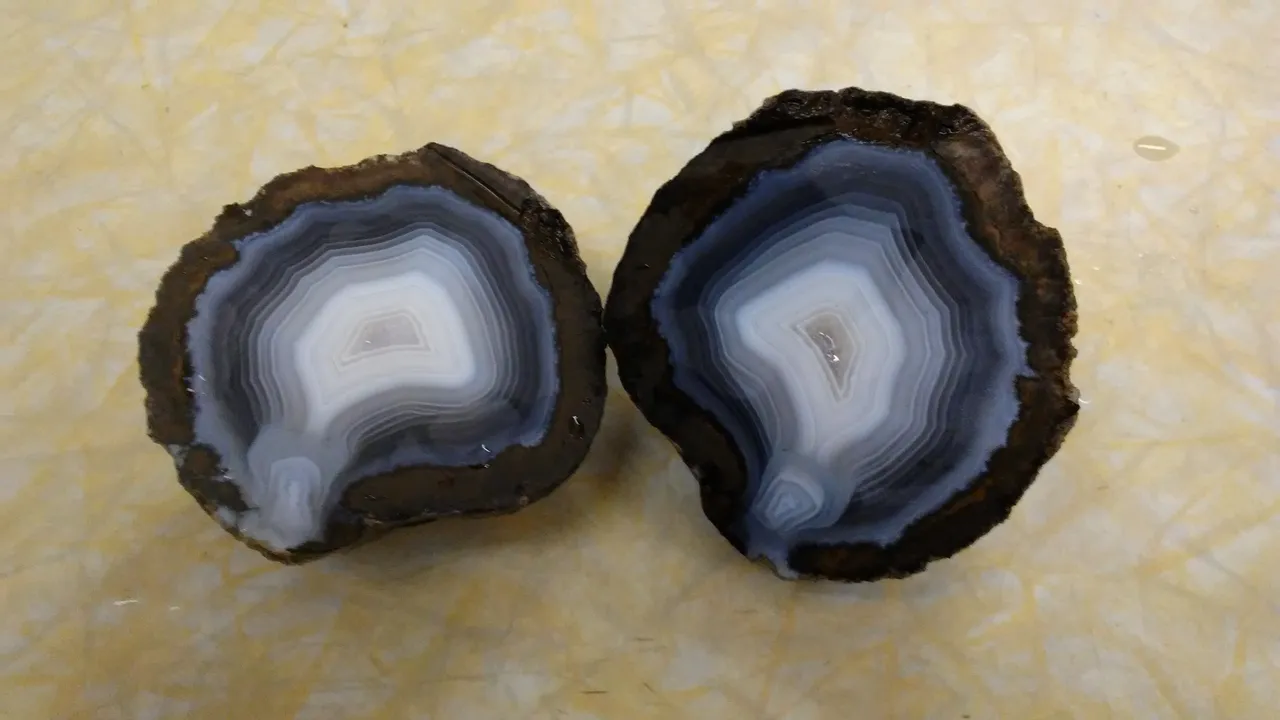
Of course there are always exceptions to the rules;
This is a cut Septarian Nodule. As clearly seen there are jagged edges with "star points" making it a thunder egg. It is also partly hollow; so how is it a nodule? So you decide; Is it a thunder egg, or a geode nodule?
