

Many people make the assumption that learning guitar is expensive and near impossible, however I am here to reassure you that it is anything but that. For a good beginner guitar, a good price range would be about 200$ to 350$ (U.S. currency, good beginner acoustic guitar brands are Yamaha and Fender). Notice that I said good, you can absolutely get away with buying a guitar for 150$ and using it for however long you need to improve to the level where you think you need a better one. Also, people often wrongly assume that you need to take private lessons in order to learn fast - completely false. Nowadays, the only thing you need is you computer or smart phone and Youtube. Honestly, it's not even necessary to have those two things, as there are countless books on guitar available everywhere online and at the book store. SO STOP MAKING EXCUSES AND GO GET YOURSELF A GUITAR. Whenever someone who wants to learn guitar asks me for the best advice I can give them, I tell them "Stop wasting time. You're only growing older. If you feel compelled enough to ask me what it is that you can do to learn right away, then you're ready to start teaching yourself". Also, your perspective is key when trying to master anything. Keep in mind that this is for you and no one else, everyone learns at their own pace and there's no need to pressure yourself into getting frustrated because you can't play the five minute long solo in Free Bird yet like you can in Guitar Hero 3. Take your time and if you get frustrated, take a break. That may be for a few minutes, a day, a week, or whatever you feel that you need. The only thing you need to worry about is why you still haven't bought a guitar.
Here's some quick advice on the most basic information you need to know when learning guitar.
Proper Technique
The better technique you have, the easier and faster you will learn.
Finger placement

Remember to always curve your fingers in an arc (left hand for right handed people, opposite for lefties). Also, try to keep your fingers close to the fret you're pushing down, this helps a bit! Curving your fingers helps prevent unwanted muting of strings you want to ring out, and keeping your fingers close to the frets helps prevent buzzing of the strings if you're simply not pressing down the string hard enough. It takes less force to push down the string the closer you are to the fret (however minimal of a difference it may be).
Chords/Strumming

Start out by learning basic open chords (C, A, D, G, and E are the main ones) and basic strumming patterns. It is important to keep in mind that if your fretting hand isn't fretting the chord properly, it won't sound right. Remember, patience is key. The easiest way to strum is to move your wrist with very small forearm movements. The motion of the wrist should be a combination of waving hello and turning a key in a lock.
Alternate Picking
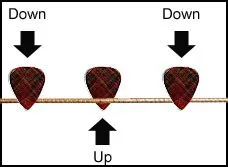
This is a bit more complicated for beginners, but the concept of it is to keep picking the string in series of down and up strokes on an individual string. The key here is to pick somewhat lightly and make very small movements with the picking hand. Watch tons of Youtube videos on this and you will pick it up relatively fast!
Rhythm

Do your best to develop a basic concept of rhythm - understand time signature, how to play with a metronome/drummer, and the values of different notes (quarter notes, whole notes, sixteenth notes, etc.). Developing good rhythm requires a lot of practice and experience.
Everything you need to start playing TODAY
- Tuner (or tuning app, there are many free ones)
- Picks
- A guitar
STOP MAKING EXCUSES.