

Kīlauea Volcano is a shield volcano located on the eastern slope of Mauna Loa Volcano on the Island of Hawai‘i. The volcano is considered to be in the shield-building stage of Hawaiian volcanism.

Hawaii's Kilauea is not your typical blow-the-top-off kind of volcano. It's been simmering and bubbling for about 35 years, sending superhot hot lava spewing up through cracks in the ground.

Kilauea is the youngest and most active of the five volcanoes on the Big Island. It's been erupting continuously since 1983.

The lava is 2,200 degrees (1,200 degrees Celsius)

The Hawaiian Islands only exists because of volcanoes. These volcanoes were created from "hot spots" of underground magma, which are mostly but not always underwater. The molten rock erupts on the sea floor, cools and forms a volcano. With each eruption, the volcano grows until it is big enough to push out of the water and form islands.


(U.S. Geological Survey handout/Reuters )
A 2,000-foot-long fissure erupts within the Leilani Estates subdivision, on the east rift zone of the Kilauea volcano threatening homes of hundreds in Hawaii, on May 5, 2018
Photo By Bruce Omori / Paradise Helicopters / EPA-EFE / REX / Shutterstock

Power lines are pulled down by lava in Leilani Estates on May 5, 2018
Photo By Marco Garcia / AP and Atlantic Magazine


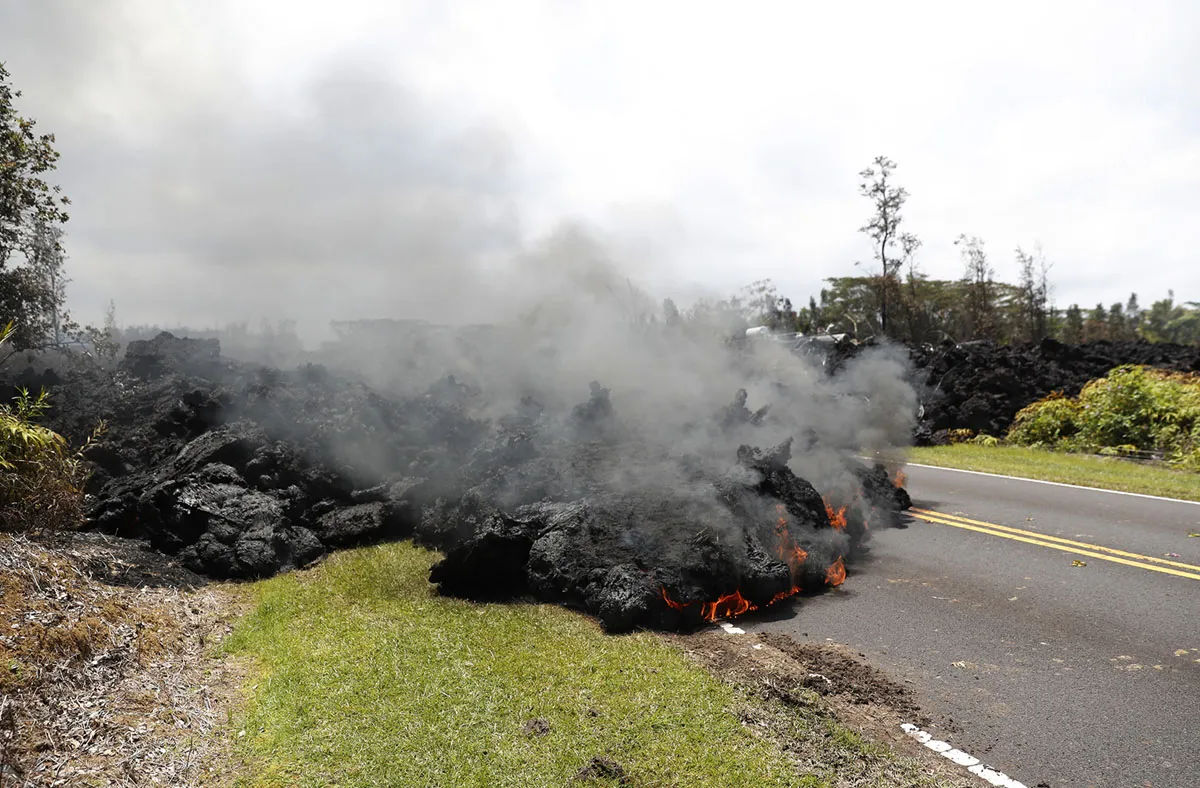

In this still frame taken from video, lava flows over a road in the Puna District as a result of the eruption from Kilauea Volcano on May 4, 2018
Photo By Byron Matthews via AP and Atlantic Magazine

Lava from the Kilauea volcano flows across a road in Leilani Estates, on Hawaii's Big Island, on May 5, 2018.
Photo By Marco Garcia / AP and Atlantic Magazine

Kilauea volcano erupts, on May 4, 2018, seen from Kalapana, Hawaii.
Photo By Marco Garcia / AP and Atlantic Magazine

**The Island of Hawai‘i with lava flows erupted in approximately the past 1,000 years shown in red. **

For the scientists or the curious
Hawaii’s Kilauea volcano has entered a new destructive period of eruptions, which has happened several times since it resumed producing lava in 1983. Here’s some context behind one of the world’s most active volcanoes, and Hawaii Island’s youngest:
Kilauea is mass building
Kilauea is currently in the second phase of growth, the “shield building” stage, where it is the most active and the most voluminous.
- Pre-shield -> Small eruptions below sea level.
- Shield building -> Volcanic mass grows above sea.
- Post-shield ->Magma cap flows, covers volcano.
References
Atlantic magazine Kilauea Lava flow on Big Island of Hawaii
https://www.theatlantic.com/photo/2018/05/photos-of-Kilaueas-newest-lava-fissures-on-hawaiis-big-island/559751/
USGS Volcano Hazards Program
https://volcanoes.usgs.gov/volcanoes/kilauea/geo_hist_summary.html
US Geological Survey
https://www.usgs.gov/
CBS News Science Behind Hawaii Volcanoes
https://www.cbsnews.com/news/hawaii-kilauea-volcano-lava-science/
USA Today: Science Behind Hawaii Volcanoes
https://www.usatoday.com/story/news/nation/2018/05/07/hawaii-volcano-science-behind-eruption-kilauea/586268002/
LA Times: The science behind the volcanic activity on Hawaii's Big Island
http://www.latimes.com/visuals/graphics/la-na-hawaii-volcano-explainer-20180509-htmlstory.html
Trip Advisor Visisting Kilauea Volcano on Big Island of Hawaii
https://www.tripadvisor.com/Attraction_Review-g29217-d105294-Reviews-Kilauea_Volcano-Island_of_Hawaii_Hawaii.html
CBS News Science Behind Hawaii Volcanoes
http://www.cbc.ca/news/technology/kilauea-volcano-hawaii-1.4651710
National Geographic magazine: science, myths of Kilauea Volcano
https://news.nationalgeographic.com/2018/05/kilauea-volcano-tsunami-explosive-hawaii-myths-explained-science/