

The second half of 4th century BC falls at the time of major political changes, especially on the outskirts of Greece, where new, Hellenized centers of power were born. An example of a leader who was not limited by loyalty to Greece but immersed in Greek culture is the Mausolus of Caria, ruling the greater part of south-western Asia Minor until his death in 353 BC. Mausoleum in Halicarnassus, the tomb of Mausolus was erected during his lifetime on the orders of his wife and sister Artemisia II.


Hypothetical diagram of the facade of the Mausoleum. The individual podiums were shown, on which were placed individual series of sculptures: Amazonomachy, genealogical sculptures, etc. At the top, a pyramid supporting the chariot of Mausolus.
The tomb remained in good condition until the Middle Ages, when some of its elements were earmarked for the construction of a nearby castle. According to Pliny, the mausoleum was 140.8 m in circumference and 45 m in height. This unparalleled architectural project was created by a team of sculptors led by architect Pyteos from Priene. Pyteos, together with the Satyrus of Paros, designed the grave itself (Stewart, 1991: 180), and the ornaments were made by a group of sculptors: Scopas (east wall), Bryaksis (north wall), Timoteos (south wall) and Leochares (west wall).


As far as only fragments of sculptures survive, we know that the lower stage of the podium depicted the Greek-Persian battles; central - standing figures of Greek and Persian; the upper collection of hunting and sacrificial groups (Stewart, 1991: 182). In total, approx. 200 figures were presented. A sixty-centimetre frieze depicting Amazonomachy served as a podium at an altitude of 18 m. Among the columns were colossal portraits of 36 members of the Mausolus family, and bas-reliefs were placed on the coffered top of the colonnade. On the ledge there were 56 statues depicting rushing lions, facing the axis of each wall. At the top of the pyramid, a chariot with dimensions of 6.5 m by 5 m has been placed and it must be assumed that he represented the Mausolus himself.

The widow after Mausolus organized after his death games and theatrical performances, and the iconography found locates Mausolus among the heroes. (Panofsky, Studies in Art History: 124)
Figures of dynastic portraits impress not only with size but also with the full expression of self-confidence and proportion. The heads suggest their shape with a non-greek origin, highlighted by thick lips, moustaches, and bent brows. Above all, as heroes they had their hair let loose.
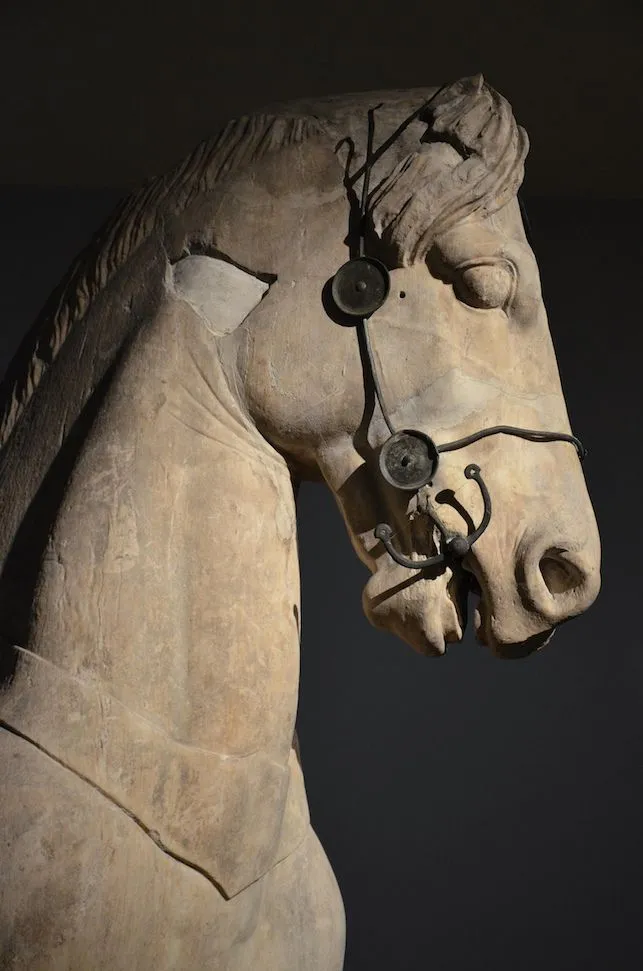

Animals in groups of hunters were sculpted to the detail of the given species. The best-preserved fragments belong to the frieze Amazonomachy, whose theme is the expedition of Heracles and Theseus to Themiscyra.
Placing the pyramid on the top of the Mausoleum seems more understandable when we take into account what it lifts. Mausolus sitting in a four-chard chariot, significantly scaled down, was probably the biggest show of its kind to date. This finally gave the whole building meaning. (Fyfe, 1974: 55).

The author of the treaties on architecture, builder, and sculptor, Pyteos was professionally active from the mid-fourth century onwards. and operated in Asia Minor. According to the report of Vitruvius, he was the author of, among others of the Temple of Athena Polias in Priene (Vitruvius.1.1.12). This temple is the best source of information about Pyteos because the participation of the sculptor in its construction does not raise any doubts. It expresses the individuality of a scholar-artist who incorporated elements of the Ionian tradition into his projects.


As Pyteos was one of the authors of the Mausoleum in Halicarnassus, the Ionic order is best expressed in the form of a plinth of the mausoleum tomb. The architect was looking for new forms, which are expressed in the elements of kyme, palmettes and volumetric capital (Bernhardt, 1992: 408-9).
In the case of the Mausoleum project, Pyteos presented an obsessive approach to regularity, incorporating a 30-cm module, which also affected the proportions of the sculptures. Figures on the bottom podium had a natural human scale (180 cm, 6 modules), while those placed at the top of the building were twice as high (about 360 cm).
According to Vitruvius, Pyteos belittled the value of the Doric order because of its "flaws and disharmonies" caused by the "inconvenient placement of the triglyphs." Instead, he developed an Ionic style in Asia Minor. The lost treatise "Comments" explained the system of proportions of the Priene temple.
References
Images: sources linked below
Photo:

- Stewart, A. Greek Sculpture: An Exploration, Volume I: Text, Yale University Press, New Haven, 1991
- Fyfe, T. Hellenistic Architecture, Ares Publishers, Chicago, 1974
- Bernhard, M. L., Sztuka grecka IV w. p.n.e., Wydawnictwa Artystyczne i Filmowe, Warszawa,1992
- Vitruvius: The Ten Books on Architecture 1.1.12, translated by Morris Hicky Morgan 1914