

In the previous two posts in this mini series we have looked at the mythology of two fairly well known 'Bird Men'. In the first post we looked at Garuda, the mythological half man/half bird deity prevalent all across Asia with ties to both Hiduism and Buddhism. In the second post the focus was on Horus, a bird headed deity from Ancient Egypt.
Today we cross the Atlantic to focus on an Aztec God whose name is much less well known and even harder to pronounce, Huitzilopochtli - The Hummingbird God.
THE BIRD MEN
MEXICO - HUITZILOPOCHTLI.

Many people won't have heard of Huitzilopochtli but that doesn't mean he wasn't a significant entity, especially when you consider the brutal sacrificial nature the Aztecs have become infamous for.
Known as the 'Hummingbird of the South' and 'Hummingbird of the Left', Huitzilopochtli was the deity of war, the sun and of human sacrifice.
Said in some accounts to be the youngest of four brothers with one brother being the more 'famous' Quetzacoatl - The Feathered Serpent, Huitzilopochtli has a strangely familiar creation story, a story that is repeated throughout the world and throughout known history.
Lets take a look at the creation myth, this is from study.com
Most people find the minuscule sized hummingbirds cute and gentle. You might think, then, that Huitzilopochtli, the Aztec god who was referred to as the ''Hummingbird of the South,'' would be gentle and calm. Instead, he dismembered his sister, and his followers performed human sacrifices to please him. If this seems like a confusing and contrasting figure, that is because Huitzilopochtli's story is so complex—so let's walk through his mythology and how the Aztecs, an indigenous Mexican group, worshiped him.
There are two major variants of Huitzilopochtli's origin story. In one mythology, he was the son of a primordial being named Ometeotl. Though Ometeotl did not have a gender, male and female qualities were used to create a son, who was Huitzilopochtli. The other—and more popular—story of Huitzilopochtli's birth is much more exciting. In this story, his divine mother, Coatlícue, had hundreds of children. One day, on Mt. Coatepec, or ''snake mountain,'' a bundle of hummingbird feathers magically fell from the sky. She put it safely under her breast and miraculously became pregnant with Huitzilopochtli!
Interesting how the 'divine Mother' and 'miracle conception' memes repeat all over the world when looking at creation myths of those who are worshipped. I understand how it could follow through from the beliefs of the Sumer and Ancient Egyptians to the Greeks, Romans and Christianity because of the proximity of the cultures to each other, however here we are talking about a culture that existed in isolation many thousands of miles away until the early 16th century when the Spanish arrived in Central America.
Continuing........

Her other children were upset about this and decided to kill their mother. When they killed Coatlícue, Huitzilopochtli jumped out from her womb—holding weapons and sought vengeance for his mother's death. He fought his siblings, particularly the leader of the mob, Coyolxauhqui.
Huitzilopochtli is considered a creator god, but not for a simple or passive creation, like you might find in other religions. This god fought with his sister, then decapitated and dismembered her. He threw her torso down to the base of the mountain and threw her head into the sky, which became the moon. He disposed of his other siblings as well, tossing them into the sky to become the constellations, completing a pretty gruesome creation story.
Huitzilopochtli was considered the sun god of the Aztecs, an indigenous group of central Mexico who ruled the area from the 14th through 16th centuries CE. The Aztecs thought that the reason the sun and moon moved away from each other was that Huitzilopochtli and Coyolxauhqui (respectively, the sun and the moon) engaged in their epic battle over and over again every day. From sunrise to noon, Huitzilopochtli was accompanied by the spirits of warriors who died in battle, who then turned into hummingbirds around noon. From this point until sunset, he was accompanied by the spirits of mothers who died while giving birth, perhaps an homage to his own unfortunate birth. At night, when the sun was not visible, Huitzilopochtli was believed to travel through the underworld before he would rise again at sunrise.

As the creator and sun god, Huitzilopochtli was very important to the Aztecs. In fact, he was so important that he was their chief deity. He was connected with gold, war, and rulership, so the Aztecs thought it was important to keep him happy. To appease him, the Aztecs performed human sacrifices, usually of prisoners of war. Keeping with the gruesomeness of Huitzilopochtli's story, the Aztecs removed the hearts of the sacrifices and decapitated them—probably to commemorate Huitzilopochtli's decapitation of Coyolxauhqui. They were dismembered and skinned. Though the sacrifice was intended to symbolically feed Huitzilopochtli, the priests were the ones actually eating it, with the heart being the most sought after part.
Ritualistic sacrifice and consumption of human flesh can be found around the world throughout time however the Aztecs took this practice to the next level. It has been hypothesised by a few scholars that the practice became increasingly brutal and more commonplace after poor harvests or terrible storms as a way of appeasing what they thought was a displeased God.
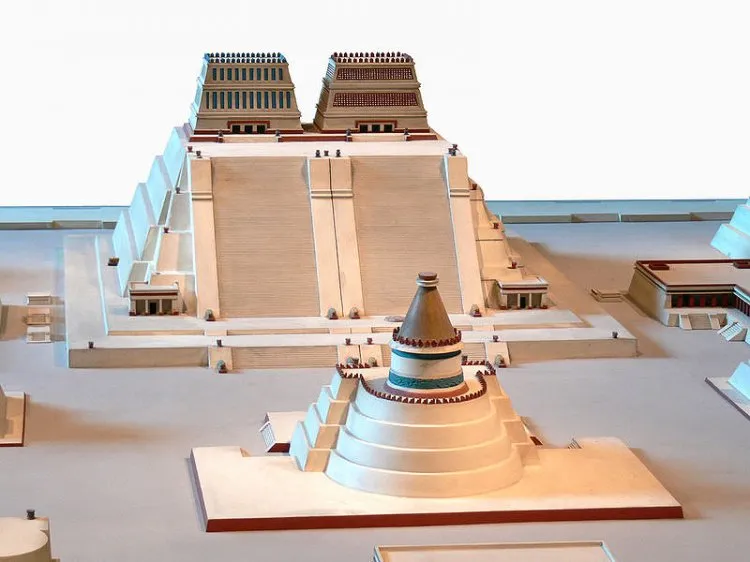
These sacrifices took place at the temple Hueteocalli. It was strategically placed to mark the winter solstice, a time typically linked to war, which Huitzilopochtli was connected with. The steps of the temple were painted red, again, indicative of bloodshed and war and symbolic of the deity. While there were not as many representations of the god as you might expect, some wooden statues were made of Huitzilopochtli.
I've said it before and I'll say it again, How cool is History!? Well technically as far as western scholars are concerned it's mythology. It may well be historical fact if the Spanish hadn't rampaged through the area at the behest of the Catholic Church destroying every piece of evidence they could get their hands. But let's not dwell.
Fortunately there were some decent folks amongst the invading Europeans that saved artwork and codices so some of the history is able to be pieced together, so along with oral traditions we can at least get a glimpse into the past.
There are other mythological similarities here to what we have seen in the previous posts. The Sun and the Moon meme and the historic 'sky battles' are almost identical to Horus and Set. Also again we find that the protagonists are related, it always seem to be a family feud that is being waged by these entities. This is seen in Sumer with Enlil/Enki and Egypt with Horus/Set as well as other mythologies worldwide.
Why would so many cultures have these similar stories in their folklore when separated from each other by time and distance?
I believe there was one historical seed for many of these mythologies, one cosmic event, one epic sky battle, one family feud in deepest antiquity on a worldwide scale that sparked these collective accounts. The Veda's, Popol Vuh, Old Testament, Sumerian tablets, Norse mythology and the Sutra's have incredible 'stories' that many believe are historical accounts of actual events. What if they are? What if the stories in the Mahabharata are documented accounts of real events? Is is plausible to assume they are all fantasy? Or is that our true failing? An inability to accept that we may not be alone and in the very distant past there were beings living on earth, more advanced that we can yet imagine?
For those of you who don't already follow my great friend 
As ever I've gone off on a tangent, back to Huitzilopochtli.....
This article found at Ancient History Encylopedia tells a similar but slightly different series of events, showing us how difficult it can be to really understand what the true beliefs regarding Huitzilopochtli were when you have very few surviving documents and rely on stories recounted to dogmatic foreign missionary's by a devastated and defeated people, which were then translated into another language!
Huitzilopochtli (pron. Huit-zi-lo-pocht-li) or ‘Hummingbird of the South’ or ‘Blue Hummingbird on the Left’ was one of the most important deities in the Aztec pantheon and for the Méxica he was the supreme god. He was the god of the sun and war, considered the patron of the Aztec capital Tenochtitlán and associated with gold, warriors and rulers. His calendar name was Ce Técpatl (1 Flint) and his nagual or animal spirit was the eagle.
Unlike many other Aztec deities, Huitzilopochtli has no clear equivalents from earlier Mesoamerican cultures. In Aztec mythology Huitzilopochtli was the son of Omecίhuatl and Ometecuhtli, respectively, the female and male aspects of the androgynous primordial god Ometeotl. In an alternative version, the god is the offspring of Coatlίcue, the supreme earth goddess. Huitzilopochtli was also considered the brother of those other great Mesoamerican gods Quetzalcoatl, Tezcatlipoca and Xipe Totec.
Huitzilopochtli famously avenged the murder of his mother Coatlίcue (or in some versions actually saved her) when he defeated his siblings the 400 Centzonhuitznahuac and Centzonmimizcoa on Mt. Coatepec, the snake mountain. According to the legend, Coatlίcue, whilst sweeping her temple, tucked some feathers under her breast and with these she became pregnant with Huitzilopochtli. Her children were outraged at this development and attacked Coatlίcue but when they decapitated their mother Huitzilopochtli sprang from the corpse with all his weapons in hand and lopped off his sister Coyolxauhqui’s head. In some versions of the myth she had been the leader of the revolt, in others, she had been trying to warn Coatlίcue of the plot against her. In any case, Huitzilopochtli dismembered her corpse so that her torso fell to the bottom of the mountain and when he slung the head into the skies it became the moon. Huitzilpochtli then dealt with his other unruly siblings the Centzonhuitznahuac and the Centzonmimizcoa, putting an end to their takeover attempt and dispersing them into the heavens to become the southern and northern constellations respectively.
Image Source

For the Aztecs the tussle between Coyolxauhqui and Huitzilopochtli was thought to reoccur everyday which explained the daily exchange for control of the sky between the sun and moon. Huitzilopochtli was believed to be accompanied on the first half of his journey across the sky by the spirits of fallen warriors (who would later return to earth as hummingbirds). From noon the god was then accompanied by the Cihuateteo, the spirits of women who had died during childbirth. When night fell Huitzilopochtli moved through the Underworld until dawn and he then once more travelled the skies.
Huitzilopochtli’s rival as the most important Aztec god was Tezcatlipoca but at his city of Tenochtitlán the god was supreme. The focal point of worship to Huitzilopochtli was at the Aztec capital where he had a wooden statue and shrine alongside that of Tláloc atop the Temple Mayor pyramid or Hueteocalli. The god’s temple was on the south side and marked the winter solstice and dry season - the traditional time of war - and the steps leading to Huitzilopochtli’s temple were painted bright red to symbolise blood and war
As Huitzilopochtli was such an important deity he was the beneficiary of human sacrifices whose blood would feed and strengthen the god. Victims usually came from war captives and they were led to the top of the Temple Mayor, their hearts were removed, they were skinned and the corpse decapitated and dismembered, perhaps in homage to Coyolxauhqui and her similar fate at the hands of Huitzilopochtli. The torso of the victim was flung down the steps of the pyramid to land at the base where, significantly, stone-carved snakes recall Mt. Coatepec and a massive round stone depicting a dismembered Coyolxauhqui was found. Meanwhile priests and nobles ate parts of the sacrificed flesh with the heart being most prized. In a more picturesque homage to Huitzilopochtli, flowers and quail eggs were offered to the god, images of him were strung with garlands and women danced the traditional serpent dance.
Image Source

Huitzilopochtli was worshipped in the ceremony of Panquetzaliztli in the month of the same name when the god’s birth on Mt. Coatepec was commemorated and he was also celebrated during the month of Toxcatl when an effigy or tzoalli made from dough using the amaranth plant and dressed as Huitzilopochtli was taken to the god’s temple in a great procession and then eaten.
The Méxica, especially, revered Huitzilopochtli as they believed he had led them from the legendary Aztlán cave in the northwest desert on a protracted journey that eventually led to their new capital Tenochtitlán. During this migration priests had carried a huge idol of the god who whispered directions, gave the Méxica their name and promised great wealth and prosperity if he was suitably worshipped. Along the way the Méxica settled at different spots, none of which really suited their purpose. A decisive event in the migration was the rebellion incited by Copil, son of Huitzilopochtli’s sister Malinalxochitl. This was in revenge for the goddess’ abandonment by the Méxica but with Huitzilopochtli’s help Copil was killed. The great war god instructed that the rebel’s heart be thrown as far as possible into Lake Texcoco and where it landed would indicate the place the Méxica should build their new home, the precise spot being marked by an eagle sitting on a prickly-pear cactus. This is exactly what came to pass and the new capital of Tenochtitlán was built.

There are few surviving depictions of Huitzilopochtli, probably because the god was relatively young in the Aztec pantheon and he was typically sculpted in wood rather than stone so that there are no surviving monumental representations of him. When he is represented, Huitzilopochtli may be depicted carrying his snake-shaped spear-thrower (atl-atl) which represents the fire-serpent Xiuhcóatl. He may also carry a shield, hold feathered arrows or darts and be painted with blue arms and legs. The god could be symbolised by either a hummingbird (huitzilin) - whose feathers he wore in his helmet - or an eagle sitting on a prickly pear cactus holding a snake in one of its talons, an image seen today in the national flag of Mexico.


I find it incredibly interesting how many familiar memes are found in the myth/history of Huitzilopochtli when you look back at Garuda and Horus. Even with the lack of historical documentation available the story has many similarities to those previously told in this series. Immaculate conception, families warring with each other, battles for and across the sky! Also fascinating to me is the green and blue skinned deities that are often portrayed in these myths, it appears readily in the myths of Egypt, India and South/Central America. Why would ancient civilisations completely unconnected do this?
I don't have the first clue why this would happen other than because it was something they witnessed, I know it probably sounds insane to some people however as they say....
This will be my last post of 2017 and before I sign off I would like to give thanks to some amazing people. Since my arrival in May my whole outlook on humanity has changed in no small part to the following people. Please accept my sincerest apologies if I missed anyone out.


Without your collective help, support, votes, comments, banter and advice I wouldn't be where I am today, I can never thank you all enough.

