
Español
Hola a todos 👋. Recientemente, tuve la oportunidad de participar en una importante actividad de trabajo en dos áreas rurales de la provincia de Mayabeque y la localidad Campo Florido (Habana del Este), con la colaboración del Servicio Geológico de China. Participaron, junto a los profesores chinos, especialistas y directivos de las Empresas Geomineras, la Dirección de Geología del Ministerio e investigadores del Instituto de Geología y Paleontología, Servicio Geologico de Cuba (IGP).

Esta actividad fue organizada por la Empresa Minera Occidente, junto al IGP y estuvo enfocada en enseñar cómo colectar correctamente muestras para la cartografía geoquímica.
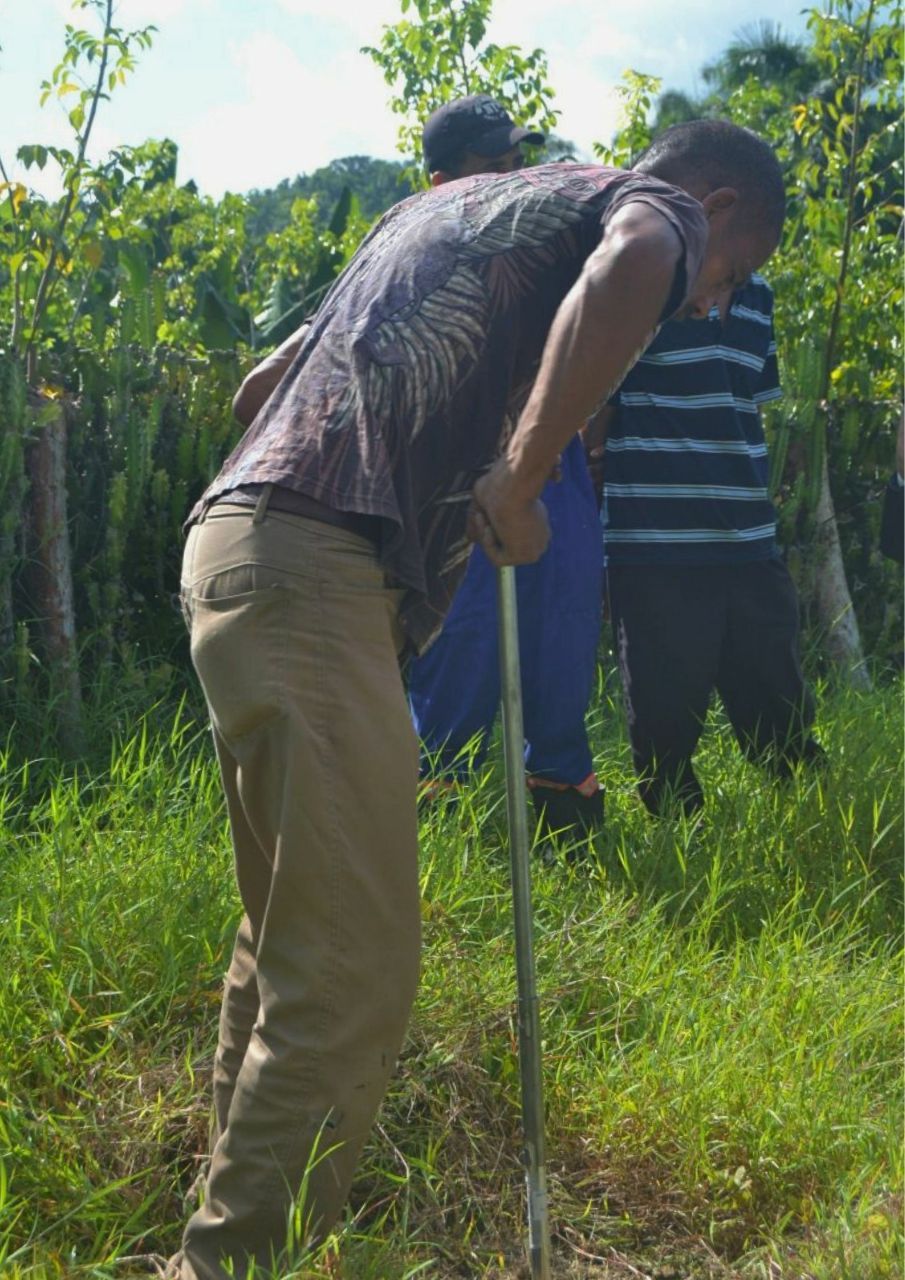
Durante el primer día de jornada en el campo, trabajamos en un terreno cubierto de vegetación no productivo, donde algunos de nosotros aprendimos a usar la herramienta especializada para extraer muestras representativas del suelo. Para ello, se removía cuidadosamente la capa vegetal, ya que contiene materia orgánica en descomposición que podría afectar los resultados del estudio. Posteriormente, se tomaban muestras a una profundidad específica para asegurar que reflejaran las condiciones reales del sustrato.

La medición de distancias entre puntos de muestreo es fundamental para obtener una buena representación espacial del área de estudio. Para ello, utilizamos cintas métricas y GPS, cuyos datos garantizan registros precisos y facilitan la elaboración de mapas. Los profesores chinos estuvieron evaluando nuestra labor constantemente y corrigiendo algunos de nuestros errores.

Además de nuestra tarea con el instrumento muestreador, también hubo espacio para intercambiar conocimientos sobre la importancia de seguir los pasos indicados y obtener buenos resultados; además, la correcta manipulación de los ejemplares, evitando contaminaciones. Por ejemplo, los cubanos pensábamos que los chinos utilizaban equipos automáticos y sofisticados para esta actividad, y la verdad es que utilizan el mismo útil que nosotros para evitar dañar la tierra.

Fue una buena experiencia: el trabajo arduo, bajo el intenso sol y el calor insoportable. Aunque este fue un entrenamiento, pudimos constatar la gran responsabilidad que tendremos una vez que comience la faena real. Algunas de las expectativas con este proyecto son mejorar la agricultura cubana, controlar y reducir la contaminación ambiental, planificar mejor el uso de nuestros recursos minerales y prevenir enfermedades causadas por metales tóxicos y elementos nocivos. Espero que se logren alcanzar los objetivos.
English
Hello 👋. Recently, I had the opportunity to participate in an important work activity in two rural areas of the province of Mayabeque and the locality of Campo Florido (Havana del Este), with the collaboration of the Geological Survey of China. Alongside the Chinese professors, specialists and managers from the Geomineral Companies, the Geology Directorate of the Ministry, and researchers from the Institute of Geology and Paleontology, Geological Survey of Cuba (IGP), also took part.
This activity was organized by the Western Mining Company together with the IGP and was focused on teaching how to correctly collect samples for geochemical mapping.
During the first day in the field, we worked on land covered with non-productive vegetation, where some of us learned to use the specialized tool to extract representative soil samples. The vegetal layer was carefully removed because it contains decomposing organic matter that could affect the study results. Then, samples were taken at a specific depth to ensure they reflected the real conditions of the substrate.
Measuring distances between sampling points is essential to obtain a good spatial representation of the study area. For this, we used measuring tapes and GPS, whose data guarantee precise records and facilitate map making. The Chinese professors were constantly evaluating our work and correcting some of our mistakes.
Besides our task with the sampling instrument, there was also room to exchange knowledge about the importance of following the indicated steps and obtaining good results; also, the correct handling of samples to avoid contamination. For example, we Cubans thought the Chinese used automatic and sophisticated equipment for this activity, but in fact, they use the same tool as we do to avoid damaging the soil.
It was a good experience: hard work under intense sun and unbearable heat. Although this was training, we could acknowledge the great responsibility we will have once the real task begins. Some of the expectations with this project are to improve Cuban agriculture, control and reduce environmental pollution, better plan the use of our mineral resources, and prevent diseases caused by toxic metals and harmful elements. I hope the objectives will be achieved.
Translated with DeepL.com (free version)
Images were taken by me

