

The big bad wolf lost, the good little pigs survived, and the world regained its order. It was a clear lesson: hard work (the brick house) triumphs over shortcuts (straw and wood) and external threats.
However, rereading it today, decades later, completely transforms its meaning. The first thing that stands out is the demonization of the wolf. Was he really "bad," or simply a hungry predator acting on instinct for survival? From a contemporary ecological and ethical perspective, the story constructs a scapegoat: the wolf represents the dangerous "other," the different one who must be eliminated. The little pigs, moreover, are not so exemplary: the first and second squander resources without foresight, and their punishment (being devoured, at least in the original versions) seems disproportionate.

Today, the story invites more complex interpretations. On the one hand, it speaks to housing vulnerability: not everyone can afford "bricks"—a symbol of structural, economic, and emotional security—and millions live in "straw houses" facing systemic threats: climate crises, gentrification, and job insecurity. On the other hand, the happy ending (the three little pigs together in the strong house, the scalded wolf fleeing) is now read as a violent resolution that avoids dialogue. Wasn't there a possibility of negotiation? Of sharing food or territory?
Even so, the story remains relevant in its essential message: community protects. The third little pig is not only diligent but also supportive: he takes in his brothers, and together they face the threat. In times of fierce individualism, that lesson endures. The wolf, meanwhile, can be seen as a symbol of that which we fear without understanding.
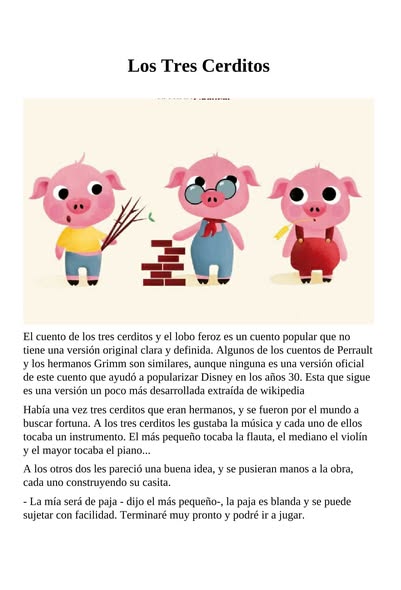
In the end, "The Three Little Pigs" no longer seems to me a simple triumph of good over evil. It's a mirror of how we construct fears and exclusions. And perhaps that's why, after so many years, it remains an adult tale disguised as a children's story.
Credits: I used Google Translate.
ESPAÑOL
“Los tres cerditos” fue, como para muchos niños, un relato fascinante. En esa edad, la magia residía en la repetición —“soplaré y soplaré y la casa derribaré”— y en la victoria final del ingenio sobre la fuerza bruta. El lobo malo perdía, los cerditos buenos sobrevivían, y el mundo recuperaba el orden.
Era una lección clara: el trabajo duro (la casa de ladrillos) vence al atajo (paja y madera) y a la amenaza externa.
Sin embargo, releerlo hoy, décadas después, transforma por completo su significado. Lo primero que salta es la demonización del lobo. ¿Realmente era “malo”, o simplemente un depredador hambriento actuando por instinto de supervivencia? Desde una mirada ecológica y ética contemporánea, el cuento construye un chivo expiatorio: el lobo representa al “otro” peligroso, al diferente que debe ser eliminado. Los cerditos, además, no son tan ejemplares: el primero y segundo derrochan recursos sin previsión, y su castigo (ser devorados, al menos en versiones originales) parece desproporcionado.
En la actualidad, el relato invita a lecturas más complejas. Por un lado, habla de la vulnerabilidad habitacional: no todos pueden permitirse “ladrillos” —símbolo de seguridad estructural, económica y emocional—, y millones viven en “casas de paja” frente a lobos sistémicos: crisis climáticas, gentrificación, precariedad laboral. Por otro lado, el final feliz (los tres cerditos juntos en la casa fuerte, el lobo escaldado huyendo) se lee hoy como una resolución violenta que elude el diálogo. ¿No cabía una negociación? ¿Compartir comida o territorio?
Aun así, el cuento conserva vigencia en su mensaje esencial: la comunidad protege. El tercer cerdito no solo es diligente, sino solidario: acoge a sus hermanos y juntos enfrentan la amenaza. En tiempos de individualismo feroz, esa lección persiste. El lobo, mientras tanto, puede reivindicarse como símbolo de aquello que tememos sin comprender.
Al final, “Los tres cerditos” ya no me parece un simple triunfo del bien sobre el mal. Es un espejo de cómo construimos miedos y exclusiones. Y quizá por eso, después de tantos años, sigue siendo un cuento adulto disfrazado de historia infantil.
Créditos: Usé el traductor de Google.