
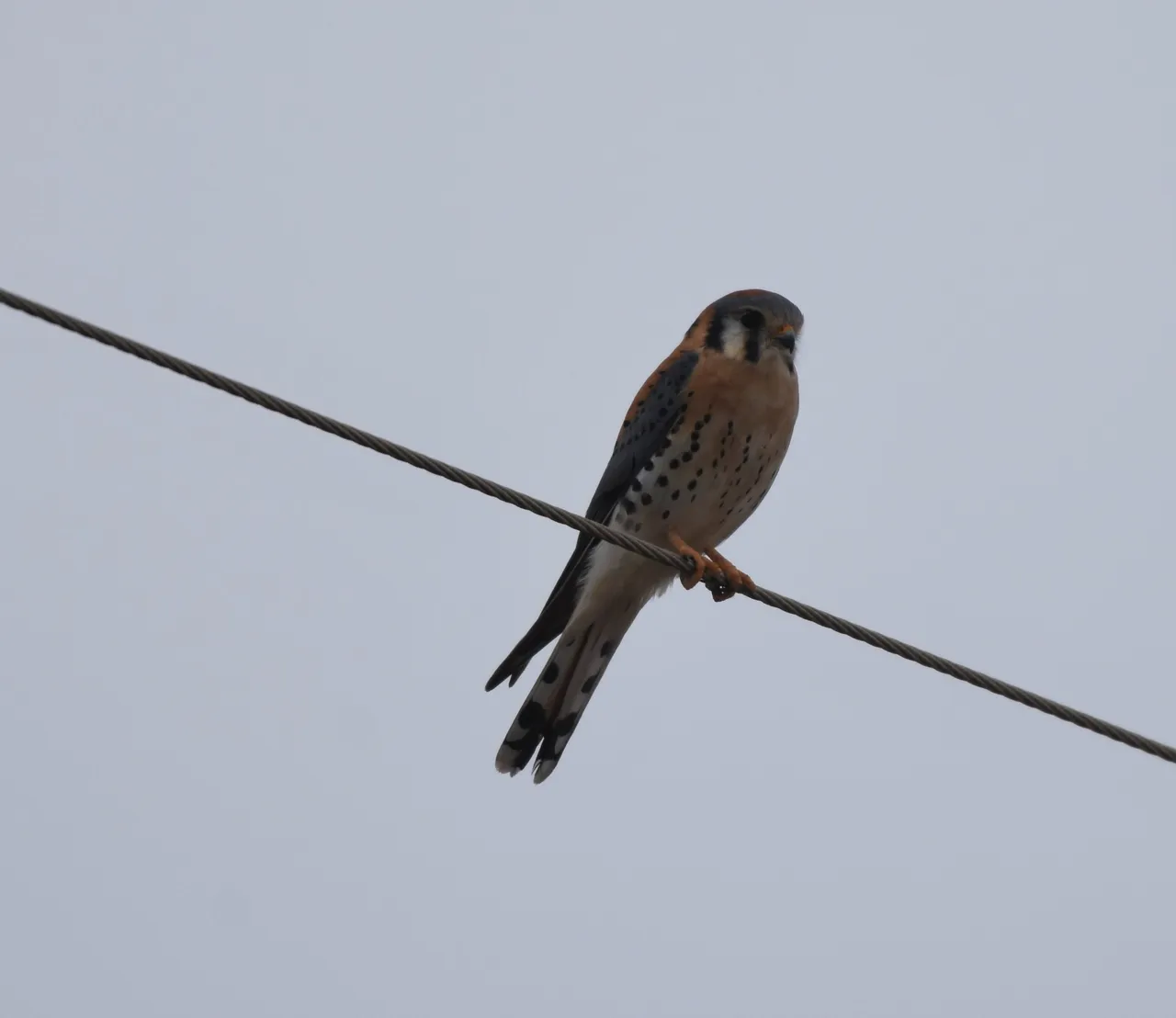
American Kestrel Falco sparverius is the smallest of the six regularly occuring falcons in the western hemisphere regularly. There are 13 kestrel species in the world, but this is the only one found in North America. This falcon is pretty common in areas with open fields, and feeds on a variety of prey, including small mammals, small birds and large insects like grasshoppers which are typically captured on or near the ground. These birds like to hunt both from a perch and by overing over a field. Like most species of birds of prey the female is larger than the male. The theory is that the larger body mass makes them better at sitting on a nest and the smaller male is a more efficient hunter.
Kestrels are just slightly larger than our next larger falcon, the Merlin, but though at first glance similar in size, all resemblence disappears in flight. Kestrels fly somewhat languidly, seeming in no hurry, and Merlin are startlingly fast, direct and powerful in flight.
American Kestrel are a cavity nester, and will use human made nest boxes in the proper habitat. The nest typically contains 4-5 eggs which hatch in 27-29 days. The young are born with a soft downy feathering, and open their eyes by the second day. In about another 28-31 days the young typically fledge. The young are only dependent on their parents for food for about 12-14 days, and during the third week the fledglings become proficient at capturing prey and cease to beg for food.

It is always a treat to see a falcon, and to admire these colorful and graceful small falcons always pleases.
Good birding.