

One of the most important and useful part of a car that acts likes a superhero snatching us away from the reaper, today we are talking about the person that saves us from crashing or killing someone.
⚡⚡ The Brakes⚡⚡
One important concept of brakes; A vehicle is in motion and for some reason needs to stop, the brakes uses friction to decelerate.
The wheels has kinetic energy and the brakes apply friction causing heat. Transforming all the kinetic energy of the wheel to heat to put the car to a stop.
Note: Different vehicles has different way to apply friction.
History of Brakes
The first brakes were just pieces of of wood pushed on the wheel (you'll find them now on some wheel chairs).
These breaking system at times tear the wheel. To avoid wheel tear, you'll have to attach something to the tyre to stop the car, in year 1900, Wilhelm Maybach was the first car maker to put in the drum on the tyre to assist braking and not tear the wheel.

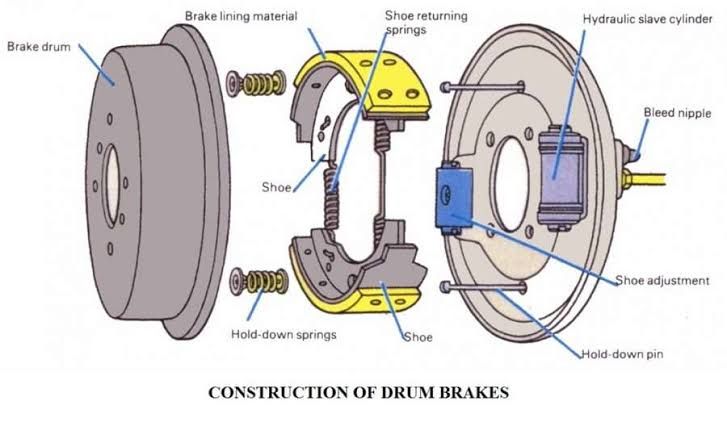
These drum brakes has a heat resistant pad that press outwards and push against the drum creating friction and stopping the car. The downside was that the early drum brakes used cables, the cables needed maintenance (a lot of maintenance) and often, the cable cut when you need them most, another problem was precision; as the cables are connect at different length, the longer cable needs more pressure, so while adding more pressure to the cable, it might overstretch the shorter cable and snap as usual.

Hydraulics were better option, the use pressurized incompressible fluids to pass energy through a pass way like pipes etc etc etc. When the brakes pads are stepped on, a plunge is depressed in the master cylinder sending the pressure through all the brake lines and all four wheels at once. They don't require much maintenance, they rearly rupture and they need very little pressure from the pad. By 1950 drum brakes were the only braking system in cars.
The downside was that on frequent braking, they got really hot and can't transfer kinetic energy to heat and at most times, that's when you need them most. Now that was not helpful; drum brakes push out, it was later realized that more friction can be created by squeezing in and increasing surface area, so disc brakes were introduced
A caliper is attached to a disc. When the brake is applied, the piston in the caliper squeezes the disc and the disc stops the wheel (they wheel and disc are attached together). The bigger the discs and calipers are, the more easy it is to dissipate heat. Disc brakes are not in a drum so they are not easily overheated. Disc brakes were first used in Formula 1 in 1951.
In 1955,
Citroën was the first company to put them on production cars, but as cars became faster, disc brakes became more necessary, that doesn't mean that drum brakes ain't useful, when a car brakes, most of the weght goes to the front due to "diving"


Giving the front about 70% of the car's weight. That's why some cars have disc brakes in front wheel and drum brakes at the rear wheel. Since drum brakes are cheaper to produce, some manufacturers put them in lighter cars.
Fun Facts
Because of the heat disc brakes produce, they may have holes or gaps or fins for air movement.
Most pads are made of semi-metallic materials; synthetics mixed with different proportions of flaked matels.

Road cars discs can heat up to 400°F (204°C) but race brakes heat up to and above 1000°F (537.7°C) hey thats as hot as me😎😎😎. That's why race pads are made of sintered steel without any synthetic additives. Sintered steel work best at high temperature.

Brakes Problems
Squealing indicates that you are running out of brakes. Manufacturers put an indicators in the brakes

Leaking brakes fluids.
Faulty Brake Calipers etc.
There are more thing than just brakes that saves our butt
I'm talking ABS, EBD etc.
Wel, I'll talk about them later.
In conclusion, always appreciate your brakes!!!!!!!!!!!!