
 Debt vs Autonomy, From Dr. Robert Malone

I came up with a new idea while reading 

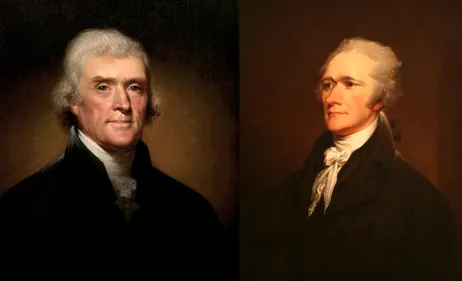
At the macro scale, the same holds true for Nation-States and those who seek to function as political leaders of either Nations or States. The leaders functionally must sell their autonomy to the highest bidders in order to gain office. They have very little operational autonomy, even if they have good intentions to implement constructive and adaptive changes which will advance the interests of their state or country. The central banks and those who control them actively promote political forces and agendas (including war!) to drive Nation-States into indebtedness so that they can functionally extract a form of rent and control the politics of these captured organizations so that the banks and their owners can control global affairs to benefit their commercial interests. Please see “The Federal Reserve Cartel: The Rothschild, Rockefeller and Morgan Families” by John Morse for a detailed historical analysis of these strategies and behaviors. Both Thomas Jefferson and Alexander Hamilton foresaw this. Jefferson fought to preserve the autonomy of United States citizens, while Alexander Hamilton fought to enable and empower what were essentially the financial oligarchy of his day - which has persisted remarkably intact through time!
To further illustrate this point, it is helpful to compare and contrast the awareness of the dangers inherent in incremental loss of autonomy and commitment to individual autonomy of Thomas Jefferson to the deeply embedded sense of entitlement and elitism of Alexander Hamilton.
“Single acts of tyranny may be ascribed to the accidental opinion of the day; but a series of oppressions, begun at a distinguished period, and pursued unalterably through every change of ministers (administrators) too plainly proves a deliberate, systematic plan of reducing us to slavery.”
Thomas Jefferson, A Summary View of the Rights of British America (ed. 1774)
“If a nation expects to be ignorant & free, in a state of civilization, it expects what never was & never will be. The functionaries of every government have propensities to command at will the liberty & property of their constituents. There is no safe deposit for these but with the people themselves; nor can they be safe with them without information. Where the press is free and every man able to read, all is safe.”
Thomas Jefferson, The Papers of Thomas Jefferson, Retirement Series, Volume 9: 1 September 1815 to 30 April 1816
“All communities divide themselves into the few and the many. The first are the rich and well born, the other the mass of the people. The voice of the people has been said to be the voice of God; and however generally this maxim has been quoted and believed, it is not true in fact. The people are turbulent and changing; they seldom judge or determine right. Give therefore to the first class a distinct, permanent share in the government.”
Alexander Hamilton. Said on June 19, 1787. The Records Of The Federal Convention Of 1787, book edited by Max Farrand. Volume I, p. 299, 1937.
In many ways, Jefferson and Hamilton represent the great tension at the heart of the American experiment in self governance, and the battle between the two political forces which these individuals represent is the central conflict which has dominated American politics since even before the Declaration of Independence, Constitution and Bill of Rights were drafted. Thomas Jefferson, together with John Adams, James Madison and Thomas Paine were the leaders of the populist block during the time of the American Enlightenment and the creation of the United States. In contrast, Alexander Hamilton was closely allied with the Rothschild banking and finance family. For example, with Rothschild financing Alexander Hamilton founded two New York banks, including the Bank of New York. The Rothschild family owns the Bank of England and leads the European Freemason movement. All US Masonic lodges are to this day warranted by the British Crown, whom they serve as a global intelligence and counterrevolutionary subversion network. Hamilton was one of many Founding Fathers who were Freemasons. George Washington, Benjamin Franklin, John Jay, Ethan Allen, Samuel Adams, Patrick Henry, John Brown and Roger Sherman were also Masons. Roger Livingston helped Sherman and Franklin write the Declaration of Independence. He gave George Washington his oaths of office while he was Grand Master of the New York Grand Lodge of Freemasons. Washington himself was Grand Master of the Virginia Lodge. Of the General Officers in the Revolutionary Army, thirty-three were Masons. The First Continental Congress convened in Philadelphia in 1774 under the Presidency of Peyton Randolph, who succeeded Washington as Grand Master of the Virginia Lodge. The Second Continental Congress convened in 1775 under the Presidency of Freemason John Hancock. In 1779 Benjamin Franklin became Grand Master of the French Neuf Soeurs (Nine Sisters) Masonic Lodge, to which John Paul Jones and Voltaire belonged. Franklin was also a member of the more secretive Royal Lodge of Commanders of the Temple West of Carcasonne, whose members included Frederick Prince of Whales.
As I read the above sentences, I concluded that American independence was achieved by George Washington, but American political and economic thought was created by Thomas Jefferson and Alexander Hamilton!😮
I thought that Thomas Jefferson created political and economic ideas for America's common people and Alexander Hamilton for America's elite!

By the way, I guess my esteemed senior 
Perhaps he had the greatest respect for George Washington!

I wonder if my younger brother 
I read
In any case, reading articles by my esteemed senior
So, I decided to write an article about Chinese history to show my respect to the genius
I will now write about Thomas Jefferson and Alexander Hamilton of ancient China!


Everything in China is Fake, Including their Sources
Perhaps my lamp's genie 
So, he wrote articles about their shortcomings, along with a personal displeasure towards the Chinese and their country.
I agree with most of his arguments! Surely he wrote a lot of information about areas the Chinese wanted to hide.
Forget the Trade War - China Has a Bigger Problem: Starvation
Reading his articles has helped me a lot. However, his claims are punishable by prison terms for spreading misinformation in the world I live in.
Because the world I live in has become an economic colony of China.
In any case, I will now write an article about Thomas Jefferson and Alexander Hamilton in ancient China!
Perhaps
 Late Spring and Autumn period, 5th century BCE, before the breakup of Jin and the Qin move into Sichuan. The Wei on this map is Wey, not the other Wei that arose from the Partition of Jin.
The Spring and Autumn period was a period in Chinese history from approximately 770 to 476 BCE (or according to some authorities until 403 BCE[a])[2] which corresponds roughly to the first half of the Eastern Zhou period. The period's name derives from the Spring and Autumn Annals, a chronicle of the state of Lu between 722 and 479 BCE, which tradition associates with Confucius (551–479 BCE).
During this period, the Zhou royal authority over the various feudal states eroded as more and more dukes and marquesses obtained de facto regional autonomy, defying the king's court in Luoyi and waging wars amongst themselves. The gradual Partition of Jin, one of the most powerful states, marked the end of the Spring and Autumn period and the beginning of the Warring States period.
The Spring and Autumn period occurred in a period similar to the Greek Dark Ages and had equal historical value.
 Greek Dark Ages
The Greek Dark Ages is the period of Greek history from the end of the Mycenaean palatial civilization around 1100 BC to the beginning of the Archaic age around 750 BC.[1]
The archaeological evidence shows a widespread collapse of Bronze Age civilization in the Eastern Mediterranean world at the outset of the period, as the great palaces and cities of the Mycenaeans were destroyed or abandoned. At about the same time, the Hittite civilization suffered serious disruption as cities from Troy to Gaza were destroyed. In Egypt, the New Kingdom fell into disarray that led to the Third Intermediate Period of Egypt.
Following the collapse, fewer, smaller settlements suggest extensive famine and depopulation. In Greece, the Linear B script used by Mycenaean bureaucrats to write the Greek language ceased, with the Greek alphabet not developing until the beginning of the Archaic Period. The decoration on Greek pottery after about 1100 BC lacks the figurative decoration of Mycenaean ware and is restricted to simpler, generally geometric styles (1000–700 BC).
It was previously thought that all contact was lost between mainland Hellenes and foreign powers during this period, yielding little cultural progress or growth. But archaeologist Alex Knodell considers that artifacts from excavations at Lefkandi on the Lelantine Plain in Euboea in the 1980s "revealed that some parts of Greece were much wealthier and more widely connected than traditionally thought, as a monumental building and its adjacent cemetery showed connections to Cyprus, Egypt, and the Levant as markers of elite status and authority, much as they had been in previous periods",[2] and this shows that significant cultural and trade links with the east, particularly the Levant coast, developed from c. 900 BC onwards. Additionally, evidence has emerged of the new presence of Hellenes in sub-Mycenaean Cyprus and on the Syrian coast at Al-Mina.
The Spring and Autumn period
The Spring and Autumn period was the longest dark period of war and barbarism in Chinese history, but at the same time it was also a golden period of culture in which the first Chinese religions, philosophies, and ideas emerged.
 Birthplaces of notable Chinese philosophers from Hundred Schools of Thought in the Zhou dynasty.
The Hundred Schools of Thought (Chinese: 諸子百家; pinyin: zhūzǐ bǎijiā) were philosophies and schools that flourished from the 6th century BC to 221 BC during the Spring and Autumn period and the Warring States period of ancient China.[1]
An era of substantial discrimination in China,[2] it was fraught with chaos and bloody battles, but it was also known as the Golden Age of Chinese philosophy because a broad range of thoughts and ideas were developed and discussed freely. This phenomenon has been called the Contention of a Hundred Schools of Thought (百家爭鳴/百家争鸣; bǎijiā zhēngmíng; pai-chia cheng-ming; "hundred schools contend"). The thoughts and ideas discussed and refined during this period have profoundly influenced lifestyles and social consciousness up to the present day in East Asian countries and the East Asian diaspora around the world. The intellectual society of this era was characterized by itinerant scholars, who were often employed by various state rulers as advisers on the methods of government, war, and diplomacy.
This period ended with the rise of the imperial Qin dynasty and the subsequent purge of dissent.
The "Yiwenzhi" of the Hanshu claims that the officials working for the government during the early Zhou Dynasty lost their position when the authority of the Zhou rulers began to break down in the Eastern Zhou period. In this way, the officials spread all over the country and started to teach their own field of knowledge as private teachers. In this way the schools of philosophy were born. In particular, the School of Scholars (i.e. the Confucian School) was born from the officials of the Ministry of Education; the Taoists from the historians; the Yin-yang School from the astronomers; the Legalist School from the Ministry of Justice; the School of Names from the Ministry of Rituals; the Mohist School from the Guardians of the Temple; the School of Diplomacy from the Ministry of Embassies; the School of Miscellany from the government counselors; the School of Agriculture from the Ministry of the Soil and Wheat; the School of Minor Talks from the minor officials. Although the details are unclear, the burning of books and burying of scholars during the Qin was the end of the period of open discussion.
It should be stressed that only the Ru, or Confucians and the Mohists were actual organized schools of teachers and disciples during this period. All the other schools were invented later to describe groups of texts that expressed similar ideas. There was never an organized group of people describing themselves as "Legalists," for example, and the term "Daoist" was only coined in the Eastern Han after having succeeded the Western Han's Huang-Lao movement.
The thinkers of this era were called The Hundred Schools of Thought (Chinese: 諸子百家; pinyin: zhūzǐ bǎijiā), and they created the foundations from which all civilizations in China and East Asia were created.
Even today, they are regarded as the greatest thinkers who have had a profound influence on East Asian thinkers.
I think they are probably geniuses comparable to
So, I've decided to call them Chinese 
Perhaps their influence is similar to that of the ancient Greeks Thales, Pythagoras, Plato, and Aristotle on my American seniors.😄
As they wandered the mainland of China 2600 years ago, they cried out that they could build a heaven on earth through their religion and ideology.
Lao-tzu is regarded as the first pioneer among such geniuses.
 Laozi by Zhang Lu; Ming dynasty (1368–1644)
Laozi (UK: /ˌlaʊˈzɪər/;[2] Chinese: 老子, Mandarin: [làu.tsɹ̩]; commonly translated as "Old Master") also rendered as Lao Tzu (/ˈlaʊ ˈtsuː, -ˈdzʌ/),[3][4] and Lao-Tze (/ˈlaʊ ˈdzeɪ/),[5] was an ancient Chinese philosopher and writer.[6] He is the reputed author of the Tao Te Ching,[7] the founder of philosophical Taoism, and a deity in religious Taoism and traditional Chinese religions.
A semi-legendary figure, Laozi is usually portrayed as a 6th-century BCE contemporary of Confucius in the Spring and Autumn period. Some modern historians consider him to have lived during the Warring States period of the 4th century BCE.[8] A central figure in Chinese culture, Laozi is claimed by both the emperors of the Tang dynasty and modern people of the Li surname as a founder of their lineage. Laozi's work has been embraced by various anti-authoritarian movements,[9] and has had a profound impact on subsequent Chinese philosophers, who have both commended and criticized his work extensively.
Laozi itself is a Chinese honorific title: 老 (Old *rˤu ʔ, "old, venerable")[10] and 子 (Old *tsəʔ, "master").[10] In traditional accounts, Laozi's actual personal name is usually given as Li Er (李耳, Old *rəʔ nəʔ,[10] Mod. Lǐ Ěr) and his courtesy name as Boyang (trad. 伯陽, simp. 伯阳, Old *Pˤrak-lang,[10] Mod. Bóyáng). A prominent posthumous name was Li Dan (李聃, Lǐ Dān).[11][12][13] Sima Qian in his biography mentions his name as Lǐ Ěr, and his literary name as Lǐ Dān, which became the deferential Lǎo Dān (老聃, Lǎo Dān).[14] The name Lǎodān also appears interchangeably with Lǎozi in early Daoist texts such as the Zhuangzi,[14] and may also be the name by which Laozi was addressed by Confucius when they possibly met.[14] According to the Companion Encyclopedia of Asian Philosophy, "the 'founder' of philosophical Daoism is the quasi-legendary Laodan, more commonly known as Laozi (Old Master)".[15]
The honorific title Laozi has been romanized numerous ways, sometimes leading to confusion. The most common present form is Laozi, which is based on the Hanyu Pinyin system.[16] From the 1920s to the 1990s, Lao Tzu was the most common romanization.[17][16] In the 19th century, the title was usually romanized as Lao-tse.[16][18] Other forms include the variants Lao-tze,[19] Lao-tsu.[20]
Laozi 老子 created the first national religion in China or East Asia.
He argued that a person can become a god through his own strength and effort.
The gods he claimed were polytheistic gods, not the monotheistic concept that Abraham advocated.
His ideology or religion was later called Taoism.
 도로 Tao, a Chinese word signifying way, path, route, road or, sometimes more loosely, doctrine.
Taoism (/ˈtaʊɪzəm/, /ˈdaʊɪzəm/) or Daoism (/ˈdaʊɪzəm/) refers to either a school of philosophical thought (道家; daojia) or to a religion (道教; daojiao); both share ideas and concepts of Chinese origin and emphasize living in harmony with the Tao (Chinese: 道; pinyin: Dào; lit. 'Way', 'Thoroughfare' or Dao). The Tao Te Ching, a book containing teachings attributed to Laozi (老子), together with the later writings of Zhuangzi, are both widely considered the keystone works of Taoism.
In Taoism, the Tao is the source of everything and the ultimate principle underlying reality.[2][3] Taoism teaches about the various disciplines for achieving perfection through self-cultivation. This can be done through the use of Taoist techniques and by becoming one with the unplanned rhythms of the all, called "the way" or "Tao".[2][4] Taoist ethics vary depending on the particular school, but in general tend to emphasize wu wei (action without intention), naturalness, simplicity, spontaneity and the Three Treasures: 慈, compassion, 儉, frugality and 不敢爲天下先, humility.
The roots of Taoism go back at least to the 4th century BCE. Early Taoism drew its cosmological notions from the School of Yinyang (Naturalists) and was deeply influenced by one of the oldest texts of Chinese culture, the I Ching, which expounds a philosophical system about how to keep human behavior in accordance with the alternating cycles of nature. The Legalist Shen Buhai (c. 400 – c. 337 BCE) may also have been a major influence, expounding a realpolitik of wu wei, or qualified inaction.[5]
Taoism has had a profound influence on Chinese culture in the course of the centuries and Taoists (道士; dàoshi, "masters of the Tao"), a title traditionally attributed only to the clergy and not to their lay followers, usually take care to note the distinction between their ritual tradition and the practices of Chinese folk religion and non-Taoist vernacular ritual orders, which are often mistakenly identified as pertaining to Taoism. Chinese alchemy (especially neidan), Chinese astrology, Chan (Zen) Buddhism, several martial arts including kung fu, traditional Chinese medicine, feng shui and many styles of qigong have been intertwined with Taoism throughout history.
Today, the Taoist religion is one of the five religious doctrines officially recognized by the People's Republic of China (PRC), including in its special administrative regions (SARs) of Hong Kong and Macau.[6] It is also a major religion in Taiwan[7] and has a significant number of adherents in a number of other societies throughout East and Southeast Asia, particularly in Malaysia, Singapore and Vietnam.
From the perspective of Westerners, it will be difficult to distinguish whether Taoism is a religion or an ideology.
The reason is that Laozi 老子 did not create the concepts of heaven and hell, soul and salvation.
He simply made a vague claim that all humans could become gods if they followed Tao道.
From my point of view, I guess that Laozi 老子's ideas or religions are similar to animism and shamanism.
My seniors
Because Laozi 老子's ideas were very simple, they were very popular with the common people, who were mostly illiterate.
So, until now, Taoism has become the foundation of the most fundamental beliefs of East Asians.
Taoism has formed the foundation of East Asians' view of the universe, the world, the present, and the soul.
As Taoism easily dominated the peoples of East Asia, overlords began to use it.
Overlords instilled in the masses new ideas in Taoism that they would be happy if they depended on the mercy and grace of the overlords.
So, Modern East Asians neither understand nor accept the argument of
Taoism provides the most fundamental doctrine that China is the center of the universe and of the world.
Taoism also became the foundation of China's national religion, in which Chinese overlords were the Son of Heaven.
 Son of Heaven was a title of the King Wu of Zhou and subsequent Chinese sovereign
Son of Heaven, or Tianzi (Chinese: 天子; pinyin: Tiānzǐ), was the sacred monarchical title of the Chinese sovereign. It originated with the Zhou dynasty and was founded on the political and spiritual doctrine of the Mandate of Heaven. Since the Qin dynasty, the secular imperial title of the Son of Heaven was "Huangdi".
The title, "Son of Heaven", was subsequently adopted by other Sinospheric monarchs to justify their rule.
The Son of Heaven was the supreme universal monarch, who ruled tianxia (means "all under heaven"). His status is rendered in English as "ruler of the whole world."[1] The title, "Son of Heaven", was interpreted literally only in China and Japan, whose monarchs were referred to as demigods, deities, or "living gods", chosen by the gods and goddesses of heaven.[2]
Taoism became the most essential foundation for polytheistic idolatry that made China's overlords gods.
Even today, it is the basis of polytheism in East Asia.
So, I believe Lao-tzu is in the same position as Thomas Jefferson and Alexander Hamilton!
Perhaps if I had the English level of
I still have many thoughts and feelings, but it is difficult for me to write any more sentences with my English writing skills.
So, I will write a sequel next time!
I look forward to your help and advice!