


Reading 
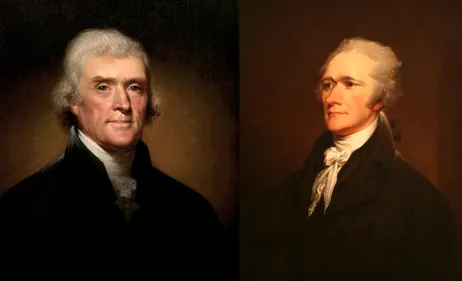 Debt vs Autonomy, From Dr. Robert Malone
In many ways, Jefferson and Hamilton represent the great tension at the heart of the American experiment in self governance, and the battle between the two political forces which these individuals represent is the central conflict which has dominated American politics since even before the Declaration of Independence, Constitution and Bill of Rights were drafted. Thomas Jefferson, together with John Adams, James Madison and Thomas Paine were the leaders of the populist block during the time of the American Enlightenment and the creation of the United States. In contrast, Alexander Hamilton was closely allied with the Rothschild banking and finance family. For example, with Rothschild financing Alexander Hamilton founded two New York banks, including the Bank of New York. The Rothschild family owns the Bank of England and leads the European Freemason movement. All US Masonic lodges are to this day warranted by the British Crown, whom they serve as a global intelligence and counterrevolutionary subversion network. Hamilton was one of many Founding Fathers who were Freemasons. George Washington, Benjamin Franklin, John Jay, Ethan Allen, Samuel Adams, Patrick Henry, John Brown and Roger Sherman were also Masons. Roger Livingston helped Sherman and Franklin write the Declaration of Independence. He gave George Washington his oaths of office while he was Grand Master of the New York Grand Lodge of Freemasons. Washington himself was Grand Master of the Virginia Lodge. Of the General Officers in the Revolutionary Army, thirty-three were Masons. The First Continental Congress convened in Philadelphia in 1774 under the Presidency of Peyton Randolph, who succeeded Washington as Grand Master of the Virginia Lodge. The Second Continental Congress convened in 1775 under the Presidency of Freemason John Hancock. In 1779 Benjamin Franklin became Grand Master of the French Neuf Soeurs (Nine Sisters) Masonic Lodge, to which John Paul Jones and Voltaire belonged. Franklin was also a member of the more secretive Royal Lodge of Commanders of the Temple West of Carcasonne, whose members included Frederick Prince of Whales.
During creation of the nation, populist Thomas Jefferson argued that the United States needed a publicly-owned central bank so that European monarchs and aristocrats could not use the printing of money to control the affairs of the new nation. However, larger forces were set in motion which favored a privately owned central bank for the new nation. In 1789 Alexander Hamilton became the first Treasury Secretary of the United States (under President George Washington). Thomas Jefferson was appointed Secretary of State. William Randolph became the nation’s first Attorney General and Secretary of State under George Washington, but his family returned to England loyal to the Crown. John Marshall, the nation’s first Supreme Court Justice, was also a Mason. The Rothschilds sponsored Hamilton’s arguments for a private US central bank, and in the end carried the day. In 1791 the Bank of the United States (BUS) was founded, with the Rothschilds as main owners.
I understood that
Perhaps from my point of view, I understood that Thomas Jefferson created policy for the American commoner, and Alexander Hamilton created policy for the American elite.
I felt that Thomas Jefferson represented the ideology of the Democratic Party of America and Alexander Hamilton of the Republican Party of America.😃

P.S. I do not agree with ValuedCustomers presentation of the history of America which you cite at the beginning of your post.
Perhaps 
Because I have English conversation at the level of an elementary school student in the United States, it is difficult to understand the thoughts and arguments of two American seniors.
Since I enjoy studying comparative American and Chinese histories, I decided to write articles about the masters of ancient China, first of all, comparable to Thomas Jefferson and Alexander Hamilton.
So, dear
Even if I don't understand your excellent English sentences, I hope you understand!
@goldgrifin007/2-lao-tzu-founder-of-chinas-first-national-religion
 Laozi by Zhang Lu; Ming dynasty (1368–1644)
Laozi (Chinese: 老子, Mandarin: [làu.tsɹ̩]; commonly translated as "Old Master") also rendered as Lao Tzu (/ˈlaʊ ˈtsuː, -ˈdzʌ/),[2][3] or Lao-Tze (/ˈlaʊ ˈdzeɪ/),[4] was an ancient Chinese philosopher and writer.[5] He is the reputed author of the Tao Te Ching,[6] the founder of philosophical Taoism, and a deity in religious Taoism and traditional Chinese religions.
A semi-legendary figure, Laozi is usually portrayed as a 6th-century BCE contemporary of Confucius in the Spring and Autumn period. Some modern historians consider him to have lived during the Warring States period of the 4th century BCE.[7] A central figure in Chinese culture, Laozi is claimed by both the emperors of the Tang dynasty and modern people of the Li surname as a founder of their lineage. Laozi's work has been embraced by various anti-authoritarian movements,[8] and has had a profound impact on subsequent Chinese philosophers, who have both commended and criticized his work extensively.
Laozi (Chinese: 老子, Mandarin: [làu.tsɹ̩]; commonly translated as "Old Master") and his successors were anarchists who denied the power the rulers of the world created.
Potential officials throughout Chinese history drew on the authority of non-Confucian sages, especially Laozi and Zhuangzi, to deny serving any ruler at any time. Zhuangzi, Laozi's most famous follower in traditional accounts, had a great deal of influence on Chinese literati and culture. Lao Tsu influenced millions of Chinese people by his psychological understanding. He persuaded people by his inaction and non-speaking.[48]
Political theorists influenced by Laozi have advocated humility in leadership and a restrained approach to statecraft, either for ethical and pacifist reasons, or for tactical ends. In a different context, various anti-authoritarian movements have embraced the Laozi teachings on the power of the weak.[49]
The ideas and religions of Laozi (Chinese: 老子, Mandarin: [làu.tsɹ̩]; commonly translated as "Old Master") and his successors became the most popular religions because they were easily understood and accepted by the illiterate, who make up the majority of the Chinese population.
Laozi was a proponent of limited government.[50] Left-libertarians in particular have been influenced by Laozi – in his 1937 book Nationalism and Culture, the anarcho-syndicalist writer and activist Rudolf Rocker praised Laozi's "gentle wisdom" and understanding of the opposition between political power and the cultural activities of the people and community.[51] In his 1910 article for the Encyclopædia Britannica, Peter Kropotkin also noted that Laozi was among the earliest proponents of essentially anarchist concepts.[52] More recently, anarchists such as John P. Clark and Ursula K. Le Guin have written about the conjunction between anarchism and Taoism in various ways, highlighting the teachings of Laozi in particular.[53] In her rendition of the Tao Te Ching, Le Guin writes that Laozi "does not see political power as magic. He sees rightful power as earned and wrongful power as usurped... He sees sacrifice of self or others as a corruption of power, and power as available to anyone who follows the Way. No wonder anarchists and Taoists make good friends."[54]
The right-libertarian economist Murray Rothbard suggested that Laozi was the first libertarian,[55] likening Laozi's ideas on government to Friedrich Hayek's theory of spontaneous order.[56] James A. Dorn agreed, writing that Laozi, like many 18th-century liberals, "argued that minimizing the role of government and letting individuals develop spontaneously would best achieve social and economic harmony."[57] Similarly, the Cato Institute's David Boaz includes passages from the Tao Te Ching' in his 1997 book The Libertarian Reader.[58] Philosopher Roderick Long argues that libertarian themes in Taoist thought are actually borrowed from earlier Confucian writers.[59]
From a Western perspective, Laozi would feel like an anarchist.
I guessed that Laozi was probably a thinker similar to
As Laozi's ideas became China's most common and popular religion, it attracted the attention of Chinese overlords.
From the point of view of the overlords, the ideas and religions of Lao-tzu were anarchic and therefore likely to threaten their power.
Overlords, loved by
 Confucianism 儒家
Confucianism, also known as Ruism or Ru classicism,[1] is a system of thought and behavior originating in ancient China. Variously described as tradition, a philosophy, a religion, a humanistic or rationalistic religion, a way of governing, or simply a way of life,[2] Confucianism developed from what was later called the Hundred Schools of Thought from the teachings of the Chinese philosopher Confucius (551–479 BCE).
Confucius considered himself a transmitter of cultural values inherited from the Xia (c. 2070–1600 BCE), Shang (c. 1600–1046 BCE) and Western Zhou dynasties (c. 1046–771 BCE).[3] Confucianism was suppressed during the Legalist and autocratic Qin dynasty (221–206 BCE), but survived. During the Han dynasty (206 BCE–220 CE), Confucian approaches edged out the "proto-Taoist" Huang–Lao as the official ideology, while the emperors mixed both with the realist techniques of Legalism.[4]
A Confucian revival began during the Tang dynasty (618–907 CE). In the late Tang, Confucianism developed in response to Buddhism and Taoism and was reformulated as Neo-Confucianism. This reinvigorated form was adopted as the basis of the imperial exams and the core philosophy of the scholar official class in the Song dynasty (960–1297). The abolition of the examination system in 1905 marked the end of official Confucianism. The intellectuals of the New Culture Movement of the early twentieth century blamed Confucianism for China's weaknesses. They searched for new doctrines to replace Confucian teachings; some of these new ideologies include the "Three Principles of the People" with the establishment of the Republic of China, and then Maoism under the People's Republic of China. In the late twentieth century, the Confucian work ethic has been credited with the rise of the East Asian economy.[4]
With particular emphasis on the importance of the family and social harmony, rather than on an otherworldly source of spiritual values,[5] the core of Confucianism is humanistic.[6] According to Herbert Fingarette's conceptualisation of Confucianism as a philosophical system which regards "the secular as sacred",[7] Confucianism transcends the dichotomy between religion and humanism, considering the ordinary activities of human life—and especially human relationships—as a manifestation of the sacred,[8] because they are the expression of humanity's moral nature (xìng 性), which has a transcendent anchorage in Heaven (Tiān 天).[9] While Tiān has some characteristics that overlap the category of godhead, it is primarily an impersonal absolute principle, like the Dào (道) or the Brahman. Confucianism focuses on the practical order that is given by a this-worldly awareness of the Tiān.[10] Confucian liturgy (called 儒 rú, or sometimes simplified Chinese: 正统; traditional Chinese: 正統; pinyin: zhèngtǒng, meaning 'orthopraxy') led by Confucian priests or "sages of rites" (礼生; 禮生; lǐshēng) to worship the gods in public and ancestral Chinese temples is preferred on certain occasions, by Confucian religious groups and for civil religious rites, over Taoist or popular ritual.[11]
The worldly concern of Confucianism rests upon the belief that human beings are fundamentally good, and teachable, improvable, and perfectible through personal and communal endeavor, especially self-cultivation and self-creation. Confucian thought focuses on the cultivation of virtue in a morally organised world. Some of the basic Confucian ethical concepts and practices include rén, yì, and lǐ, and zhì. Rén (仁, 'benevolence' or 'humaneness') is the essence of the human being which manifests as compassion. It is the virtue-form of Heaven.[12] Yì (义; 義) is the upholding of righteousness and the moral disposition to do good. Lǐ (礼; 禮) is a system of ritual norms and propriety that determines how a person should properly act in everyday life in harmony with the law of Heaven. Zhì (智) is the ability to see what is right and fair, or the converse, in the behaviors exhibited by others. Confucianism holds one in contempt, either passively or actively, for failure to uphold the cardinal moral values of rén and yì.
Traditionally, cultures and countries in the East Asian cultural sphere are strongly influenced by Confucianism, including China, Taiwan, Korea, Japan, and Vietnam, as well as various territories settled predominantly by Han Chinese people, such as Singapore. Today, it has been credited for shaping East Asian societies and overseas Chinese communities, and to some extent, other parts of Asia.[13][14] In the last decades there have been talks of a "Confucian Revival" in the academic and the scholarly community,[15][16] and there has been a grassroots proliferation of various types of Confucian churches.[17] In late 2015 many Confucian personalities formally established a national Holy Confucian Church (孔圣会; 孔聖會; Kǒngshènghuì) in China to unify the many Confucian congregations and civil society organisations.
The overlords were convinced that Confucius (/kənˈfjuːʃəs/ kən-FEW-shəs; Chinese: 孔夫子; pinyin: Kǒng Fūzǐ, "Master Kǒng"; or commonly 孔子; Kǒngzǐ; c. 551 – c. 479 BCE)'s Confucianism was the most appropriate idea for them!
 Confucius孔子. Imaginary portrait by Wu Daozi (685–758), Tang dynasty
Confucius (/kənˈfjuːʃəs/ kən-FEW-shəs; Chinese: 孔夫子; pinyin: Kǒng Fūzǐ, "Master Kǒng"; or commonly 孔子; Kǒngzǐ; c. 551 – c. 479 BCE) was a Chinese philosopher and politician of the Spring and Autumn period who is traditionally considered the paragon of Chinese sages. Confucius's teachings and philosophy underpin East Asian culture and society, remaining influential across China and East Asia to this day.[24]
Confucius considered himself a transmitter for the values of earlier periods which he claimed had been abandoned in his time. His philosophical teachings, called Confucianism, emphasized personal and governmental morality, correctness of social relationships, justice, kindness, and sincerity. His followers competed with many other schools during the Hundred Schools of Thought era, only to be suppressed in favor of the Legalists during the Qin dynasty. After the collapse of Qin and the victory of Han over Chu, Confucius's thoughts received official sanction in the new government. During the Tang and Song dynasties, Confucianism developed into a system known in the West as Neo-Confucianism, and later as New Confucianism. Confucianism was part of the Chinese social fabric and way of life; to Confucians, everyday life was the arena of religion.[25]
Confucius is traditionally credited with having authored or edited many of the Chinese classic texts, including all of the Five Classics, but modern scholars are cautious of attributing specific assertions to Confucius himself. Aphorisms concerning his teachings were compiled in the Analects, but only many years after his death.
Confucius's principles have commonality with Chinese tradition and belief. With filial piety, he championed strong family loyalty, ancestor veneration, and respect of elders by their children and of husbands by their wives, recommending family as a basis for ideal government. He espoused the well-known principle "Do not do unto others what you do not want done to yourself", the Golden Rule.
Confucius (/kənˈfjuːʃəs/ kən-FEW-shəs; Chinese: 孔夫子; pinyin: Kǒng Fūzǐ, "Master Kǒng"; or commonly 孔子; Kǒngzǐ; c. 551 – c. 479 BCE) was a philosopher and politician who received the greatest love, interest, and respect from the overlords of East Asia.
Loyalty (忠, zhōng) is particularly relevant for the social class to which most of Confucius's students belonged, because the most important way for an ambitious young scholar to become a prominent official was to enter a ruler's civil service.
Confucius himself did not propose that "might makes right," but rather that a superior should be obeyed because of his moral rectitude. In addition, loyalty does not mean subservience to authority. This is because reciprocity is demanded from the superior as well. As Confucius stated "a prince should employ his minister according to the rules of propriety; ministers should serve their prince with faithfulness (loyalty)."[52]
Similarly, Mencius also said that "when the prince regards his ministers as his hands and feet, his ministers regard their prince as their belly and heart; when he regards them as his dogs and horses, they regard him as another man; when he regards them as the ground or as grass, they regard him as a robber and an enemy."[53] Moreover, Mencius indicated that if the ruler is incompetent, he should be replaced. If the ruler is evil, then the people have the right to overthrow him.[54] A good Confucian is also expected to remonstrate with his superiors when necessary.[55] At the same time, a proper Confucian ruler should also accept his ministers' advice, as this will help him govern the realm better.
In later ages, however, emphasis was often placed more on the obligations of the ruled to the ruler, and less on the ruler's obligations to the ruled. Like filial piety, loyalty was often subverted by the autocratic regimes in China. Nonetheless, throughout the ages, many Confucians continued to fight against unrighteous superiors and rulers. Many of these Confucians suffered and sometimes died because of their conviction and action.[56] During the Ming-Qing era, prominent Confucians such as Wang Yangming promoted individuality and independent thinking as a counterweight to subservience to authority.[57] The famous thinker Huang Zongxi also strongly criticised the autocratic nature of the imperial system and wanted to keep imperial power in check.[58]
Many Confucians also realised that loyalty and filial piety have the potential of coming into conflict with one another. This may be true especially in times of social chaos, such as during the period of the Ming-Qing transition.
The overlords of East Asia created the legitimacy and sanctity of their power through the ideas and religions of Confucius(/kənˈfjuːʃəs/ kən-FEW-shəs; Chinese: 孔夫子; pinyin: Kǒng Fūzǐ, "Master Kǒng"; or commonly 孔子; Kǒngzǐ; c. 551 – c. 479 BCE).
Confucius argued that the subjugated class should obey the ruling classes, including overlords.
So, Confucius is a character opposite to Lao Tzu because he created ideas and religions for the ruling class.
In conclusion, I thought the two figures were comparable to the Americans Thomas Jefferson and Alexander Hamilton.😄
East Asian civilizations, including China, have always been born and developed through harmony and confrontation between the two religions and ideas of Taoism and Confucianism.
Based on the two religions and ideologies, the Chinese have absorbed and synthesized foreign ideas, cultures, and sciences of India and Islam and Christianity.
Currently, the East Asian world is absorbing the modern civilization of the West on top of the emotional and ideological foundations of Taoism and Confucianism, which originated in China.


My dear senior
Did my brother 
Taoism and Confucianism had a crucial ideological difference in that they each insisted on decentralization and centralization. However, they both have in common that they have dogmatism that China is the center of the universe and the world.
So, these two ideas have existed as the most popular and fundamental religions of the Chinese people from time immemorial to the present.
In conculsion, From my point of view, perhaps anyone who wants to know about the Chinese and their civilization should first look at Taoism and Confucianism.
It is very difficult for an American elementary school student like me to write more English sentences. So, I decided to write an article on Confucius at the next opportunity to supplement it.😄
Your advice and help on my insufficient articles are always welcome!

PS: