

I believe that 
He introduces me to American freedom, liberation, and revolutionary ideas.
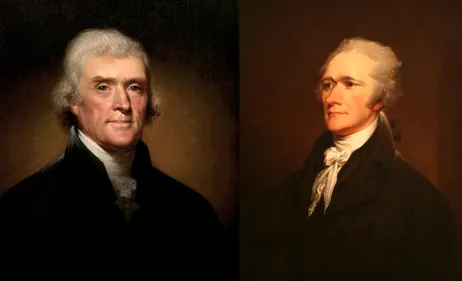 Debt vs Autonomy, From Dr. Robert Malone
In many ways, Jefferson and Hamilton represent the great tension at the heart of the American experiment in self governance, and the battle between the two political forces which these individuals represent is the central conflict which has dominated American politics since even before the Declaration of Independence, Constitution and Bill of Rights were drafted. Thomas Jefferson, together with John Adams, James Madison and Thomas Paine were the leaders of the populist block during the time of the American Enlightenment and the creation of the United States. In contrast, Alexander Hamilton was closely allied with the Rothschild banking and finance family. For example, with Rothschild financing Alexander Hamilton founded two New York banks, including the Bank of New York. The Rothschild family owns the Bank of England and leads the European Freemason movement. All US Masonic lodges are to this day warranted by the British Crown, whom they serve as a global intelligence and counterrevolutionary subversion network. Hamilton was one of many Founding Fathers who were Freemasons. George Washington, Benjamin Franklin, John Jay, Ethan Allen, Samuel Adams, Patrick Henry, John Brown and Roger Sherman were also Masons. Roger Livingston helped Sherman and Franklin write the Declaration of Independence. He gave George Washington his oaths of office while he was Grand Master of the New York Grand Lodge of Freemasons. Washington himself was Grand Master of the Virginia Lodge. Of the General Officers in the Revolutionary Army, thirty-three were Masons. The First Continental Congress convened in Philadelphia in 1774 under the Presidency of Peyton Randolph, who succeeded Washington as Grand Master of the Virginia Lodge. The Second Continental Congress convened in 1775 under the Presidency of Freemason John Hancock. In 1779 Benjamin Franklin became Grand Master of the French Neuf Soeurs (Nine Sisters) Masonic Lodge, to which John Paul Jones and Voltaire belonged. Franklin was also a member of the more secretive Royal Lodge of Commanders of the Temple West of Carcasonne, whose members included Frederick Prince of Whales.
I read Debt vs Autonomy, From Dr. Robert Malone, I felt I was able to understand the fundamentals of the Republican Party and the Democratic Party in the United States!
I understood that George Washington created the American republic, and that Thomas Jefferson and Alexander Hamilton created the political and economic foundations of the United States!
I first learned that George Washington, Thomas Jefferson, and Alexander Hamilton were the Founding Fathers of the United States!

I wonder how my respected senior 
I concluded that the fundamental ideas of the American state, politics, and economy were created by George Washington, Thomas Jefferson, and Alexander Hamilton!
Today in Japan, Mar 26 ~ The Ume Blossoms Weep
By the way, I accidentally discovered that
I don't speak Japanese, so I don't know haiku, but I guessed that maybe the
When I read articles about haiku written by a guy named 
I was also surprised to see
I guess
Can
I know a little about Chinese history, culture, literature, art, and language, but since I don't speak Japanese, I'm surprised that Westerners enjoy the classic Japanese haiku!😃
 Haiku by Matsuo Bashō reading "Quietly, quietly, / yellow mountain roses fall – / sound of the rapids"
Haiku (俳句, listen (help·info)) is a type of short form poetry originally from Japan. Traditional Japanese haiku consist of three phrases composed of 17 phonetic units (called on in Japanese, which are similar to syllables) in a 5, 7, 5 pattern;[1] that include a kireji, or "cutting word";[2] and a kigo, or seasonal reference. Similar poems that do not adhere to these rules are generally classified as senryū.[3]
Haiku originated as an opening part of a larger Japanese poem called renga. These haiku written as an opening stanza were known as hokku and over time they began to be written as stand-alone poems. Haiku was given its current name by the Japanese writer Masaoka Shiki at the end of the 19th century.[4]
Originally from Japan, haiku today are written by authors worldwide. Haiku in English and haiku in other languages have different styles and traditions while still incorporating aspects of the traditional haiku form. Non-Japanese haiku vary widely on how closely they follow traditional elements. Additionally, a minority movement within modern Japanese haiku (現代俳句, gendai-haiku), supported by Ogiwara Seisensui and his disciples, has varied from the tradition of 17 on as well as taking nature as their subject.
In Japanese, haiku are traditionally printed as a single line, while haiku in English often appear as three lines, although variations exist. There are several other forms of Japanese poetry related to haiku, such as tanka, as well as other art forms that incorporate haiku, such as haibun and haiga.
 The character that more-or-less means "poetry", in the ancient Chinese Great Seal script style. The modern character is shī (詩/诗).
Classical Chinese poetry is traditional Chinese poetry written in Classical Chinese and typified by certain traditional forms, or modes; traditional genres; and connections with particular historical periods, such as the poetry of the Tang dynasty. The existence of classical Chinese poetry is documented at least as early as the publication of the Classic of Poetry (Shijing). Various combinations of forms and genres have developed over the ages. Many or most of these poetic forms were developed by the end of the Tang dynasty, in 907 CE.
The use and development of Classical Chinese poetry actively continued up until the May Fourth Movement, in 1919, and is still developed even today. Poetry created during this period of more-or-less continuous development displays a great deal of diversity – categorized by both major historical periods and by dynastic periods (the traditional Chinese historical method).
Another key aspect of Classical Chinese poetry is its intense inter-relationship with other forms of Chinese art, such as Chinese painting and Chinese calligraphy. Classical Chinese poetry has proven to be of immense influence upon poetry worldwide.
I enjoy Classical Chinese poetry(漢詩 pronunciation: han si)
.
Classical Chinese poetry can be said to be the ancestor of haiku!
Classical Chinese poetry had a great influence on the birth and development of literature in Vietnam, Korea, and Japan.
So, although I am not Chinese, I enjoy Classical Chinese poetry.
However, I can't read haiku.😂
Only people who can speak Japanese very well enjoy haiku.
I would like to introduce my friends to a poem by Du Mu (Chinese: 杜牧; pinyin: Dù Mù; Wade–Giles: Tu4 Mu4; 803–852), one of China's greatest poets.😃
杜牧 Du Mu 's Poetry 山行 climbing
遠上寒山石徑斜
Climbing the sloping stone path in the distant cold mountains in autumn
白雲生處有人家
A village can be seen where white clouds form.
停車坐愛楓林晚
The late autumn leaves are beautiful, so I stop the wagon.
霜葉紅於二月花
The red leaves are redder than the flowers in February.
 Du Mu by Shangguan Zhou (上官周, b. 1665)
Du Mu (Chinese: 杜牧; pinyin: Dù Mù; Wade–Giles: Tu4 Mu4; 803–852) was a Chinese calligrapher, poet, and politician who lived during the late Tang dynasty. His courtesy name was Muzhi (牧之), and art name Fanchuan (樊川).[1] He is best known for his lyrical and romantic quatrains.[2]
Regarded as a major poet during a golden age of Chinese poetry, his name is often mentioned together with that of another renowned Late Tang poet, Li Shangyin, as the "Little Li-Du" (小李杜), in contrast to the "Great Li-Du": Li Bai and Du Fu. Among his influences were Du Fu, Li Bai, Han Yu and Liu Zongyuan.
I wonder what differences
I know a little Chinese characters(漢字:prononceation:Han zi , but no Japanese characters!😃