
Stalingrad was the end of the beginning, but the Battle of Kursk was the beginning of the end.
Winston Churchill
Eve of the battle

On the eve of the battle John Erickson observed:
When it came, and as both sides reached their fighting peak, Kursk provided for many ghastly days the greatest clash of armour ever seen, a monstrous confrontation which consumed men and machines in one appalling, fiery nightmare. On the eve of it the Russians were under no illusions over what was about to hit them.
After midnight on 5 July German troops were read out Hitler’s order of the day telling them;
Today you will launch a great attack, whose outcome will have decisive significance for the war. Your victory must strengthen the conviction of the entire world that resisting the German Wehrmacht is useless...
The waiting German troops had no idea that their offensive had been compromised and that 1.5 million Red Army soldiers were waiting for them behind large minefields and hidden in trenches, bunkers and fortified buildings.

Red Army journalist Vassily Grossman reached the front just before the start of the battle. He interviewed intelligence officers at the headquarters of

Marshal Rokossovsky about the impending battle. In his notebook Grossman remarked on the obstinacy of the Germans in attacking the massively well defended sectors on the northern flank of the Kursk salient:
… although pilots kept telling them how strong our defence was. (There’s no freedom of will. Mass dominates over brain.) Under estimation of the enemy, of the enemy’s strength. This is typical of Germans. It is due to their past success over the past few years.
Writer and war correspondent Vassily Grossman

During the night of 4 July the Red Army captured a German sapper who told them about the imminent offensive at 3.30 hours. In response it laid down a two hour artillery bombardment of German forward positions at 2.00 hours. One German soldier Bernard Roth recalls;
The shells came plunging out of the darkness without warning and we were caught in the open. We had not expected the enemy to catch us at such a time.
The unexpected Soviet artillery attack forced the German offensive to be delayed by 40 minutes. It was time for the largest tank battle in history to begin.
Preceding the opening attack of the German Ninth Army in the north of the salient and the Fourth Panzer Army and Army Detachment Kempf in the south was an 80 minute artillery bombardment.

The attacking ground formations were supported by Luftwaffe in the form of Ju-88 and He-111 bombers. Hundreds of Meschermitts were sent to intercept a massive Soviet raid on German artillery while also attacking ground troops.
On the first day of the battle the Luftwaffe gained air superiority destroying 176 Soviet aircraft. Thus began an intense and crucial air battle which was one of the largest of the war.
German Offensive in the north: Ninth Army Attacks

At 0530 hours General Model’s Ninth Army began its attack.

A diversionary attack by XX111 Corps was halted 1.5 kilometres into the first defensive belt of the 13th and 48th Armies. The main attack by XXXXV111 Panzer and XXXX1 Panzer Corps had more success north-west of Ponyri. Panzer forces advanced five kilometres seizing the village of Bobri before being halted by intense fire from the 6th Guards Rifle Division. To the east, German infantry divisions supported by Tigers and self propelled guns had smashed through Soviet defences north-west of Ponyri. Further east, the 86th Infantry Division advanced towards Ponyri Station forcing several Red Army divisions to retreat.
Marshal Rokossovky responded to German advances by committing numerous armoured, anti-tank and artillery forces designed to blunt the German attack and deny it the operational freedom beyond the Soviet tactical defences. Glantz and House in their account of the battle have observed;
This was attritional war with a vengeance.
As the ground fighting intensified a large air battle took place over the battlefield. Both sides lost over a hundred aircraft as Soviet fighters tried to prevent Luftwaffe bombing raids across the entire northern front.
The crew of the Focke-Wulf Fw.189A reconnaissance aircraft from the Nazi Luftwaffe

Both German and Soviet troops were shaken by the ferocity of the fighting. One German observer noted:
The Soviet infantry refused to panic in the face of the roaring Tiger and Ferdinand tanks...Everything had been done to inoculate the troops against the notorious ‘’tank panic’’.
The result was unmistakable.
The Russian infantrymen allowed the tanks to rumble past their well camouflaged foxholes and then came out to deal with the German grenadiers in their wake. Thus the battle continued to rage on in sectors that the forward tank commanders believed had already been won.
Tanks and assault guns had to be brought back to relieve the grenadiers. Then they had to be sent forward again. Then pulled back once more. By evening the grenadiers were exhausted, and the tanks and assault guns were out of fuel.
Another thing all the German commanders reported unanimously;
Nowhere has the enemy been taken by surprise. Nowhere has he been soft. He had clearly been expecting the attack…That was a nasty surprise.
Vasily Grossman was with an anti-tank brigade during the battle for Ponyri Station. He managed to get his editor to publish his account of the bloody nature of the fighting:
At dawn German tanks started to attack. [Enemy] aircraft attacked at the same time and set the village on fire. Battery commander Ketselman was wounded. He was dying in a puddle of black blood; the first artillery piece was broken. … Only the ammunition bearer, Davydov, was still on his feet. And Germans had already come very close. They were ‘seizing the barrels’, as artillerists say. Then the commander of the neighbouring gun, Mikhail Vasilev, took control. These were his words: “Men, it isn’t a shame to die. Even cleverer heads than ours sometimes happen to die.” And he ordered them to open fire at the German infantry with canister. Then, having run out of anti-personnel rounds, they began to fire at the German sub-machine gunners at point blank range with armour piercing shells. That was a terrible sight.
At the end of the first day the German Ninth Army had created a wedge in the Soviet first line which was 15 kilometres wide and 8 kilometres deep. This modest progress had come at a very heavy cost. General Model had lost 200 tanks and assault guns due to mechanical failure and enemy fire.
On the second day of Ninth Armies attack the Central Front commander, Rokossovky, ordered a counter-attack. Rifle divisions from the second line of defence were brought forward to expel German forces from their positions in the first defensive belt. This counter-attack was supported by 200 tanks from the 2nd Tank Army and the 9th and 19th Tanks Corps. Several historians of the battle have observed that this Soviet counter attack was premature and many Red Army units were not properly prepared.
Insignias of the Soviet 2nd Tank Army

On 6th July an immense tank battle raged for four days along the ridges west of Ponyri Station. Glantz and House have commented:
Between Ponyri and the small village of Saburovka, an armada of 1,000 tanks and self-propelled guns, accompanied by massed infantry and artillery firing over open sights, struggled mightily and bloodily for possession of the key fortress villages of Ol’khovatka, and nearby Hill 274. The ferocity of the fighting was unprecedented, and its potential consequences immense.
A German infantryman, who was a survivor of this fighting, recalls:
It was Armageddon. Every second that passed I expected to be my last. Men were falling all around me but we just focused on our objective. Our officer was killed in an explosion, my section commander was shot through the neck shortly after … Soviet aircraft added to the hell as they appeared through the smoke without warning as we could not hear their engines over the noise of battle. They strafed us time after time, hour after hour … Death would have been a merciful release from that hell, but I came through. Those were the worst moments of my war, of my life. I am haunted by memories of it. Absolutely terrifying.
During the day Soviet armoured units lost scores of tanks as the advance of German forces ground to a halt on the outskirts of Ponyri. Committed in piecemeal fashion the tanks of the 2nd Tank Army no longer remained a cohesive fighting force by the close of the day. The Red Air force committed hundreds of fighters into the fray forcing the Germans to take precious aircraft from the southern sector of the battle to barely maintain local air superiority.
At dawn on 7 July Ninth Army renewed its assault to break through the Soviets second defensive belt around the town of Ponyri. It dominated the road and rail approach into Kursk from the north. Both sides understood its significance. German participants in the battle later recalled:
Ponyri, a strung out village, and Hill 253,5 were the Stalingrad of the Kursk salient. The most fiercely contested points were the tractor station, the railway station, the school and the water tower. The railway embankment and the northern edge of the settlement had been captured on the first day of the attack. But after that a savage struggle in which the 18th and 9th Panzer Divisions, as well as the 865th Infantry Division participated.
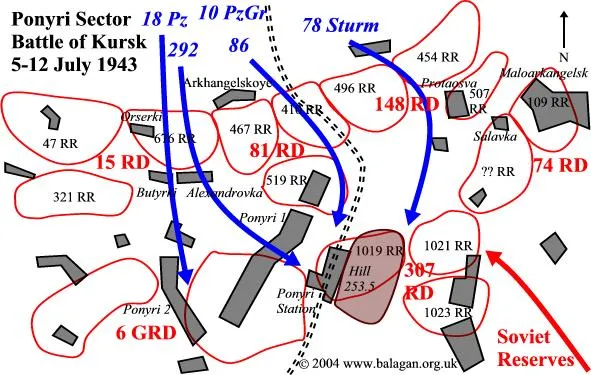
During the day German units attacked the town five times only to be repulsed. By the end of the day at a heavy cost the Wehrmacht had captured half of the town. The Red Army threw reinforcements into the battle comprising a tank brigade and a tank corps along with an artillery regiment and anti-tank brigade.
As the battle for Ponyri raged Central Front commander Rokossovky sent further reinforcements to defend the critical chain of hills around Ol'khovatka. He understood as well as General Model, commander of the German Ninth Army, that these hills which overlooked Kursk, were critical to the success of the attack on the northern shoulder of the salient. Therefore, on the evening of 6 July he sent two tank corps and the 3rd Destroyer Brigade to beef up the defence of Ol'khovatka.
Headlong assaults by German panzer units suffered terrible casualties and made minimal gains. Glantz and House have observed;
Efforts to turn the flank of these [Soviet] defenders and to widen the penetration were halted by massed tank destroyers and artillery firing over open sights.
The losses of Ninth Army greatly increased during the 7 July as the Red Air force sent large groups of fighter aircraft to achieve air superiority over the battlefield. This lasted for the remainder of the battle in this sector.
The 8th of July proved to be the turning point on this critical front as hundreds of German tanks attacked Soviet defences along the ridge of hills covering Ol'khovatka. A German military observer later described the ferocious nature of the fighting:
The grenadiers of 20th Panzer Division fought a … furious battle on 8th July near the village of Samodurovka under a scorching sun. Within an hour all the officers of 5th Company, 112th Panzer Grenadier Regiment, had been killed or wounded. Nevertheless, the grenadiers swept on through cornfields capturing trenches and encountering new ones. The battalions melted away. Companies became mere platoons. … Even Stalingrad, in spite of its more apocalyptic and tragic aura, does not stand comparison in terms of forces employed and the gigantic open-field battle of Kursk.
Red Army assessments of the days fighting recorded:
The fiercest battles took place on Hill 257.0 which was 17th Guards Rifle Corps’ key defensive sector. Three times, in groups of 60 to 100 tanks each, simultaneously from the north-east and north, the enemy attacked the hill; German infantry, despite fire from defending units, stubbornly attempted to advance behind the tanks to the hill. By 1700 the enemy had successfully occupied it. His further advance was stopped. The enemy was completely unsuccessful in the remaining front sectors of 17th Guards Rifle Corps.
Thus on 8 July, after fierce battles along this axis, German forces were unable to achieve significant success. The final attempt to penetrate Ol’khovatka failed.
The Soviet commander of the 2nd Destroyer Divisions 3rd Destroyer Brigade sent a report of that days defensive action. He noted the bloody nature of the Red Army’s resolute defence;
The 1st and 7th Batteries have perished, but they have not withdrawn a step. Forty tanks have been destroyed. There have been 70 per cent losses in the first battalion of antitank rifles.
During 8 July to the 10 July control for Ponyri see-sawed as each side threw large numbers of tanks, infantry and artillery into the battle. Glantz and House have commented on the outcome of this immense struggle:
Through Herculean efforts and at immense cost, the German finally gained possession of most, but not all, of Ponyri. The largely Pyrrhic victory left the victorious attackers exhausted and utterly incapable of further offensive action.
Clearly, Model had almost shot his bolt. After four days of high-intensity combat, the troops of Ninth Army, particularly the infantry and tankers, were worn down and out.
In six days the German Ninth Army had advanced a meagre 15 kilometres for the loss of 20,000 men and over 400 tanks. The failure of Ninth Army in its attack on the northern shoulder of the salient now meant that any hope of German success rested on the Hoth’s tank forces attacking in the south. They had to contend with Soviet armoured forces which were massing on its flanks.
The failure of the German attack on the northern shoulder of the Kursk salient encouraged Stalin to give the order for Operation Kutuzov to be launched during 11-12 July. The objective of this offensive was to destroy the German held Orel salient towards Briansk. It placed further pressure on the German Ninth Army as it would now be faced with Soviet forces to its rear.
German Attack In The South
At 0500 hours the Fourth Panzer Army and Army Detachment Kempf went into attack.

After a 50 minute artillery bombardment, during which German guns fired more shells than in the French and Polish campaigns combined, medium bombers from the Luftwaffe attacked Soviet front lines. Hundreds of German fighter planes also went into the air to deal with over 400 Soviet warplanes heading for Wehrmacht staging areas. An intense battle for air superiority ensued which developed into one of the most costly of the war. In the first morning the Soviet air force took heavy losses amounting to 176 warplanes.

In the south the German tanks of the elite Grossdeustchland ("GD") Panzer Grenadier Division soon ran into a minefield and the attack paused as sappers under heavy enemy fire worked tirelessly to clear the minefield. The divisions official history recalls:
It was enough to make one sick. Soldiers and officers alike feared that the entire affair was going to pot. The tanks were stuck fast, some bogged down to the tops of their tracks, and to make matters worse the enemy was firing at them with antitank rifles, antitank guns and artillery. Tremendous confusion breaks out. The Fusiliers advance without the tanks- what can they do? … [and] walked straight into ruin. Even the heavy company suffered 50 killed and wounded in a few hours. Pioneers were moved up immediately and they began clearing a path through the mine infested terrain. Ten more hours had to pass before the first tanks and self-propelled guns got through.
Tiger tanks to the right of Grossdeustchland had more success in their advance towards Cherkasskoe. Vasily Grossman recalls;
Stories about 45mm canons firing at [Tiger] tanks. Shells hit them, but bounced off like peas. There have been cases of artillerists going insane after seeing this.
The Tigers were well supported by waves of Stukas whose 550lb fuselage bomb and two wing mounted 110lb bombs were devastatingly successful at destroying Soviet defences. This close air support enabled the German tanks and grenadiers to capture the village that afternoon after a short and brutal battle.
In the south the II SS Corps made progress and smashed through the Soviet first line of defence by noon of the first day. By midday the three elite SS divisions; Totenkopf, Das Reich and Leibstandarte Adolf Hitler (LAH) that comprised the corps, had reached the Soviet second line. The Tigers advance was described by a German war correspondent:
This is the hour of the tank. Unnoticed we assembled at the bottom of the balka, the Tigers flanked by medium and light companies. Our field glasses searched the horizon, groping in the smoke that covers the enemy bunkers like a curtain...The heavy tanks roll into the battle zone. At 200 metres the first anti-tank fires at us. With a single round we blow it up.
As the tanks advanced SS infantry used flame throwers to great effect in clearing Soviet trenches. Hans Huber who led a flame thrower team recalls:
It was a strange feeling to serve this destructive weapon and it was terrifying to see the flames eat their way forward and envelop the Russian defenders. … The enemy could not fight against these flame-throwers and so we made good progress taking many prisoners.
In the afternoon the Das Reich division had its first battle with a 40 strong group of Soviet T-34 tanks of the 1st Guards Army which lasted four hours. Lloyd Clark describes this intense encounter:
At 1300 hours Das Reich’s armour came under fire from two T-34s, and although they were quickly despatched, 40 more appeared over the horizon firing on the move. Several Tigers were hit but not damaged. Reacting quickly and taking up firing positions, the German armour selected targets and sent their armour piercing rounds hurtling towards the enemy. Red Army tanks burst into flames as the panzers moved to new locations, stopped and repeated the process. After an hour of fighting, the field was covered by blazing hulks.
The Red Army sought to negate the advantage of the more powerful gun and thicker armour of the Tigers by fighting at close quarters, aiming at the tracks of the German tanks to immobilize them. Soviet infantry used small groups of men as tank killers which came in between T-34 tanks. At close quarters they attached magnetic mines and sticky bombs on to German tanks often to great affect. Suffering heavy casualties the 1st Guards Army failed to stop the panzers advance but they did buy time for Soviet defences further back to bring up more anti-tank guns and infantry.

Advancing German units were taken aback by the depth of Soviet defences. General Erhard Raus, commander of two German infantry divisions recalls:
[T]he advancing infantry surprised them [the Soviets] and had no difficulty ferreting them out. But when the infantry reached the two to three mile deep zone of battle positions prepared in the preceding months, they had to make extensive use of hand grenades in order to mop up the maze of densely dug in trenches and bunkers, some of which were a dozen or more feet deep.
By the end of the first day Manstein’s forces had not achieved their objectives. Many units had barely breached the Soviet first line while some of the SS panzer divisions had broken through the first line and were approaching the Soviet’s second line of defence. It was clear that the German high command had underestimated the Red Army’s defences.
The slow pace of the German advance on the first day gave Red Army commanders time to prepare their second echelons for the renewed assault of the Wehrmacht. Several rifle divisions were moved forward to reinforce the 6th and 7th Guards Army. At the same time over 1,000 tanks were brought forward to support the rifle divisions. Clark has observed the strategic thinking behind Red Army deployments:
These deployments made [General] Vatutin’s priority extremely clear- the enemy would be denied the roads and communications hubs necessary to maintain his impetus, and reinforcements would be moved forward as needed to provide unremitting pressure on his main axes. Manstein’s offensive was to be robbed of all momentum, ground down and snuffed out.
Red Army commanders before the battle had expected the main German blow to come in the north. The events of the first day proved that assumption to be incorrect. The 27th Army which originally was to have been support for Rokossovky’s forces in the north was now given to Vatutin. Vatutin was aware of the danger to Prokhorovka and Oboyan from the Fourth Panzer Army. Much was expected from the Soviet tank forces, 1st Tank Army and 2nd and 5th Tank Corps which were brought up to support the second line of defence. Many of the tanks from these units were dug in with only their turrets showing. They would act as fire support for the infantry.

General Katukov, commander of the 1st Tank Army, later recalled the success of this reinforcement:
[The enemy] did not suspect that our well-camouflaged tanks were waiting for him. As we later learned from captured prisoners we had managed to move our tanks forward into the combat formations of Sixth Guards Army.
At 0300 hours on 6 July the three divisions of the SS Panzer Corps resumed their attack supported by a heavy artillery bombardment and Luftwaffe bombers. The LAH and Das Reich assault was led by 120 tanks with the Tigers leading the advance towards the heavily mined defences of Yakovlevo and advance to the Pokrovka-Prokhorovka road.
Despite its reinforcement, the Soviet second line was unable to contain the German attack. Red Army units launched numerous counter attacks especially against the flanks of the 11 SS Corps.
By the end of the day the SS divisions were just seven miles west of Prokhorovka. Yet they had lost over two hundred tanks destroyed/damaged and over 10,000 dead. Meanwhile, the Luftwaffe was struggling to contain the Soviet air force whose ground attacks began to take their toll on German ground units. The German air force had too few planes and was woefully short of petrol and oil lubricants. This led the Luftwaffe to ration it services with priority going to ground support missions over containing Soviet air strikes.

The right flank of 11 SS Panzer Corps was very exposed due to the failure of Army Detachment Kempf to make enough progress. Glantz and House estimate that 30% of Manstein’s armour was being used to protect the flanks and were engaged in battles which ‘were quietly assuming decisive importance.’
German forces had suffered ‘fearsome’ casualties due to the resolute defence of Soviet units protected by large minefields, trenches and anti-tank strong points. This deprived the Wehrmacht of the momentum it needed to make faster progress. Peter Maschmann, a German sapper, later called how minefields kept stalling the attack:
Life expectancy was not high. In a battle such as this, it could be measured in days, but there were a few of us that got lucky. The [mine] belts before the Soviet line…were particularly dense and it was disappointing to be held up again after our excellent progress earlier in the day. But that was the enemy’s aim. To slow us down and grind us into those never-ending, god-forsaken and blood soaked fields.
The exasperation of many German commanders was expressed by Clemens Graf Kageneck, commander of the 503rd Heavy Tank Battalion, when he wrote:
Never before had a major German offensive had to master such a deeply echeloned and imaginatively organised defensive system. What Manstein and von Kluge had feared since May, that with every weeks delay the Russians would create a nearly impenetrable fortification, was what we now had to face.
Fortifications of the Red Army in the Battle of Kursk

By the end of the second day General Vatutin, commander of Soviet forces on the southern front of the salient was aware of a big hole in his defences. He requested and was given the 5th Guards Tank Army from the Steppe Front reserve with the stipulation from Moscow that Vatutin must continue ‘to exhaust the enemy at prepared positions and prevent his penetration until our active operations [counter attacks] begin.’ The 2nd Tank Corps and 5th Guards Army 10th Tank Corps were ordered immediately to Prokhorovka area to prevent a breakthrough of the 11 SS Panzer Corps and XLV111 Panzer Corps.
The next day 11 SS Panzer Corps and XLV111 Panzer Corps attacked a cross a 30 mile front supported by 500 Luftwaffe aircraft. During the day the SS Corps, after several gruelling battles, captured Tetervino and Greznoye. Meanwhile, the 300 tanks of XLV111 Panzer Corps became embroiled in a savage battle west of Pokrovka. As usual the German attack faced very determined resistance as it navigated the minefields, bunkers, trenches and anti-tank emplacements.
By late afternoon German forces reached Syrtsevo where they were met by a Soviet counter-attack of over 100 T-34s supported by hundreds of fighter aircraft. The panzer forces were held as Red Army reinforcements poured into Syrtsevo. Technical breakdowns of the Tigers and Panthers were just as costly as enemy anti-tank fire. A Yak fighter pilot, Artyom Zeldovich, later recalled his impressions of the battlefield on this day:
The ground gradually lit up with flaring tanks...The sky filled with a dense black smoke. We managed to keep the enemy’s aircraft away for periods, but sometimes they broke through when we returned to base to refuel and rearm. When we returned, more tanks were burning and the battle had moved forward, several hundred metres...It was clear that the Germans were heading for Syrtsevo and we had orders to stop them at all costs. Flying over the sector it was easy to see why. The road system was opening up, Oboyan was close by with Kursk not so far beyond it. The battle was a battle of resources, but it was also a test of wills. Looking down at Syrtsevo an inferno I wondered whose will would break first.
By the end of 7 July the battle in the south was finely poised. Red Army commanders were aware of the grave dangers facing Soviet forces as Manstein’s panzers attempted to breakthrough to Kursk. Nikita Khrushchev, Stalin’s representative at Vatutin’s headquarters, spelled out to the assembled commanders the gravity of the situation facing them:
The next two or three days will be terrible. Either we hold out or the Germans take Kursk. They are staking everything on this one card. For them it is a matter of life or death. We must see to it that they break their necks.
Vatutin moved up the 40th Army to help prevent the enemy breaking through to Oboyan. He gave orders for two counter attacks against Fourth Panzer Army to be delivered the next day along with diversionary attacks by the Southern and South-Western Fronts to ‘tie down enemy forces and forestall manoeuvre of his reserves.’
After three days of intense fighting soldiers on both sides were under immense strain and struggling to cope with the lack of rest and sleep. Felix Karelin, a Red Army infantryman later recalled:
I hardly recall the first days of the battle. They were a blur, but I remember that we did not sleep. Some men were in worse shape than I. One man I tried to wake as we moved back to a new position but he was so tired that he decided to stay in his shell scrape and take his chances. The position was overrun an hour later … The lack of sleep made it difficult to understand basic orders and to carry out simple tasks. I was confused and we could barely operate as soldiers. However, we learned to take very, very brief naps which helped a little. I also found that enemy action was an excellent stimulant. I could be falling asleep on my rifle and shells falling around me, but as soon as I was in danger from tanks or enemy [infantry] I would suddenly become alert. But as the days passed, this became increasingly difficult. My energy was being sapped.
On 8 July the Soviet 7th Guards Army launched numerous counter-attacks against 111 Panzer Corps which largely prevented it from supporting the advance of Fourth Panzer Army. Despite this lack of support the 11 SS Panzer Corps and XLV111 Panzer Corps linked up at Yakovlevo and were able to fend off Soviet counter-attacks once the 167th Infantry Division took over flank duties from the Totenkopf SS Division. This reinforcement of the German attacking front led it to take several villages by noon of that day. Still the ferocious Soviet counter-attacks slowed down the German advance as revealed by the diary of one German gunner:
We are under extreme pressure and the guns have been in action since 0400 hours. By noon we had run out of ammunition and had to wait two hours for resupply. It arrived with Soviet aircraft...Enemy attacks have diluted our offensive...This is the most intensive fighting that I have experienced. We must break through soon or face the consequences.
By the end of the day 11 SS Panzer Corps had made limited progress as a series of Soviet counter-attacks had prevented it from breaking through Red Army defences. Vatutin used the same strategy of counter-attack and containment against XLV111 Panzer Corps.
At dawn on 8 July Grossdeustchland led the attack of XLV111 Panzer Corps. It encountered a Soviet counter-attack of 40 T-34s at Syrstevo which initially forced it to pull back. Undeterred it regrouped and launched a series of devastating blows which captured Syrtsevo in the early afternoon after some hand to hand fighting. Sasha Reznikova, a Red Army infantryman, recalls the relentless nature of the German attackers;
I have to say that the Germans were extremely tenacious-our equals in that regard. They did not give up and we knew they wouldn’t.
In the afternoon Grossdeustchland fought a bloody battle against an unrelenting group of a large group of T-34s in the village of Gremutsch. Major Peter Frantz, commander of a group of German assault guns, described the battle:
The Soviet commanders attacked time and time again. Their wireless traffic showed that they had orders to break open the German line regardless of the cost. Seven times the Russians attacked. … After three hours, 35 wrecked tanks littered the battlefield, smouldering. Only five T-34s, all of them badly damaged, limped away from the smoking arena to seek shelter in a small wood.

By early evening the tanks of Grossdeustchland had reached Verkhopenye after fending off a series of Soviet counter-attacks on its flanks. It was unable to take its objective due to a resolute steadfast defence by the Soviet garrison as one eyewitness describes:
Ferocious, unparalleled tank battles ensued on the flats of the steppe, on hills, in gorges, gullies and ravines, and in settlements...The scope of the battle was beyond all imagination. Hundreds of panzers, field guns and planes were turned into scraps of metal. The sun could barely be seen through the haze of smog from thousands of shells and bombs that were exploding simultaneously.
The battle continued through the night as low flying Soviet bombers repeatedly bombed the exposed positions of German troops.
General Vatutin, commander of the Voronezh Front, ordered the defenders of Verkhopenye to withdraw during the night of 8-9 July to prevent the unnecessary destruction of his remaining troops. They were ordered to establish new defences north of Oboyan. Vatutin feared that Fourth Panzer Army was close to a breakthrough and ordered several fresh tank brigades and anti-tank regiments to support the 31st Tank Corps, remnants of the 3rd Mechanized Corps along with the 309th Rifle Division to hold the Germans long enough as the Red Army prepared a large armoured counter-attack around Prokhorovka.
On the advice of Vatutin the Stavka ordered the 5th Guards Tank Army, with its 593 tanks, to positions west of Prokhorovka along the line of the Psel river.

Meanwhile, the 5th Guards Army, with its 80,000 men, was ordered to take up positions along the Psel river from Oboyan to Prokhorovka. The picture was completed with 69th Army being directed to take up the defence of the Prokhorovka-Lipovyi Donest river sector between the 7th and 6th Guards Army.
Vatutin also prepared forces, comprising several tank corps, which would launch counter-attacks against the German flanks as they advanced towards Prokhorovka.
Despite considerable losses and the slow pace of the advance Field Marshall Manstein remained optimistic that, ‘The prospects for a breakthrough remained good.’ However, General Hoth, the commander of the Fourth Panzer Army was becoming increasingly alarmed by reports of ‘considerable Soviet armoured forces’ being concentrated on both the right and left flanks of German forces. This led to a conference of the top German commanders on the evening of 8 July as to how to proceed.

The conference decided that 4th Panzer Army was to continue its advance towards Oboyan and Kursk with maximum air support pledged and later received. The advance would lose some of its combat strength as the Grossdeustchland, 3rd Panzer and 332d Infantry Division were diverted to protect the vulnerable left flank.
On 9 July the remaining 283 tanks and assault guns of 11 SS Panzer Corps resumed their attack with intensive support from the Luftwaffe. The daily sortie rate increased to over 1,500 double that of the Soviet air force. The northern thrust of Leibstandarte Adolf Hitler and Totenkopf divisions along with 11th Panzer pushed Soviet forces back to Kochetovka and reached the Psel river.
Meanwhile, Das Reich division renewed its assault along the Prokhorovka road making little progress in the face of attacks by the Soviet 2nd Tank Corps and 5th Guards Corps. However, it was the lack of progress of 111 Panzer Corps in the south and XXXXV111 Panzer Corps north-west towards Novoselovka which led to a fundamental change in German plans. The lack of progress towards Oboyan led to the fateful decision to shift the focus of the main attacks towards Prokhorovka.
Vatutin, observing the lack of German progress towards Oboyan, moved strong forces to his right flank which pinned down the Grossdeustchland, 3d Panzer and the 255th and 332d Infantry Divisions. This ensured they would no longer play a part in the German drive towards Kursk.
He also understood the threat to his plans from an advance by 111 Panzer Corps in the south. On 9 July this corps had been ordered by Manstein to keep Hoth’s flank free by intercepting the Soviet 5th Guards Army and prevent it from linking up with Katukov’s 1st Tank Army. Its failure to do so would have dire consequences for the Wehrmacht at the battles for Prokhorovka.

In light of the drive towards Oboyan being thwarted and the threats to his left and right flanks Hoth made fundamental changes to his plans. According to Glantz and House the commander of Fourth Panzer Army ‘fatally altered his plans’ by shifting the axis of attack north-eastward towards Prokhorovka. They contend that Hoth believed that the 11 SS Panzer Corps had sufficient combat strength to smash the Soviet tank forces gathered around Prokhorovka which would unlock the advance of 111 Panzer Corps in the south thus opening up a new if longer route to Kursk.
At this point in the battle Soviet generals were confident they had blunted the Nazi juggernaut. The German 9th Army had been completely contained in the northern shoulder of the salient. Within days the Soviet Western and Briansk Fronts would launch their counteroffensives towards the German controlled Orel salient. The Fourth Panzer Army’s advance towards Oboyan had been effectively halted. The Soviet 1st Tank Army had limited Hoth’s advance to a mere 25 kilometres and taken very heavy casualties in doing so.
Now the focus of Operation Zitadelle would move to the east. The three elite divisions of the 11 SS Panzer Corps were moving towards a head on collision with the 5th Guards Tank Army.