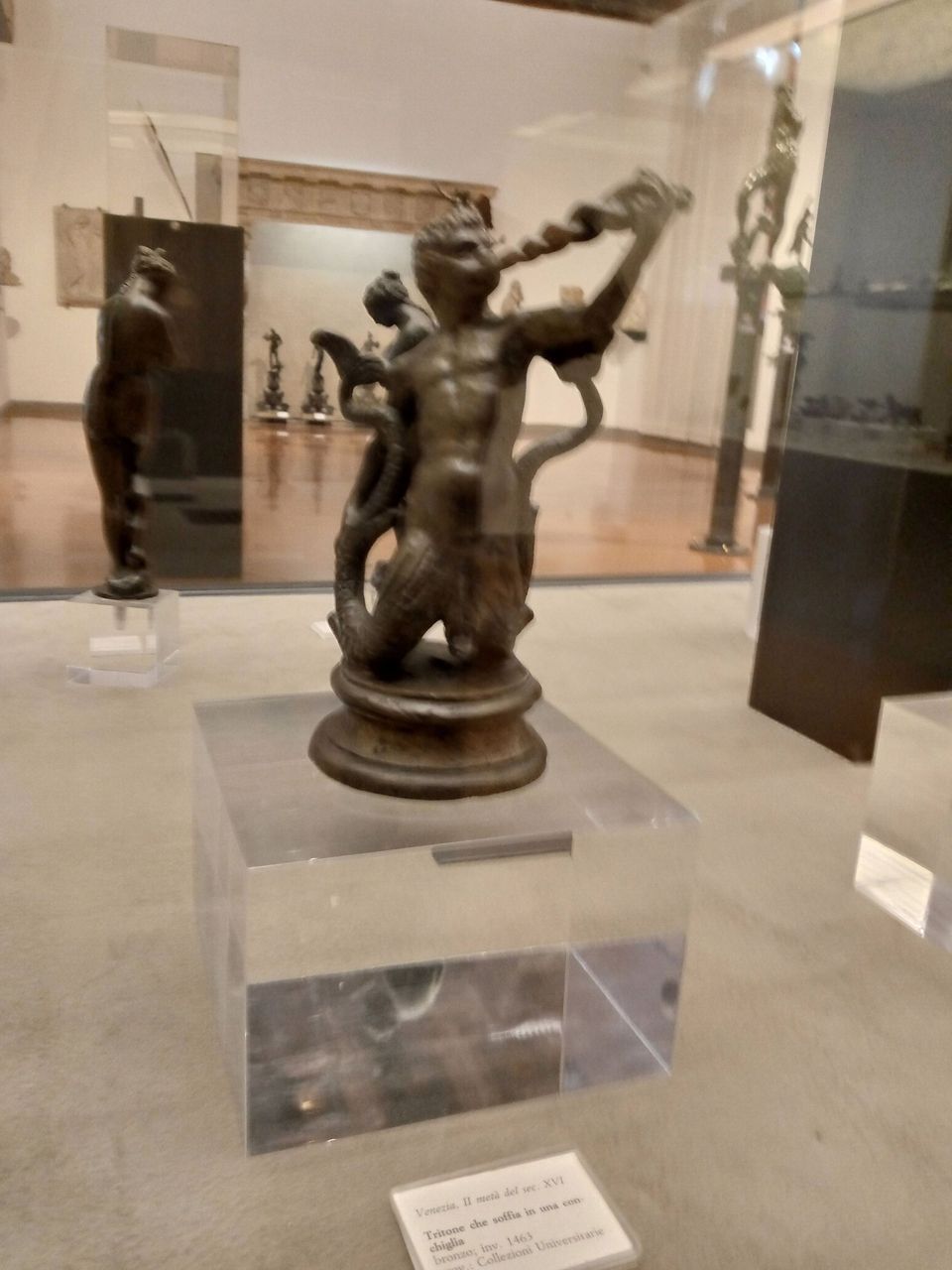
El imaginario medieval está lleno de seres fantásticos, quizá los que más conocemos a través de relatos y películas son las brujas y los magos, pero también forman parte de ese imaginario los sátiros, diablillos y tritones. En su colección el Museo Cívico Medieval de Bolonia tiene unas estatuillas maravillosas. Te comparto fotos de algunas.
Son quizá el objeto que más vinculamos con la época medieval, esa protección metálica que llevaban los caballeros, cuando se enfrentaron en las Justas o en las guerras. Cuesta imaginar que pudieron enfrentarse con esa vestimenta tan pesada, de metal, pero así lo dicen las leyendas. En el Museo Medieval de Bolonia hay un área dedicada a las armaduras, las lanzas y las espadas. Fue una época en la que no existían aún las armas de fuego. Los combates eran cuerpo a cuerpo, vencías al enemigo con la lanza o la espada.
Una de las piezas más hermosas que pude ver en el Museo Cívico Medieval de Bolonia fue la Virgen Theotokos (“La que da a luz a Dios”). Esta pieza realizada con micromosaicos nos muestra una Virgen María de estilo bizantino, no tiene esa expresión dulcificada que conocemos de la Virgen. No la vemos con el niño Jesús, sólo vemos cabeza, cuello y hombros. La figura está rodeada por diminutos mosaicos dorados, que representan su beatitud. Pero sí la cubre un manto azul y el halo que generalmente acompaña a los santos.

Mosaico Virgen Theotokos en la pared


Mosaico virgen Theotokos de cerca observa los micromosaicos que componen el cuadro
Lápidas y sepulcros
En la Antigüedad las más importantes expresiones artísticas las encontramos en las tumbas de los grandes personajes y en los templos sagrados. Esto fue así aún en la Edad Media y el Renacimiento. Muchas de las pinturas y esculturas que se conservan las encontramos en las iglesias y en los sarcófagos. En el Museo Cívico Medieval de Bolonia hay un área importante dedicada lápidas y sarcófagos. A pesar de los siglos transcurridos, y el deterioro que se ve en algunas de estas piezas, dedicadas a sacerdotes y personajes importantes, son, sin duda, piezas extraordinarias. Hoy, quizá, nos cuesta entender el respeto y el culto a la muerte, pero entonces era importante, era un símbolo de estatus.

lápida de Geremia Angelelli

lápida sacerdote

sepulcro de Matteo Gandoni, probablemente un educador por la talla en su sepulcro

sepulcro de Bonifacio Galluzi, probablemente un educador por la talla en su sepulcro

Proyecto para un monumento fúnebre de Pietro Barilotto
Sala de grabados Japoneses

Cuando visité el Museo Cívico Medieval de Bolonia pude ver una exhibición de grabados japoneses de la época medieval, que acababa de recibir como donación de la embajada de Japón. Hermosos grabados que disfruté mucho, porque tenía una bella curaduría, las paredes pintadas de amarillo que resaltaban los grabados exhibidos. Te comparto fotos de algunos de los grabados que vi. Me gustaron especialmente el guerrero luchando con su sombra, los músicos, la geisha. El imaginario medieval japonés tiene sus personajes característicos, entre los que destacan los samurais, pero también los músicos, que contaban historias y las geishas


Espero que hayas disfrutado este recorrido por el Museo Cívico Medieval de Bolonia. Un lugar que debes visitar si te encuentras en Bolonia. Especialmente si tienes interés en la época medieval.
Texto original para mi blog de Hive, sin uso de IA. Todas las fotos fueron tomadas con mi teléfono móvil.
He traducido el presente texto al inglés con Deepl.com para que personas de habla no hispana también puedan entenderlo.

BOLOGNA, MEDIEVAL CIVIC MUSEUM

Entrance to the Medieval Museum of Bologna
Greetings, fellow readers. Are you, like me, fans of the Middle Ages? Have you enjoyed the series and films on the subject? In recent times, George R. R. Martin's books and the series “Game of Thrones,” which were based on them, are a clear example that the medieval imagination has a large number of fans today. My interest in that period is not a recent one. In my youth, more than forty years ago, I read various books and articles about that era. I enrolled in university courses on medieval troubadours and read novels such as “The Knight of the Cart” by Chrétien de Troyes. I also had the pleasure of listening to medieval songs in concerts by the Camerata de Caracas and the French early music group “Clemencic Consort”

. The culmination of my interest in this period was the writing and publication of my book of poems Acto de fe (Act of Faith), which was adapted for the stage by Venezuelan actress Juliana Cuervos. Here is a poem from my book Acto de fe and a photo of its theatrical adaptation.
In the courts where you move,
pleasure is squandered with prodigality
and fear.
Torches must be lit and revelry begun,
the jesters must be made to dance,
the musicians must distract us.
Let the wine and delicacies flow,
for tomorrow we know not what. Betrayals reign supreme
in these places.
Plagues decimate our people.
Eternity is a moment well lived,
my René of Anjou,
drink it to the dregs.
Beatriz Alicia García N.

Theatrical performance of my book Act of Faith at the Sacred Museum of Caracas
few weeks ago, I wrote a review for the Travel Feed community about my trip to the Italian city of Bologna, a truly impressive city
@beaescribe/bolonia-una-ciudad-monumental-bologna-a-monumental-city-spanish-english I have left the review of the city's Medieval Museum for a separate article. Imagine seeing all those objects you've seen in movies, which seemed distant in time and space, there in front of you in a museum. It's incredible. All those objects built so many centuries ago, perfectly preserved. The building that houses the museum, Palazzo Ghisilardi Fava, was built between 1484 and 1491, during the Renaissance. Come with me to visit it.
Objects
Upon entering the museum, in the first rooms I could see some objects displayed in glass cases. But I must confess that my memory is a little unreliable, and some of the objects whose images I will share below were probably in rooms on upper floors. What is certain is that they are all on display in the museum. Some are curious objects for us because we don't use them today, such as the ewer in the shape of a warrior on horseback. The ewer was used in the past to wash hands and faces, especially during meals. Think of a time when there was no cutlery. There are also chalices on display, which we have seen at Mass, but they are not for everyday use.

scoop in the shape of a warrior on horseback

Murano glass chalice attributed to Angelo Barovier (1363)

statuette, probably also used as a water jug

jug made using the majolica technique (13th century)

wooden and ivory chest

metal shoes

Mirror box cover depicting The Siege of the Castle of Love (French origin, 14th century)
fantastic beings
The medieval imagination is full of fantastic beings. Perhaps the ones we know best from stories and films are witches and wizards, but satyrs, imps, and mermen are also part of that imagination. The Medieval Civic Museum of Bologna has some wonderful statuettes in its collection. Here are some photos of a few of them.


Armor, spears, and swords
They are perhaps the object we most associate with the medieval period, the metal protection worn by knights when they fought in jousts or wars. It is hard to imagine that they could fight wearing such heavy metal armor, but that is what the legends say. In the Medieval Museum of Bologna, there is an area dedicated to armor, spears, and swords. It was a time when firearms did not yet exist. Combat was hand-to-hand, and you defeated your enemy with a lance or sword.

armor and shield

breastplate and helmet

breastplate and helmets

helmet and spears

medieval swords

dagger and knives
Theotokos Virgin
One of the most beautiful pieces I saw at the Medieval Civic Museum in Bologna was the Virgin Theotokos (“She who gives birth to God”). This piece, made with micro-mosaics, shows us a Byzantine-style Virgin Mary, without the sweet expression we are familiar with. We do not see her with the baby Jesus, only her head, neck, and shoulders. The figure is surrounded by tiny golden mosaics, representing her beatitude. However, she is covered by a blue cloak and the halo that usually accompanies saints.
Theotokos Virgin mosaic on the wall
Virgin Theotokos mosaic close up look at the micro-mosaics
Gravestones and tombs
In ancient times, the most important artistic expressions were found in the tombs of great figures and in sacred temples. This was still the case in the Middle Ages and the Renaissance. Many of the paintings and sculptures that have been preserved are found in churches and sarcophagi. The Medieval Civic Museum in Bologna has a large section dedicated to tombstones and sarcophagi. Despite the passing of centuries and the deterioration seen in some of these pieces, dedicated to priests and important figures, they are undoubtedly extraordinary works. Today, it may be difficult for us to understand the respect and worship of death, but at that time it was important, it was a symbol of status.
Geremia Angelelli's gravestone
priest's gravestone
Tomb of Matteo Gandoni, probably an educator, judging by the size of his tomb.
Tomb of Bonifacio Galluzi, probably an educator, judging by the size of his tomb.
Project for a funerary monument by Pietro Barilotto
Japanese Prints Room
When I visited the Medieval Civic Museum in Bologna, I saw an exhibition of Japanese engravings from the medieval period, which had just been donated by the Japanese embassy. I really enjoyed these beautiful engravings because they were beautifully curated, with yellow-painted walls that highlighted the engravings on display. Here are some photos of the prints I saw. I especially liked the warrior fighting his shadow, the musicians, and the geisha. The medieval Japanese imagination has its characteristic characters, among which samurai stand out, but also musicians, who told stories, and geisha.
I hope you enjoyed this tour of the Medieval Civic Museum of Bologna. It's a place you must visit if you're in Bologna, especially if you're interested in the medieval period.
Original text for my Hive blog, without the use of AI. All photos were taken with my cell phone.
I have translated this text into English using Deepl.com so that non-Spanish speakers can also understand it.


