
No es fácil iniciar una publicación con un título tan extraño. Sin embargo, esa fue mi impresión al leer las primeras líneas, de la respuesta que Marcos López dio, a la periodista Verónica Abdala, de la Revista CABAL ¿"Cuál es la función del arte"...?
Su respuesta fue, "... todo el tiempo pienso que el arte no sirve para casi nada y al mismo tiempo es esencial para aguantar el dolor de la vida."
Marcos López es fotógrafo, y ha sido reconocido como uno de los artistas más importantes de Latinoamérica. Afirma que su estilo, "pasa del colorinche pastiche popular berreta, a un barroco churrigueresco cuzqueño, y luego puedo hacer minimalismo, cuyo objetivo primordial, son los sentimientos más esenciales de la existencia humana, la melancolía, el mestizaje cultural, la desigualdad social, las máscaras, el hecho de querer ser otro, la ilusión... el dolor."

Amigos de #Hive, Justamente el día en que nace el proyecto para realizar el primer #HivemeetupArgentina, al culminar la primera reunión, muy productiva, por cierto con 


Marcos López dedicó dos años y medio durante el encierro de la pandemia a transformar o intervenir una gran cantidad de fotografías antiguas que compraba en el mercado de San Telmo, unas que trajo de México y otros países donde ha expuesto sus fotografías famosas, que ya pertenecen al Museo Nacional de Arte Reina Sofía de España, o sus colecciones en Suiza, en la Tate Modern Gallery de Londres etc. Asimismo, entre sus obras, están libros como Retratos (1993)Pop Latino (2000) Sub-realismo Criollo (2003) El Jugador (2007) Pop latino plus (2007) y Marcos López (2010)Como también, realizó documentales y otros proyectos artísticos exitosos.

Según sus propias palabras, "La fotografía ya no me motiva tanto. Por eso tuve ganas de intervenir estas fotos. Me pregunto con qué derecho, cuando la imagen tiene un lenguaje propio”
Realmente cada imagen tuvo, antes de esa intervención, su razón
de ser. Yo sin ser experta en artes visuales, puedo fantasear a un López en su casa, manipulando una caja con fotografías de extraños y conocidos, esas fotos con olor a viejo, pero aún nítidas, imaginando toda esa cantidad de atrocidades monstruosas al ojo humano que presenta, y qué le inspiró cada retrato. De acuerdo a sus más profundos pensamientos e ideas, afirma:
“Comprar estas fotografías es una adicción. Hay grupos de familia, novias, casamientos, comuniones, retratos personales y también es una reflexión sobre todo ese mundo católico, sobre la fe, el pecado, el casamiento para toda la vida; y sobre esos grandes temas estoy yo pintarrajeando. Hay algo sadomasoquista. Y también ciertas perversiones ocultas en algunas fotografías”, dice frente a la imagen de una niña de comunión con alas de murciélago, junto a una novia que pasea un cocodrilo.


Esta imagen me recuerda, un cuento de un rey que quería que los sabios, a su servicio, fabricasen un anillo muy valioso, que tuviera oculto un mensaje para que le ayudara cuando tuviera algún problema o se sintiera desesperado. ¿Se imaginan el tamaño del mensaje, para que cupiese en ese anillo? Les invito a leerlo.
Lo interesante de esto, es que en la pared dibujó unas manos con el anillo, uniéndolas a una foto de una pareja de casados, cuyas características son extrañas, pues de sus ojos salen llamas o algo así. Hay allí una relación talvez, de odio y lazos de amor. Relacionado con la frase del anillo, "Todo pasa". La verdad es desconcertante y además me hizo mucha falta que el autor estuviese presente, para escuchar de sus labios el verdadero sentido de todo aquello tan extraño que observaba.


Todas sus obras, pasan por tener un contenido único y de tipo surrealista, donde se mezcla lo fantasioso con lo extraño, al estilo paranoico del mismo Salvador Dalí, que era capaz de unir cosas u objetos que no estaban relacionados entre sí. Confieso que siempre fui una admiradora de las obras de Dalí. Por otra parte, no me siento con la experticia artística suficiente para opinar en cuanto a técnicas. Solo hago una comparación, tal vez algo inapropiada, siendo sincera.

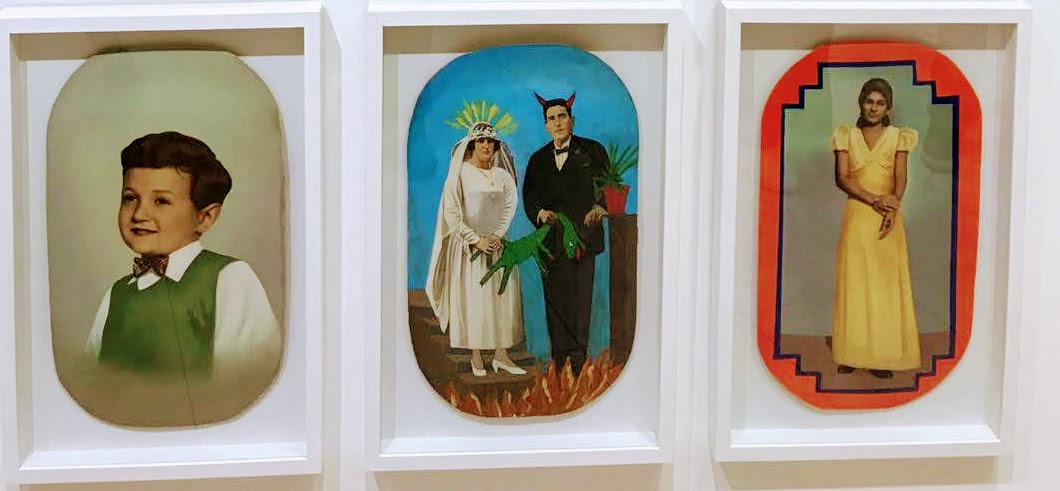
A medida que me acercaba a cada fotografía, iba sintiendo como un escalosfrío, por lo raro y macabro de las intervenciones fotográficas. Por ejemplo, en la imagen anterior, hay una pareja muy extraña, ella con una corona tipo sol y él con unos cachos, además en sus manos ambos cargan un animal verde, y si observan mejor, el cuadro, se nota que la pareja ardía en fuego . Es algo a simple vista incomprensible.
También se puede notar que algunas fotos tienen barbijos , para evocar esa terrible etapa pandémica. Igualmente a travás de coronas, resaltando al virus. Ah, y no podía faltar la imagen de Perón con un gran sol tras él.

La entrevista que al principio destaco, me pareció un buen referente, para poder comprender un poco la intencionalidad de sus obras. Allí el artista tuvo la oportunidad de expresar sus más profundos sentimientos y por ende, las razones que tuvo para intervenir más de 90 fotografías antiguas, convirtiéndolas en inexplicables, e impresionantes imágenes.
Cuando se le pregunta acerca de lo que sus obras reflejan, responde que, "La melancolía, el mestizaje cultural, la desigualdad social, las máscaras, el hecho de querer ser otro, la ilusión... el dolor" forman parte de ese reflejo. Afirma que cada vez que pinta lo disfruta, se divierte y que se siente prisionero de su propia profesión de artista.(palabras más, palabras menos)

Seguidamente, los invito a continuar disfrutando de está muestra que les he traído. Es mucho el material fotográfico expuesto, pero cada imagen , sugiero detallarla, para que disfruten de este excéntrico artista argentino y de sus obras. Es un referente entre los mejores fotógrafos y artistas plásticos, tanto nacional como internacionalmente.

En la imagen anterior, observamos un niño con armas, una niña con un hombre perro, muchas coronas, manos rotas etc. Y si es en la siguiente , aparece una niña emulando a la caperucita roja, que le cortó la cabeza a lobo... Una mujer abrazando una hiena etc. Dejaré que los artistas y los que no son pero que admiran todo lo que tiene que ver con el arte, opinen y puedan disfrutar de esta exposición . Yo realmente la disfruté y sentí mucha tristeza, pues me hubiese gustado conocer al artista personalmente.


Finalmente, les dejo un collage con la imágenes y parte del amplio salón de exposiciones.

Allí pueden observar, la distribución, el espacio y el diseño de la muestra. Entre los presentes en el centro a la izquierda, estaban mis compañeras de #hive y yo, mientras mi hijo tomaba las fotografías, las cuales son de mi propiedad. Espero que cuando estén paseando por el centro de Buenos Aires, no dejen de visitar "Galerías Pacífico" y sus espacios culturales como el CCB.

Marcos López, nace un 10 de septiembre de 1958
Fue nominado al premio Condor de Plata a la mejor película
Película, Ramón Ayala López .
Sus fotografías se caracterizan por ser puestas en escena, donde juega el rol de director teatral, con influencias del cine, de la pintura y de la fotografía documental clásica.
Libros publicados: "Retratos en blanco y negro", ed. La Azotea, ; "Pop latino", ed. La Marca, y "Sub Realismo criollo", Universidad de Salamanca, España. Su obra puede verse en ...
ENGLISH

It is not easy to start a publication with such a strange title. However, that was my impression when I read the first lines of the answer Marcos López gave to journalist Verónica Abdala, from Revista CABAL "What is the function of art"...?
His answer was, "... all the time I think that art is good for almost nothing and at the same time it is essential to endure the pain of life."
Marcos Lopez is a photographer, and has been recognized as one of the most important artists in Latin America. He states that his style, "goes from the colorful pastiche colorinche popular berreta, to a baroque churrigueresque cuzqueño, and then I can do minimalism, whose primary objective, are the most essential feelings of human existence, melancholy, cultural miscegenation, social inequality, masks, the fact of wanting to be another, the illusion... pain."
Friends of #Hive, Just the day the project was born to make the first #HivemeetupArgentina, at the end of the first meeting, very productive, by the way with
Marcos Lopez dedicated two and a half years during the confinement of the pandemic to transform or intervene a large number of old photographs that he bought in the San Telmo market, some that he brought from Mexico and other countries where he has exhibited his famous photographs, which already belong to the Reina Sofia National Museum of Art in Spain, or his collections in Switzerland, the Tate Modern Gallery in London, etc. Also, among his works are books such as Retratos (1993), Pop Latino (2000), Sub-realismo Criollo (2003), El Jugador (2007), Pop latino plus (2007) and Marcos López (2010), as well as documentaries and other successful artistic projects.
In his own words, "Photography no longer motivates me as much. That's why I wanted to intervene in these photos. I wonder with what right, when the image has a language of its own".
Actually, before this intervention, each image had its own reason for being.
of being. Without being an expert in visual arts, I can fantasize a Lopez at home, manipulating a box with photographs of strangers and acquaintances, those photos with the smell of old, but still sharp, imagining all those monstrous atrocities to the human eye that he presents, and what inspired each portrait. According to his deepest thoughts and ideas, he states:
"Buying these photographs is an addiction. There are family groups, brides, weddings, communions, personal portraits, and it is also a reflection on the whole Catholic world, on faith, sin, marriage for life; and I am painting about these great themes. There is something sadomasochistic. And also certain perversions hidden in some photographs," he says in front of the image of a communion girl with bat wings, next to a bride walking a crocodile.
This image reminds me of a story about a king who wanted the wise men in his service to make a very valuable ring with a hidden message to help him when he had a problem or felt desperate. Can you imagine the size of the message, so that it would fit in that ring? I invite you to read it
The interesting thing about this is that on the wall he drew some hands with the ring, joining them to a photo of a married couple, whose characteristics are strange, because from their eyes come out flames or something like that. There is a relationship there, perhaps, of hate and bonds of love. Related to the phrase of the ring, "Everything happens". The truth is disconcerting and I really needed the author to be present, to hear from his lips the true meaning of all the strange things I observed.
All of his works have a unique and surrealistic content, where the fantastic is mixed with the strange, in the paranoid style of Salvador Dalí himself, who was able to unite things or objects that were not related to each other. I confess that I have always been an admirer of Dalí's works. On the other hand, I don't feel I have enough artistic expertise to give an opinion on techniques. I am only making a comparison, perhaps a little inappropriate, to be honest.
As I approached each photograph, I felt a chill, because of the weirdness and macabre of the photographic interventions. For example, in the previous image, there is a very strange couple, she with a sun-like crown and he with some horns, and in their hands they both carry a green animal, and if you look at the picture better, you can see that the couple was burning in fire. It is something incomprehensible to the naked eye.
You can also notice that some pictures have chinstraps, to evoke that terrible pandemic stage. Also through crowns, highlighting the virus. Oh, and we could not miss the image of Perón with a big sun behind him.
The interview I mentioned at the beginning, seemed to me a good reference, to be able to understand a little of the intentionality of his works. There the artist had the opportunity to express his deepest feelings and therefore, the reasons he had to intervene more than 90 old photographs, turning them into inexplicable and impressive images.
When asked about what his works reflect, he answers that, "Melancholy, cultural miscegenation, social inequality, masks, the fact of wanting to be someone else, illusion... pain" are part of that reflection. He affirms that every time he paints he enjoys it, he has fun and that he feels like a prisoner of his own profession as an artist. (more words, less words).
Next, I invite you to continue enjoying this exhibition that I have brought to you. There is a lot of photographic material on display, but I suggest you detail each image, so that you can enjoy this eccentric Argentinean artist and his works. He is a reference among the best photographers and plastic artists, both nationally and internationally.
In the previous image, we can see a boy with weapons, a girl with a dogman, many crowns, broken hands, etc. And in the next one, we see a girl emulating Little Red Riding Hood, who cuts off the head of a wolf.... A woman embracing a hyena, etc. I will leave it to the artists and those who admire everything that has to do with art, to give their opinion and enjoy this exhibition. I enjoyed it very much and felt very sad, because I would have liked to meet the artist personally.
Finally, I leave you a collage with the images and part of the large exhibition hall.
There you can see the layout, space and design of the exhibition. Among those present, in the center left, were my colleagues from #hive and myself, while my son took the photographs, which I own. I hope that when you are strolling through downtown Buenos Aires, do not fail to visit "Galerias Pacifico" and its cultural spaces such as the CCB.
Marcos López, born September 10, 1958.
He was nominated for the Condor de Plata award for best film.
Film, Ramón Ayala López .
His photographs are characterized by being staged, where he plays the role of theatrical director, with influences from cinema, painting and classic documentary photography.
Published books: "Retratos en blanco y negro", ed. La Azotea, ; "Pop latino", ed. La Marca, and "Sub Realismo criollo", Universidad de Salamanca, Spain. His work can be seen at ...

Traductor
Generador de logos