
Hi friends.
Hello homesteaders.
As promised, I will be sharing my cassava flour process which is popularly known as garri in my country.
Processing cassava flour during dry season is a difficult job, normally during this period the ground will be so dry.
To pull the cassava tubers is difficult, and they easily break while pulling them out.
So, it requires a hard gentle pull.
In all I and my brother was able to pull out some cassava tubers.
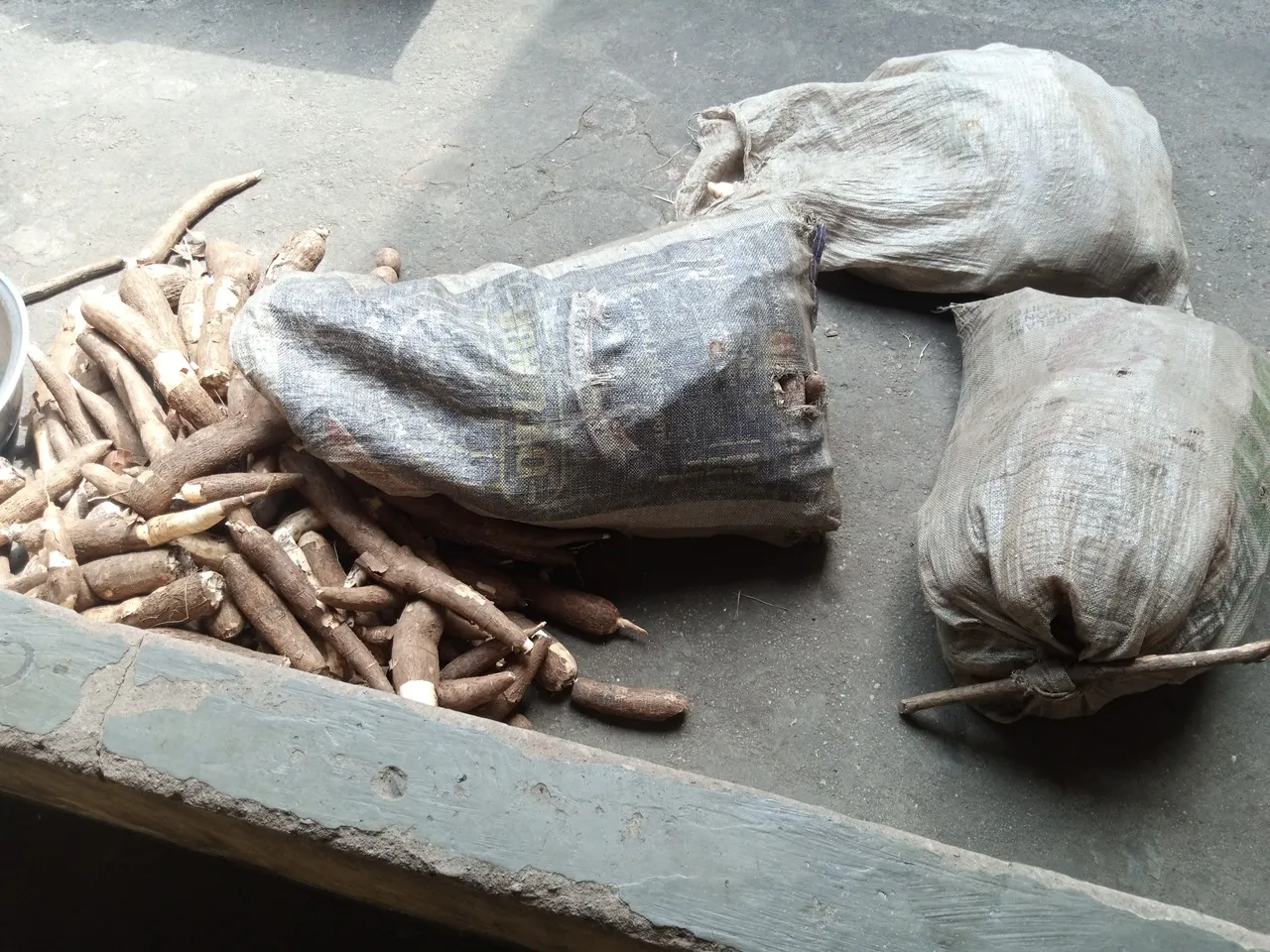
This is the cassava tubers we were able to pull out.
We packed it in bags so it can enter the wheel barrow, which we used to bring it back home.

This is how the cassava tubers looks like.
After removing it from the bags, we poured it out immediately to start the next thing.
Which is to peel them all.

The peeling process going on.

The peeled cassava tubers.

The cassava tubers peels.
After peeling them all, the next thing is to wash them all.


The cassava tubers about to be washed in water.
After washing it all, we packed it again in a big bowl.

This will be taken to the mill for grinding.
We are here in the mill.
It's been long I visited this type of mill that uses lister generator for it's operations.
The ones I know uses a small generator.
Infact the mill looks so different.


This is the lister generator connected to the grinding machine.

The grinding process is ongoing.
We added little palm oil to the grinded cassava tubers.

The grinded cassava tubers packed in a bag.

The grinded cassava tubers in the pressing machine
After grinding and packing them in a confined bag, it will be taken to the pressing machine to drain the water.
It is important to use a suitable bag that allows only the passage of water.
The draining process was done in our house, as we had the machine and haven't used it for a while now.
We didn't start the draining immediately after grinding the cassava tubers.
We left it for a day for it to ferment, and started pressing it the next day.
We got two bags of the cassava, so we took turns to press and drain the water.
After draining it for a whole day, the next day we started with the last process which is sieving and frying the cassava flour.
Which we also did at home.

This is the sieve used in sieving the cassava.

This is the sieved cassava flour.

This is sieved out from the bag of cassava.

In a medium heat fire, you add little of the sieved cassava flour in a frying pot and continue to turn it, making sure it doesn't form lumps.
Once, the little you added changes color.
You continue to add more little by little, until you get your preferred quantity.
Which you can be able to manage i.e one you can be able to easily turn continuously, only taking breaks for a short period.
Because when you leave it for long, the cassava flour might burn.
During the frying process, you alternate between middle heat fire and high heat fire.
You apply anyone that works for you.
But never you use a low heat fire, if not the cassava flour won't last long after frying.
I.e you won't be able to store it for a long time, maybe for four-five months or longer.

This is the cassava flour final stage.
Please this is not all the cassava flour.
It was immediately distributed to hungry family and friends 😜
This can be made by adding boiled water to it.
Molded and used to eat any soup of your choice or
It can be sipped by adding water, sugar, milk, Milo etc to it.
I apologize for not adding some pictures, this is because my hands were busy with the process during that period.
I am also sharing this because I was encouraged by 
Because I mentioned it in Monday 
I hope to see you join the chat, you will stand a chance to win HP delegation, alive tokens and ecency points when you do so.
All photos are mine and taken with my Android mobile phone.
Thank you very much visiting my blog.