
Plant identification floats my boat. I get a total buzz out of discovering some nondescript "weed" is actually a well documented, ancient remedy for at least 33 ailments. And so often that is the case.
Every year when the monsoonal rains start here in Chiang Mai, Thailand, we get these lovely purple flowering "weeds" popping up - often along roadsides & verges and the wildish edges of the village. And I have wondered.
And the last weeks, here they are again. The pretty purple weeds. Growing literally in the tiny bit of grass in the laneway at the side door of our old Thai teak house.


I asked our old Thai landlady who was BORN in this house NEARLY 80 years ago. She laughed and said it had no purpose - just a weed with pretty flowers. She said she'd send the grass cutting guy.
I asked several Thai people around-about.
"No cannot eat."
"No, is not yaa." (medicine plant)
They seed out like crazy, have little hairs on them and these cute little popping seed pods that the local children like to play with. The pods pop when water hits them and I watched with delight a few days ago as a man from down the laneway showed his very little son how to pee on the first seed pods to make them pop. The little boy squealed and laughed with delight and it piqued my curiosity about this plant.

Some people do jigsaw puzzles to unwind. Me? I prefer my puzzles to be mental and have some purpose. And I just know life will feel a tiny bit more meaningful, connected and ordered if I can name and find out something about these pretty flowers that are literally growing outside the door on the side of our house.
And so today I sat over coffee and image searched, pondering leaf shapes, colour, petal shapes and numbers... and voila! I have a match.
Ruellia tuberosa. It even has a Thai name: ต้อยติ่ง&
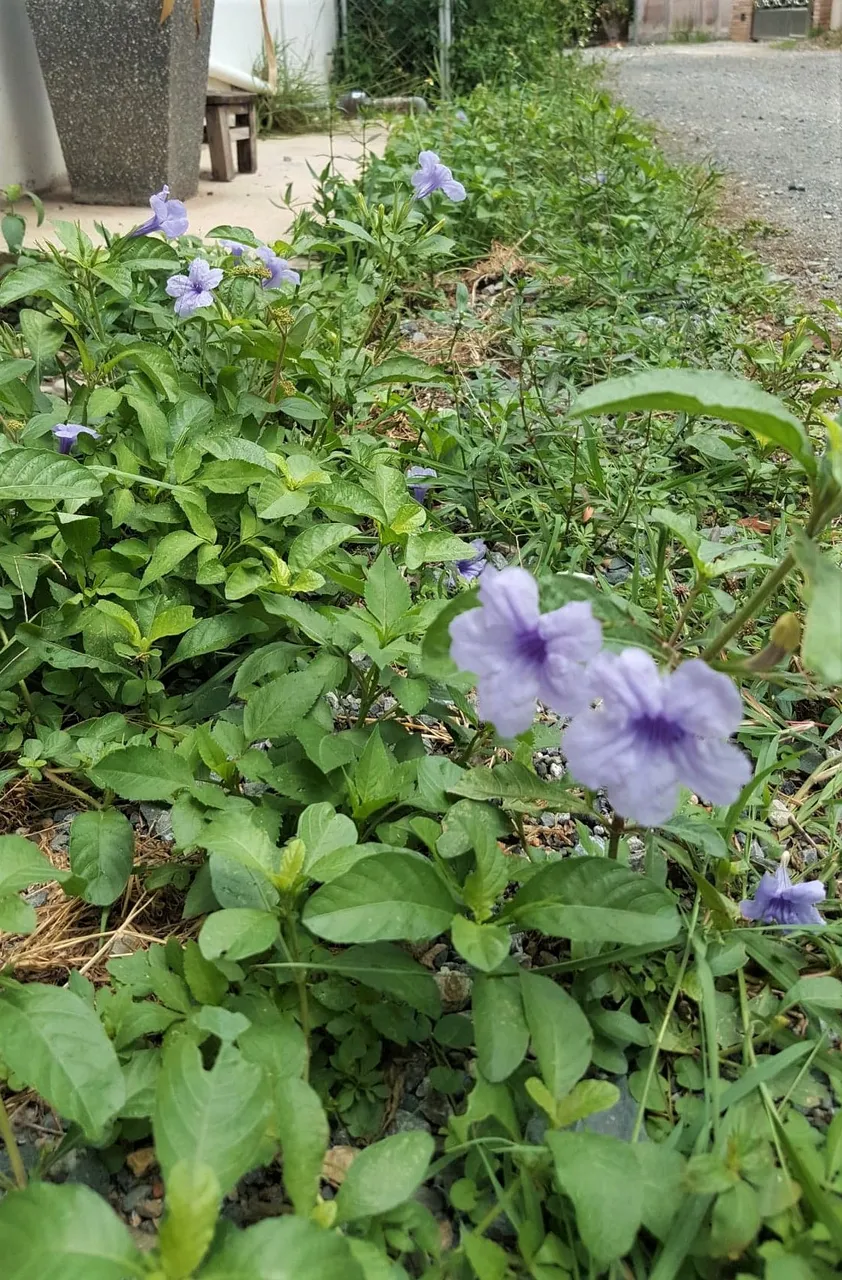
It's other common names in English are minnieroot, fever root, iron root, snapdragon root, sheep potato and popping pod. In Hindi it is called Chatpati. The not-surprise? It's a powerful natural medicine and rather well documented, even in English. It's indigenous to South America and, like soooo many "Thai" plants, flowers and vegetables, was introduced into South East Asia by the Spanish and Dutch traders in 1600-1900's. Ruellia is now commonly found from The Philippines to India and beyond, and well documented as a healing plant.
This is when I realize, again, that Thailand is predominantly a regional and oral culture. Herbal wisdom passed down is shared about the few local plants that are known, and known well. The curiosity "What IS that?" factor (which I seem to have in spadesful) isn't common here, nor are there well equipped libraries or herbal websites in Thai or the indigenous languages to make it easy. And so most Thai people don't know.
It IS well known in Ayurveda.
Plant decoction antacid, in indigestion and stomachache; plant and roots decoction taken internally for urinary troubles. Leaf paste for eczema; leaf decoction drunk by pregnant women for cold in the body. Roots infusion for oliguria, heat, fever, influenza, venereal diseases, constipation; root decoction diuretic and aphrodisiac. A paste made of root and few peppers is taken to cure stomachache. Tuber poultice for swelling, joint pain. [CRC World Dictionary of Medicinal and Poisonous Plants] Source
- It's considered gastroprotective - generally aqueous whole plant solution - to protect against gastric ulcers. This is super important in cultures which eat spicy and where stomach haemmorhage is surprisingly common. Source My own daughter's father lost half his stomach and part of his lower left lung after a ruptured stomach ulcer nearly killed him in his mid-40s. Clearly I need to harvest and dry some of these plants TODAY (before the grass cutting guys shows up) an get my head around a gastro-protective TEA for him. I feel a natural medicine post coming on. 😆
. In Trinidad and Tobago, used as a "cooling" agent, for urinary problems and high cholesterol.
• In Suriname's traditional medicine, used as anthelmintic; for joint pains and muscle strain. Also used as abortifacient. Root is used against kidney diseases and whooping cough. Infusion used for cleansing the blood.
• Root and leaf used for alleviating urinary retention.
• Used for gonorrhea, syphilis, bladder stones, bronchitis and cancer.
• In the Cayman Islands, used for heart ailments.
• In Grenada, used for common colds, fevers and hypertension.
• In the Dominican Republic, an ingredient in a concoction for a male potency drink.
• In Sri Lankan traditional medicine, used for stomach problems.
• In India leaf juice applied to scorpion bite sites.
• In India, used for kidney stone disorders. Source
I am in awe. Constantly. At the diversity and power of medicinal healing plants. And how different cultures use them.
It seems a pity to pull them up, but today I shall uproot a few and carefully hang them in a cool place to dry, before storing them in my witchy herbal cupboard in a sealed brown glass jar. I shall have to think about what to add to it to make the tea drinkable for Ploi's father - maybe lemongrass and Dok Anchan - the blue butterfly pea. I will also leave a few, deliberately, to let them go to seed
So much diversity in the natural world and there is SO MUCH to learn. Every day. If we simply engage our curious childish minds which know to step over the boundaries between "weed" and "flower" and "medicine" and to consider new possibilities. I feel blessed to NOT be confined by only one culture and what it deems to be medicinal. I love that I live in the digital age where I can learn and engage in plant identification while I enjoy my morning coffee on my sunny front porch here in Chiang Mai. With my natural pharmacy blooming not 3 feet from my door.
BlissednBlessed.


Visit our online store here

Join The Best Natural Health Community on Hive
