

¡Muy buenas noches, amigos de Hive! Tenía un par de semanas sin publicar, pero hoy les traigo algo muy bueno; una técnica muy fácil y practica para librarnos de un agarre, en alguna situación de peligro.
Good evening, friends of Hive! I had a couple of weeks without publishing, but today I bring you something very good; a very easy and practical technique to get rid of a hold, in some dangerous situation.
Hace poco dicté un taller de Defensa Personal y Técnicas Básicas de Karate, y esta técnica que les traigo es una de las que implementé. En lo personal, me parece una técnica muy fácil de aprender y muy efectiva en la vida real. Además de que es muy fácil de recordar, puesto que cumple con los principios básicos de la Defensa Personal.
I recently gave a workshop on Self Defense and Basic Karate Techniques, and this technique that I bring you is one of the ones I implemented. Personally, it seems like a very easy technique to learn and very effective in real life. In addition to being very easy to remember, since it complies with the basic principles of Personal Defense.
Recomiendo practicar al menos una vez a la semana junto a un compañero para dominar la técnica, y luego ir añadiendo más fuerza y velocidad. No quieran hacerlo tan real desde la primera vez, podrían lesionarse y restarle técnica a la mecánica del movimiento. Sin más que acotar ¡COMENCEMOS!
I recommend practicing at least once a week with a partner to master the technique, and then adding more strength and speed. Do not want to make it so real from the first time, you could injure yourself and make the mechanics of the movement less technical. Without further ado, LET'S START!
- La persona que tendrá el papel de agresor sujetará tu camisa, hombro o pecho, puede hacerlo con una o dos manos, es indiferente puesto que la técnica va dirigida a una sola mano, y es más que suficiente para librarte del agarre de ambas manos.
- The person who will have the role of aggressor will hold your shirt, shoulder or chest, he can do it with one or two hands, it is indifferent since the technique is aimed at only one hand, and it is more than enough to free you from the grip of both hands.

El objetivo será tomar uno de los dedos de la mano del atacante(preferiblemente índice o medio) y llevarlo hacia el cuerpo del mismo. Aunque en la fotografía no se hizo, siempre recomiendo que mientras se tome el debo, nuestro debo pulgar haga una especie de llave sobre la muñeca del adversario; ésta sólo consiste en poner nuestro debo pulgar con firmeza sobre la muñeca del otro, al mismo tiempo que tomamos su debo. En caso que no se pueda, tomar sólo el dedo será suficiente.
The objective will be to take one of the fingers of the attacker's hand (preferably index or middle) and bring it towards his body. Although it was not done in the photograph, I always recommend that while taking the debit, our thumb makes a kind of key on the opponent's wrist; this only consists of putting our must thumb firmly on the wrist of the other, at the same time that we take their must. In case it is not possible, taking only the finger will be enough.
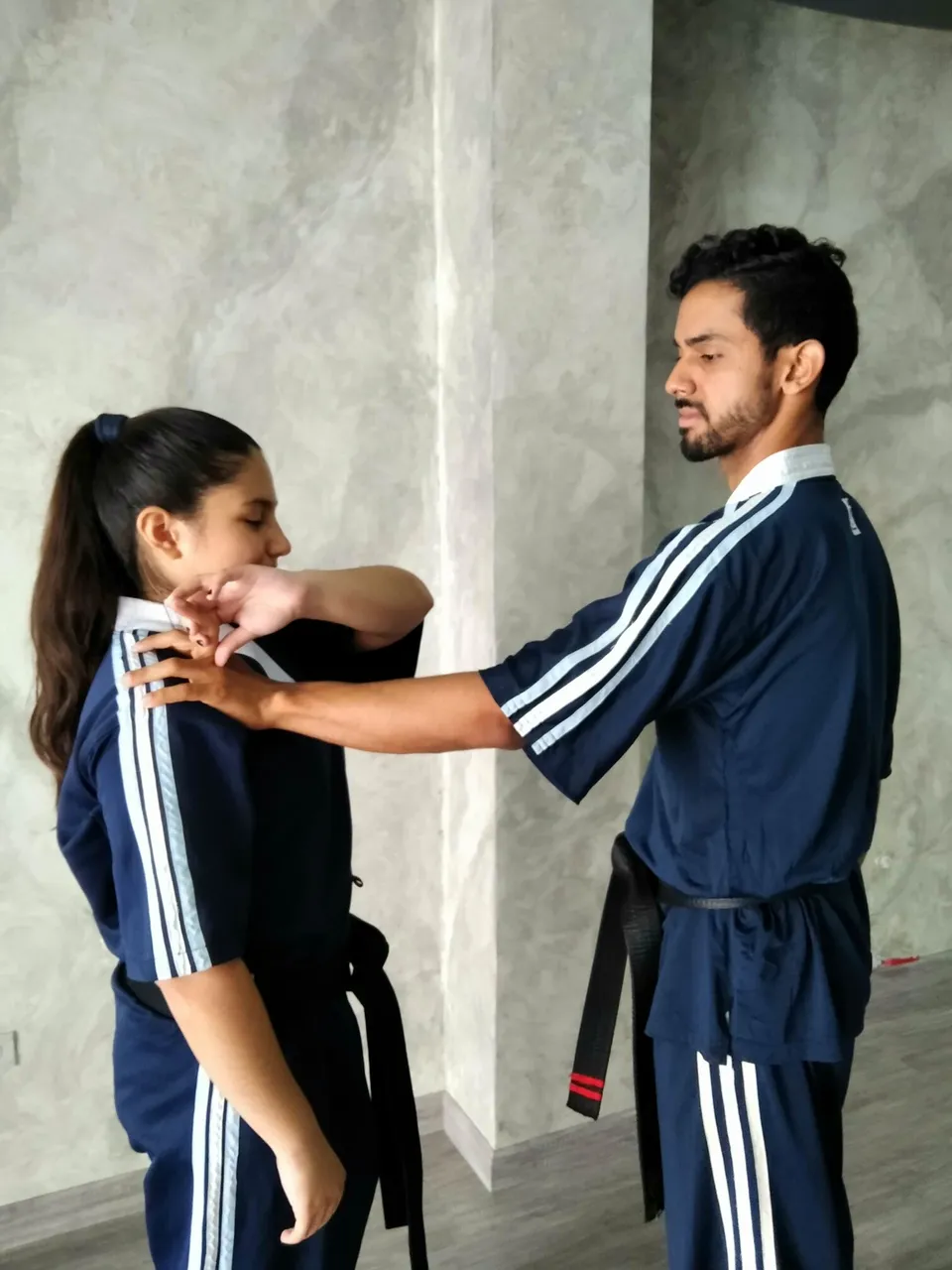
- Casi al mismo tiempo que tomamos el dedo del agresor, debemos tomar su codo y empujar hacia arriba con fuerza, haciendo que todo el brazo del atacante se vuelva hacia él(si este paso se realiza con fuerza, será suficiente para salir de la situación de peligro).
- Almost at the same time that we take the aggressor's finger, we must take his elbow and push up with force, making the entire arm of the attacker turn towards him (if this step is done with force, it will be enough to get out of the dangerous situation).


- Teniendo su dedo y codo sujetados con fuerza, el debo debe está a la altura del cuello del agresor, mientras el codo apunta hacia arriba. Hecho esto, pasamos a colocar un pie detrás del atacante, y procurando que gran parte de toda nuestra pierna y cadera estén situados a sus espaldas; esto creará una zancadilla.
- With your finger and elbow firmly held, the must should be at the neck of the assailant, while the elbow points upward. Once this is done, we move on to place one foot behind the attacker, and ensuring that a large part of our entire leg and hips are located behind him; this will create a trip.

- Al crear la zancadilla podemos proceder a seguir empujando su brazo hacia atrás para hacer que pierda el equilibro e incluso llevarlo al suelo.
- When creating the trip we can proceed to continue pushing his arm back to make him lose his balance and even bring him to the ground.

¡Y ESTO HA SIDO TODO POR HOY! Como vieron es una técnica fácil de aprender y recordar una vez que se practique un par de veces. Luego de desestabilizar a nuestro agresor, lo más recomendable es huir del lugar o pedir ayuda. Recuerden que todo enfrentamiento es incierto y siempre será mejor correr en la mínima oportunidad. Espero les haya gustado y servido de ayuda. Si quieren aprender un poco más sobre Defensa Personal y Karate, los invito a seguirme para que no se pierdan de mis futuras publicaciones. ¡Gracias y hasta la próxima!😉
AND THIS HAS BEEN ALL FOR TODAY! As you saw it is an easy technique to learn and remember once it is practiced a few times. After destabilizing our aggressor, the best thing to do is flee the place or ask for help. Remember that every confrontation is uncertain and it will always be better to run at the slightest opportunity. I hope you liked and it helped. If you want to learn a little more about Self Defense and Karate, I invite you to follow me so you do not miss my future publications. Thanks and see you next time! 😉
Todas las fotos usadas en esta publicación son de mi propiedad.
All photos used in this publication are my property.