
Nuevamente les saludo, queridos compañeros y lectores de mi preciosa comunidad de Foodies Bee Hive. Hoy he querido traerles un postre que hice para aprovechar una fallida cosecha de papayas (lechozas) de mi solar, y es DULCE DE LECHOZA, un clásico de la gastronomía venezolana, que siempre es protagonista de las mesas navideñas y de Pascua. Hice este dulce, ya que hace tres días recogí la única lechoza que pudo darse en mi solar. En el siguiente enlace les cuento cómo fue este proceso:
I salute you again, dear colleagues and readers of my precious Foodies Bee Hive community. Today I wanted to bring you a dessert that I made to take advantage of a failed harvest of papayas (lechozas) from my lot, and it is DULCE DE LECHOZA, a classic of Venezuelan gastronomy, which is always the protagonist of Christmas tables and Easter. I made this sweet, since three days ago I collected the only bed that could have been on my lot. In the following link I will tell you how this process was:
Siempre veía a mi madre comprar la lechoza muy verde en el mercado municipal, y proceder a su preparación, lo cual era casi ceremonioso. Generalmente preparaba entre 15 y 20 kilos de papaya verde en un enorme caldero de hierro colado, y este ritual comenzaba con la compra de la fruta, que debía estar absolutamente verde, porque esto es lo que garantiza el buen sabor y consistencia del postre. Una vez que las llevaba a casa, las lavaba y procedía a tender un mantel viejo que mi padre le había traído años atrás de Guatemala, de uno de sus viajes, y ponía manos a la obra, hasta obtener varios frascos de un dulce dorado y exquisito. Viendo a mi madre, yo aprendí a hacer este dulce, al cual le he incorporado una pequeña variación, y es adicionar una mayor cantidad de azúcar para obtener más almíbar, pues me encanta comerlo con pan salado o con natillas. Bueno, vamos a prepararlo.
I always saw my mother buy the very green papaya in the municipal market, and proceed with its preparation, which was almost ceremonial. Generally, he prepared between 15 and 20 kilos of green papaya in a huge cast iron cauldron, and this ritual began with the purchase of the fruit, which had to be absolutely green, because this is what guarantees the good flavor and consistency of the dessert. Once he took them home, he washed them and proceeded to lay out an old tablecloth that my father had brought him years ago from Guatemala, from one of his trips, and he got down to work, until he obtained several jars of a golden sweet and exquisite. Watching my mother, I learned how to make this sweet, to which I have incorporated a small variation, and that is to add a greater amount of sugar to obtain more syrup, because I love to eat it with salty bread or with custard. Well let's prepare it.

LA RECETA / THE RECIPE
Ingredientes y equipo:
Para aproximadamente 600 gramos de dulce de lechoza (papaya), se requieren los siguientes ingredientes y equipo:
Tiempo de preparación: 3 horas, aproximadamente.
690 gramos de lechoza (papaya) muy verde, sin piel ni semillas.
350 gramos de azúcar blanca, (la proporción de azúcar debe ser el 50% del peso de la fruta).
1 cucharadita colmada de bicarbonato de sodio.
1 cucharada de vinagre blanco.
3 hojas secas de higo.
Tabla de picar, cuchillo, bol, olla o caldero, cucharilla, etc.
Agua suficiente para remojar y enjuagar bien a la lechoza.
300 ml de agua

Ingredients and equipment:
For approximately 600 grams of dulce de lechoza (papaya), the following ingredients and equipment are required:
Preparation time: 3 hours, approximately.
690 grams of papaya (papaya) very green, without skin or seeds.
350 grams of white sugar, (the proportion of sugar must be 50% of the weight of the fruit).
1 heaping teaspoon of baking soda.
1 tablespoon of white vinegar.
3 dried fig leaves.
Chopping board, knife, bowl, pot or cauldron, teaspoon, etc.
Enough water to soak and rinse the papaya well.
300 ml of water, for cook.
EL PROCEDIMIENTO / THE PROCESS
Para trabajar más eficazmente, es preciso que tengamos todos los ingredientes medidos y a temperatura ambiente, así como los utensilios a mano. Comenzamos por hacer unas leves incisiones longitudinales a la lechoza (papaya), a fin de que drene el látex que lleva dentro, pues el mismo es cáustico. Esta sustancia se encuentra sólo en las papayas que están verdes o ligeramente maduras. Cuando ya están bien maduras este látex desaparece. Esperamos aproximadamente una hora, mientras termina de salir la sustancia.
To work more effectively, it is necessary that we have all the ingredients measured and at room temperature, as well as the utensils at hand. We begin by making slight longitudinal incisions to the lechoza (papaya), in order to drain the latex that is inside, since it is caustic. This substance is only found in papayas that are green or slightly ripe. When they are well ripe, this latex disappears. We wait about an hour, while the substance finishes coming out.

Procedemos a abrir la fruta. Como pueden ver, esta estaba algo madura y esto no es deseable, ya que el sabor y consistencia del dulce cambia drásticamente. Yo utilicé esta porque fue la que coseché de mi solar, pero recomiendo AMPLIAMENTE, que consigan fruta muy verde. Seguidamente extraigo las semillas y la membrana que tiene adherida a su interior. Las semillas las resembré, y ese proceso lo expliqué en el post que compartí al inicio. Luego procedo a pelarla y trocearla en tajadas grandes y gruesas, para luego volverla a picar en tajadas más pequeñas.
We proceed to open the fruit. As you can see, this was somewhat ripe and this is not desirable, since the flavor and consistency of the dessert changes drastically. I used this one because it was the one I harvested from my plot, but I HIGHLY recommend that you get very green fruit. Then I extract the seeds and the membrane that is attached to it. I reseeded the seeds, and I explained that process in the post I shared at the beginning. Then I proceed to peel it and cut it into large and thick slices, and then chop it again into smaller slices.


A continuación coloco la lechoza (papaya) a remojar en agua con el bicarbonato. La dejé en remojo una hora porque estaba algo madura, pero si está verde con 20-30 minutos es suficiente. Luego enjuago bien, dos o tres veces para extraer cualquier residuo de bicarbonato y las escurro. Seguidamente añado el azúcar, el vinagre, (el cual impide que se formen desagradables cristales de azúcar), adiciono las hojas de higo ya secas, (si no tienes secas, las tomas frescas y las hierves por 5 minutos, para extraer el verdín), y pongo la olla al fuego alto, añado los 300 cc de agua. Al hervir, remuevo, bajo la llama a fuego medio-bajo, tapo y dejo que se cocine unas dos horas, removiendo ocasionalmente y verificando la cantidad de líquido, hasta que el dulce adquiera un color como el que se ve en la foto.
Next, I place the papaya to soak in water with the bicarbonate of soda. I let it soak for an hour because it was somewhat ripe, but if it is green, 20-30 minutes is enough. Then I rinse well, two or three times to remove any bicarbonate residue and drain them. Then I add the sugar, the vinegar, (which prevents unpleasant sugar crystals from forming), I add the already dried fig leaves, (if you do not have dry, take them fresh and boil them for 5 minutes, to extract the verdigris) , and I put the pot on high heat, I add the 300 cc of water. When boiling, I stir, under the flame over medium-low heat, cover and let it cook for about two hours, stirring occasionally and checking the amount of liquid, until the candy acquires a color like the one seen in the photo.


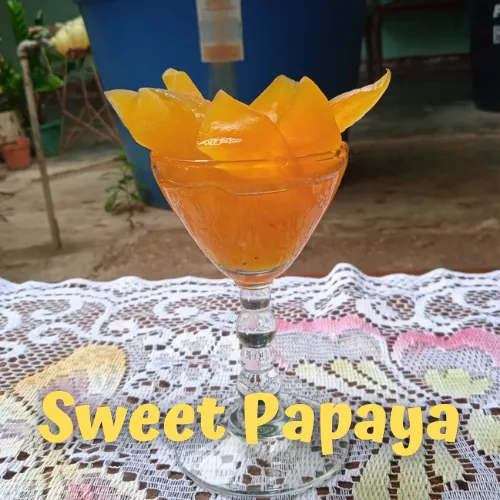
Una vez que el dulce está listo, lo bajo del fuego y dejo que repose para servir. Puedes servirlo solo, como está en la foto o acompañado de queso rallado, es delicioso el contraste de sabores que se obtiene, y disfruta tu delicioso dulce de lechoza tradicional.
Once the candy is ready, I lower it off the heat and let it rest to serve. You can serve it alone, as it is in the photo or accompanied by grated cheese, the contrast of flavors obtained is delicious, and enjoy your delicious traditional sweet papaya.


Quiero decirles algo: La cocina es un juego, un juego hermoso y feliz, razón por la cual ustedes pueden crear y recrear platos diversos, que de seguro les quedarán geniales. Aquí finalizo mi publicación de hoy, espero que haya sido agradable para todos ustedes, y la preparen en sus respectivos hogares. Un gran abrazo.
I want to tell you something: Cooking is a game, a beautiful and happy game, which is why you can create and recreate various dishes, which will surely be great for you. Here I end my publication for today, I hope it has been pleasant for all of you, and prepare it in your respective homes. A big hug.

Fuentes de las imágenes / Image sources:
Los separadores utilizados, son cortesía de  Hive account@eve66 quien comparte hermosos diseños que embellecen el maquetado de nuestros post. / The dividers used are courtesy of Hive account@eve66 who shares beautiful designs that embellish the layout of our post.
El diseño de portada incluido en esta publicación, han sido elaborado por mi persona con la aplicación CANVA / The cover design included in this publication has been made by me with the CANVA application.
En caso de que se requiera emplear el contenido o imágenes de este post y de mis otras publicaciones, agradecería se hiciera referencia a mi autoría (Fabiola Martínez) y se citara el link correspondiente. Gracias. / In the event that it is required to use the content or images of this post and my other publications, I would be grateful if my authorship (Fabiola Martínez) was made and the corresponding link was cited. Thank you.

 IIDiscord
